

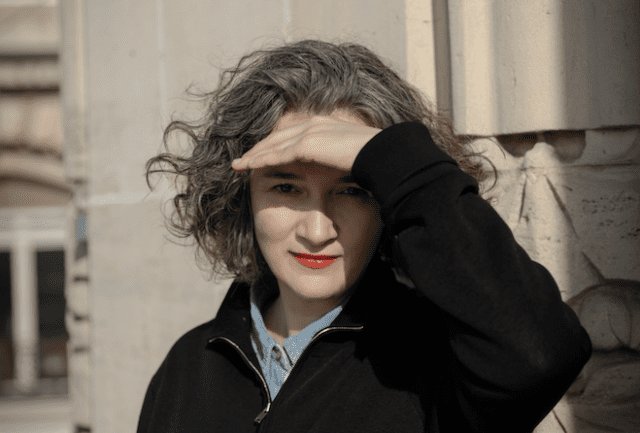
After nine years at the helm of Visions du Réel, one of Europe’s leading festivals for experimental doc and hybrid cinema, Emilie Bujès is moving on. As of August 1, she will head up Geneva International Film Festival, which means this is the last time Business Doc Europe gets to sit down with her, at least formally, to ruminate on all matters non-fiction (a term she prefers to documentary).
This year’s Visions boasts 128 films, culled from 3,700 submissions that Bujès and five programming colleagues painstakingly viewed, assessed and cogitated over between October 2025 and February of this year, the most intense period being between December and the closing of the selection. The outgoing boss has never made a secret of her love for films that subvert audience expectations of non-fiction, and so one of her parting gifts to the fest is a new section (Borderlight) which happily expunges any distinction between fiction and doc.
“It’s fiction leaning towards documentary, towards reality, towards a way of working in the documentary field,” Bujès tells BDE of the new section, citing such ingenious selections as Tobias Nölle and Loran Bonnardot’s Tristan Forever, and Bouchra, the story of a young coyote, who is both filmmaker and lesbian, and who serves to enable filmmaker Meriem Bennani to come out to her mother. Bennani is a Guest of the festival in 2026. Bouchra is co-directed with NY filmmaker Orian Barki.
Bujès also understands the role that film festivals, especially non-fiction, have come to play in a world that has becoming increasingly (and terrifyingly) divisive. “Everyone right now in culture has to provide a space for resistance. This is, for me, really crucial,” she says. “I think I feel it more strongly each year, actually. I think that we [festivals] are maybe more useful today than we were in past years, which is sad, but it’s also kind of true.”
But as well as being provocative, surely festivals must also provide distraction and respite from the troubles of the world, I suggest? “Yes, it’s also clear that there are audiences that want to see something else and hear about something else because the world outside is gloomy. So I guess it’s really a matter of finding the right balance. But I do feel we still have a commitment to share stories and allow for greater understanding of stories and people and the context of their lives.”
For Bujès, this “right balance” must be found within a program that celebrates “the cinematic experience first and foremost,” she adds. “But at the same time, I truly believe in the power of creating bridges, spending one hour and a half with somebody looking at things the way they are looking at them, and understanding what they want to share beyond the aesthetic experience – a common life, a common present, a common moment, a common history. This is important and relevant in a festival such as ours.”
Many filmmakers feel nervous or exposed when they show their film for the first time, whether as a rough cut or a finished work. Do festival directors and programmers feel a similar sense of trepidation before they publish their program of selections? Not in the same way, Bujès responds, as the choice is a collective one. Nevertheless, there is a particular sense of joy in discovering a hitherto unknown talent, or unearthing a particularly valuable cinematic gem.
“Of course, sometimes you’re unsure, but when it’s a first-time filmmaker and they have a great success, then it’s your great success as well,” she says. “Programming world-premieres and programming films that have already travelled are two very different things. Not better, not less interesting. It’s just that when films travel they gain weight, they get more solid somehow. When they start out for the first time, it’s not like that.”
“But I have to say also now because it’s my ninth [and final] edition, I feel more secure. I know that we have created a platform and a machine. I like the word ‘machine’ in this sense. It’s something that creates an energy around the films and helps to launch them, even with their frailties.”
The festival’s dedication to fledgling directors is reflected in the 2026 program, with 58 first films, 36 of which are debut features. “We are delighted to note that the reputation of Visions du Réel and its films continues to grow, allowing us to continually expand the cinematic territories and realities explored, as well as to reaffirm our ambition to showcase new talent,” Bujès underlined when the selection was announced back in March.
“While some producing countries differ from the filmmaker’s origin or the country where the film was shot for financial or political reasons, the number of countries represented in the selection continues to rise steadily and significantly,” she added. “Certain regions, such as Asia, particularly stand out in 2026, as well as relatively rare countries like Sudan (in the Burning Lights Competition), Vietnam, Indonesia, Yemen and Palestine – which delights us both from a cinematic and a symbolic perspective.”
No fewer than 75 countries are represented across all selections – a record “that speaks to the festival’s international status,” she further stresses.
Swiss filmmakers are again in the ascendant in Nyon this year, even more so perhaps than in recent years. Aside from the 13 films in National Competition, three Swiss films are selected for International Feature Film Competition (Saudades Eternas by Emma Boccanfuso; Dentro by Elsa Amiel; Heat by Jacqueline Zünd), and one in Burning Lights Competition (The Echo of the Herd by Matthias Joulaud & Lucien Rouxhe).
“I’m really happy that it’s three [Swiss] women sitting in International Competition,” says Bujès. “Switzerland in general is always a really, really strong country for non-fiction. It’s a genre that is really important historically and culturally within Swiss cinema, and I have to say that the National Competition has never been so multi-layered and multi-coloured and adventurous. I’m really happy about that.”
Guest of Honour for the 57th edition of Visions du Réel is US filmmaker Kelly Reichardt, who will enjoy a retrospective of her films and a curated selection of documentaries of her own choice. The festival will also present the Swiss premiere of Reichardt’s latest film, The Mastermind, and a masterclass will be led by critic Raphaëlle Pireyre, presented in collaboration with the Cinémathèque suisse, ECAL and Fondazione Prada.
“Reichardt has made mainly fiction so, for me, it is really interesting to think about non-fiction through fiction,” Bujès tells BDE. “How do you capture moments, or glimpses of things? How do you build films with almost no narration, with a very low amount of dialogue? How do you compose a portrait of the US in all its different colours and specificities? There are a lot of things [about her work] that are highly fascinating. It was a dream of mine to welcome her.”
Laura Poitras will open the festival with Cover-up, which she co-directed with Mark Obenhaus, and is the Special Guest of Industry, participating in a conversation on Sunday 19 April.
Sergei Loznitsa will deliver a masterclass on Saturday 18 April, presented in collaboration with ARTE and HEAD, and moderated by Emmanuel Chicon, a member of the selection committee, and Violeta Bava, from the Industry selection committee. His work will be the subject of a curated retrospective, comprising both lesser-known short films and major works that have been widely acclaimed at the likes of Cannes and Venice.
The Festival will also dedicate a focus to video and visual artist Meriem Bennani, who will also take part in a public conversation with filmmaker and artist Valentin Noujaïm.
Bujès announced her departure from the festival just after our interview. In her statement she underlined how, “my years with the Visions du Réel team, first as a member of the selection committee and then as Artistic Director, have been filled with challenges, encounters, cinematic discoveries, and joys—artistic, professional and personal.”
She adds to Business Doc Europe: “After those wonderful nine years, it now feels like it is the right moment both for the festival and for me to start new adventures, and I personally aim to further expand my cinematic field of work, as well as to take on a new challenge and hopefully help another festival grow and evolve. Visions du Réel will remain a key milestone in my professional career, and I believe it is in an excellent condition to be passed on to someone else.”





