

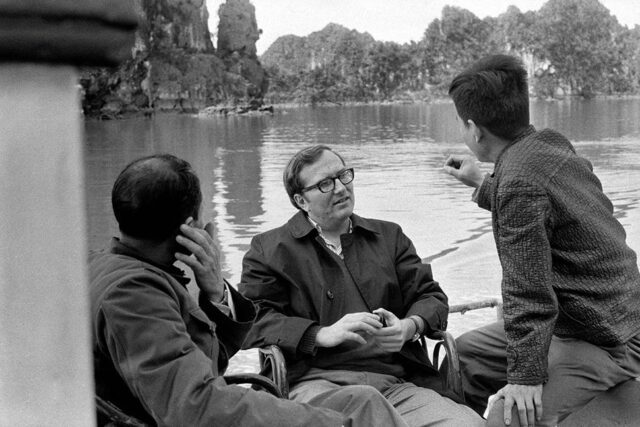
To the outside world, the legendary US journalist Seymour “Sy” Hersh, now 88, can seem a little cranky, as filmmakers Laura Poitras and Mark Obenhaus acknowledge. Ask him a stupid question and you might get a salty response.
“Sometimes, I’ve experienced his orneriness on a weekly or even daily basis and I just ignore it, quite frankly. He has been angry at me so many times I couldn’t count, and I just let it pass and then we are back in business,” Obenhaus, who has known Hersh for many years, explains how best to deal with his grumpier moments.
Poitras confides that she too learned to let the mood swings wash over her.
That said, the filmmakers’ immense affection for Hersh is very evident. Both talk about him as if he is a much-loved relative rather than the subject of a hard-hitting film.
Poitras had first talked to Hersh about making a documentary about Hersh and his work in 2005. Twenty years on, she has finally done so. Cover-up, which world-premiered at Venice 2025 and which opens Visions du Réel 2026, tells the story of Hersh’s investigative reporting from the My Lai massacre to the Abu Ghraib torture scandal, from Nixon and Watergate to the sabotage of the Nord Stream platform. Sales are handled in North America by Submarine Entertainment and internationally by MK2 Films.
“I approached him [Hersh) because of his adversarial journalism against the Bush doctrine, the war on terror, and the horrible occupation and invasion of Iraq. He was, I think, the most important voice of dissent in national security reporting – and that is vital. I was in a state of despair about the collapse of journalism in that period,” Poitras, the Oscar and Golden Lion-winning director of CitizenFour and All The Beauty And The Bloodshed, recalls her bleak mood at the time she first suggested the project two decades ago.
Hersh’s journalism may have sparked the idea initially but when she met him, Poitras realised that he’d make a tremendous subject anyway through the sheer force of his personality. “My interest went from very high to off the charts because he is a great character, so funny and engaging – and he has time for people. He met with me for 40 minutes and I could see there was a great film to be made.”
The one problem back in 2005 was that Hersh said ‘no’ to her. He worried about compromising his sources by collaborating on a film. The project was therefore put on indefinite hold. “I have been obsessed by it since then and we have stayed in touch as colleagues,” Poitras says of the intervening years.
Once work on the project finally began, the bonds between subject and filmmakers soon grew even closer. “Everybody who worked on the film, Sy would want to know who they were. He has a genuine curiosity and love for people. And he gave everything to this process…”
Almost the entire crew turned up at the premiere simply because they were so fond of him.
One sign of Hersh’s trust in Poitras and Obenhaus was that he gave them access to his famous notebooks – stacks and stacks of them, going back 40 years or more. “They were not easy to read at all,” Poitras says of all those lined and heavily annotated volumes whose yellow pages were scrawled full of Hersh’s reporting, and contained CIA sources and assassination code names as well.
“That’s why he keeps secrets so well. No-one can read his writing, not even the CIA,” quips Obenhaus. Thankfully, Hersh helped the two directors to “translate” his often impenetrable text into comprehensible English.
The film is very deeply researched. It draws on “over 6000 archival documents” including pictures and documents – a huge amount for a two-hour film. Both directors pay strong tribute to their archival producer, Olivia Streisand, who helped collate the material.
As the documentary reveals, Hersh’s sleuthing sometimes upset even those you might have expected to be his closest allies. When he was working at the New York Times, his bosses got very alarmed when he started asking too many questions about corporate corruption. It turned out that the much-vaunted newspaper had a few uncomfortable secrets of its own.
How do Poitras and Obenhaus think the NYT will respond to the film today? Are they more transparent than in the late 70s, when Sy and colleague Jeff Gerth were investigating companies like Gulf & Western Industries?
“I think they have changed, but they’re still terribly nervous about corporate reporting,” Obenhaus suggests. “That’s not just with the New York Times. It’s general within the mainstream media. Look at what is going now, with CBS intimidated by the Trump administration.”
At times, Hersh’s methodology has been criticised by fellow journalists. He’ll often rely on a small number of sources whose identity he’ll never reveal. The documentary discusses the incident when small time crook and former law clerk Lex Cusack forged papers linking Marilyn Monroe to JFK. Hersh never used these documents but was still attacked by some of his peers for even looking at them.
“The truth is he didn’t publish the letters,” Poitras states.
Obenhaus himself uncovered the fraud. “None of that material was ever in a book or was ever written about…there was, in my opinion, a feeding frenzy and glee among some reporters that Sy had ‘stumbled’ or was characterised as stumbling.”
As for the anonymous sources, the filmmakers point out that Hersh is far from the only filmmaker to use them – and it has always been a point of principle among journalists that sources need to be protected. The key vindication of his methods is that his stories are almost always right.
These days, Hersh publishes most of his work on Substack. Is it depressing that mainstream newspaper organisations no longer employ him? “He really is an outsider journalist who has worked within institutions, but he has always quit them,” Poitras suggests it’s nothing new for him to be out on his own again.
“He is very comfortable where he is and the film makes it clear that he has been quite uncomfortable in more institutional settings,” agrees Obenhaus.
Hersh may not have a huge media company like the New York Times or New Yorker behind him, but he still works with fact-checkers and editors – so it’s never just him firing from the hip.
Cover-up is a very male dominated film. Hersh’s wife, Liz, a psychoanalyst, declined to appear on camera partly for privacy reasons and partly because of her profession.
Poitras seems surprised when Business Doc Europe asks why the film didn’t feature more women. “I have been making films about power and US power for a couple of decades. Who runs the world? White men,” she answers her own question. “I’ve made a lot of films about white men and I am trying to be critical of them.”
However, the film does provide insights into Hersh’s private life. It includes intimate photos of the journalist, his wife and family. Hersh also talks at length about his background, his parents and how he came in to journalism.
After Venice, the film was selected for a host of international festivals, such as Telluride and TIFF. It was later short-listed for the Feature Documentary Oscar 2026.
“Like any collaboration, there was conflict and tension…but there’s a goal here, and I am enormously proud of what we achieved,” Obenhaus signs off on the film. “We have made the film we set out to make – and Sy is celebrated in the way I hoped he would be.”
This is an updated version of the interview, first published for Venice 2025.





