Many documentary lovers are familiar with Scottish film pioneer John Grierson’s famous definition of the genre as ‘the creative treatment of actuality’. Feature documentary Holgut puts a surprising twist on this, with something I can only call ‘the mythological treatment of actuality’. Normally one would consider mythology and actuality to be, if not opposites, at least extremely dissimilar. One being concerned with facts of life in the real world, the other with spiritual truths contained in fictional tales.
With Holgut (trailer) director Liesbeth De Ceulaer (co-director of Victoria), manages a seemingly impossible feat by incorporating both. Concurrently, not just one after the other, and without making one subservient to the other. Mythology is not just used to contextualize current events; and actuality is not reduced to its mythological resonance. Both dreamlike and crystal-clear, Holgut is like a prehistoric skeleton, pushed to the surface of the thawing Siberian tundra, both a bearer of mythical meaning and a sign of our current times of climate crisis and transgressive science.
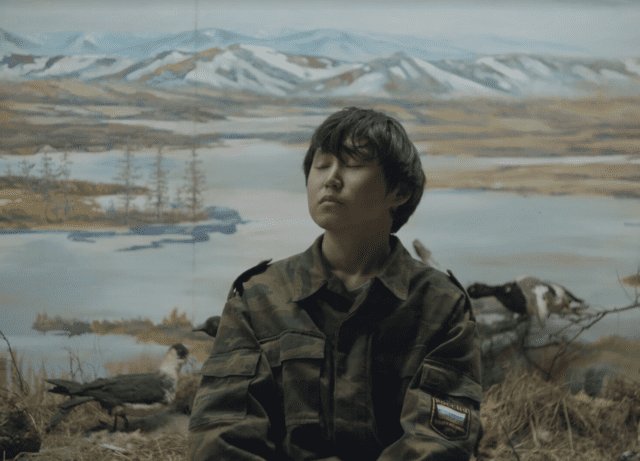
So, what is Holgut about? There are two main stories, which partly interweave. One is about a city kid visiting his tundra uncle, who teases him about his “women’s hands” when he struggles to pluck a duck. The uncle wants to take the curious but naive boy on a reindeer hunt to boost his confidence, but no matter how far north they go, the endless open plains are devoid of prey.
The second story is about a scientist who is looking for mammoth skeletons with traces of skin or flesh on them, so he can extract DNA for his project of cloning a living mammoth. His goal is different from the ivory hunters he encounters (a good mammoth tusk bringing in the equivalent of a common worker’s annual salary), but equally dependent on the melting of the not-so-permanently frozen permafrost.
One could imagine a documentary treating the scientist’s futuristic efforts as part of the same unbounded and megalomaniacal techno-capitalistic system that caused the permafrost and reindeer to disappear, thus opposing him to the hunters’ culture. Another option would have been the juxtaposition of inverted quests: the hunters looking for live wild reindeer that appear to have gone extinct; the scientist looking for an extinct animal he wants to bring back to life.
But Holgut does something much more interesting: it presents these three Sakha or Yakutians – from the Siberian Russian Republic of Sakha (Yakutia) – as fundamentally the same. They are all spiritual hunters, looking for elusive animals with great meaning. Animals that represent life and culture, history and dreams. For the hunters, the mammoths (like the reindeer) live on in stories, told through countless generations, that define their land and culture. We hear the young hunter, who has only just learned how to shoot a rifle, repeat a story that minutes before his uncle told him, and thereby turning it into myth, for himself and for us.
This is how layers get added to mythology, just as his own story of hunting will be told and retold – and just as the documentary itself is not just a record of this mythologizing, but part of it. The beautiful thing is that when the scientist, who is clearly deeply committed, says that he will call his cloned mammoth ‘Yana’, after the river where he grew up, he is taking – whether he realizes it or not –the same mythological stance, using the magical power of words to connect the ancient animal to his native land.
Oral history, the bedrock of mythology, weaves this documentary together. The film starts with the myth of Holgut, a mammoth left behind when all the animals gathered on a raft during a massive flood and kept alive in stories ever since. Other myths follow, always told in voice-over, mingling with everyday dialogues about reindeer and hunting, which gradually take on a mythological flavour themselves.
More and more, as the documentary progresses, vertical drone shots of landscapes of bewildering beauty and confusing scale, close-ups of drawings in a palaeontological style, dreamlike moments where reality seems to give way to our protagonists’ inner lives, and droning sounds such as an ever-falling tone, combine to form a very particular rhythm and flow, which starts to feel like the flow of history, the flow of mythology, carrying our protagonists along through something larger than this moment in time.
Did our heroes know what kind of story De Ceulaer would integrate their adventures into? I think they did. Take the scene where the scientist sits in the back seat of a van, with a deadpan expression, while we hear what I assume is traditional chanting, recalling the story of a mythical giant sleeping underground, who is woken by a soldier. It seems distinctly non-diegetic, another mythological layer added by the filmmaker – until the camera turns to the side and shows the singer sitting right next to him. Meanwhile, the scientist keeps ignoring the chanting, as if the singer’s not actually there. It’s a fun little moment, where myth, reality and the documentary’s own storytelling structure merge to make clear that in this film, it’s really not necessary, and quite simply impossible, to say where actuality ends and mythology begins.
Belgium, 2021, 73 minutes
Director Liesbeth De Ceulaer
Production Minds Meet & Stempel
Producer Tomas Leyers
International sales Filmotor
Cinematography Jonathan Wannyn
Editing Guillaume Graux
Sound design Kwinten Van Laethem
Sound Gert Verboven
With Roman Skrybykin, Kyym Skrybykin, Semyon Grigoriev
(The World Premiere is co-presented with CPH:DOX, in their Next Wave Competition)