In Bellum – The Daemon of War, Swedish directors David Herdies and Georg Götmark invite three disparate characters to meditate on their perceptions of war, a US veteran of Afghanistan, a Swedish developer of AI for use in battle, and a US photographer whose latest work chronicles the Afghanistan conflict.
First, however, we see the sculpted face of Robert Oppenheimer in archive as he quotes Vishnu from Hindu scripture (“now I am become Death, the destroyer of worlds”) before the co-directors demonstrate how destruction is meted out not only in military terms, but very much in psychological and sociological terms as well.
Swedish scientist and developer Fredrik Bruhn is an intriguingly complex character. He may design and produce weapon systems for use in remote warfare but he is a family man who cares greatly for his sons’ upbringing and education. Yes, there will be those who will cite the obvious ‘banality of evil’ charge against someone whose cosy domestic set-up belies his trade in such weaponry, but Bruhn himself sees war as inevitable – as long as there are humans on the planet.
Together with colleagues, he discusses the efficiency of non-human (or ‘deferred’) decision-making, which points to a type of warfare in which emotions are taken out of the equation. Technology is ‘dead’, meaning war becomes more objective, and therefore more efficient, he argues. Yes, of course there are benefits to the bottom line, but there can also be greater efficiency, or accuracy, in the targeting of enemies, a co-worker points out. A terrorist embedded in an Iraqi community is well protected, until a remote and constant ‘eye in the sky’ detects his or her movement in the open space of the desert.
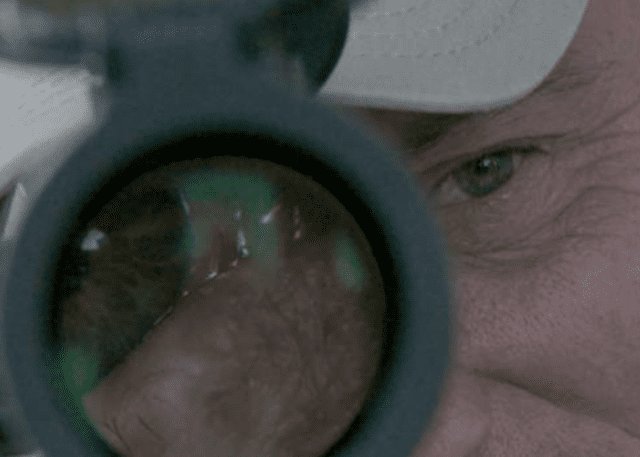
Afghanistan war veteran Bill may very much applaud the development and deployment of such remote weaponry – but that is where any similarity with Swedish Fredrik ends. When we first meet Bill he seems, for all intents and purposes, a gun-toting, warmongering redneck, a man who loves to shoot out in the Nevada desert and prepared to scrap in a local bar after a skinful of beers.
But little by little, we see nuance and sensitivity in him. At the age of eight he witnessed the extremely violent death of his best friend, and of course saw horrific death and destruction while serving with the army. He has a black wife, we discover late in the film, and together with her he wants to move on with his life. After an awe-inspiring visit to the Grand Canyon with Aisha, his wife, we see how his perception of the world begins to change as he assesses its potential for beauty, and for possibilities.
“The emotional journey for me on a personal level was definitely with Bill,” say co-director Herdies. Studying the effects of war through the eyes of a psychologically damaged soldier was less of an obvious “open door” to the subject, Herdies underlines, and therefore more interesting. “When we got to know him and see how much he was actually suffering from everything, it gave me a new perspective on war.”
Götmark adds how, “we spent a lot of time in bars with Bill and he is easy to hang out with, but [with] Fredrik I really did respect and admire his decision to be part of this [film] because it was an unknown journey, being someone who manufactured war technology, [with] two, unknown to him, filmmakers. So we tried to treat him with respect, even though we might not agree with any of the three characters actually.”
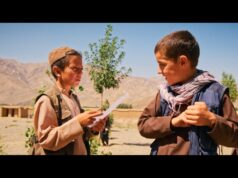
Despite embarking on the project in 2013, the filmmakers came to photographer Paula Bronstein late in the production, in 2019. Herdies stresses how, having followed Fredrik and Bill, “after a while it was more interesting to go in from the point of view of those who are creating the narrative of war.” In the film Paula is putting together a book and an exhibition on local Afghans post-war. In one desperately sad sequence she asks permission to photograph a boy who refuses to talk or smile. He complies, facing the camera silently for each shot, but is nevertheless a study in post-traumatic torment.
In their notes for the film, the filmmakers address their specifically Western view of a war that was being played out on a non-European, non-US terrain.
“We originally spoke to someone in Yemen. We were filming in Pakistan as well, but we ended up looking at ourselves. Who are we to tell this story? With this film we are part of creating a narrative that is connected to war. So it felt like we wanted to film from where we are standing,” comments Herdies. “We decided to stay with the people that are part of the war machine, pushing the narrative of the war forward. We wanted to make a film where you didn’t see any drones, you didn’t see any victims in that sense. We wanted to see the everyday bureaucracy behind war.”
The film’s visuals are stunning, ranging from airborne activity in the Nevada desert to rooftop vistas over Kandahar to the Grand Canyon. In one shot a computer circuit board morphs seamlessly into an aerial view of a city. In another sequence, we are shown (in night-view) the terrifying accuracy of remote weaponry as a convoy is destroyed. In another scene, a group of masked protesters stand with placards outside the Creech base in Nevada as US military vets look on, passing sarcastic comment.
“All these shots that you are mentioning are actually nothing that we planned, it was pure chance in combination with a lot of time,” says Herdies, who pays tribute to the film’s DOPs, among them co-director Götmark and Camilla Skagerström (Searching for Sugarman).
“The shots with the drones, we were there for 5 hours trying to find the exact shot, and then of course the circuit board and the landscape, that was [an analogy] that we saw a little bit by chance. It’s been a lot of work and editing and re-editing, shooting and re-shooting. We spent a lot of time to get there. We really wanted to aim high on cinematic ambition.”