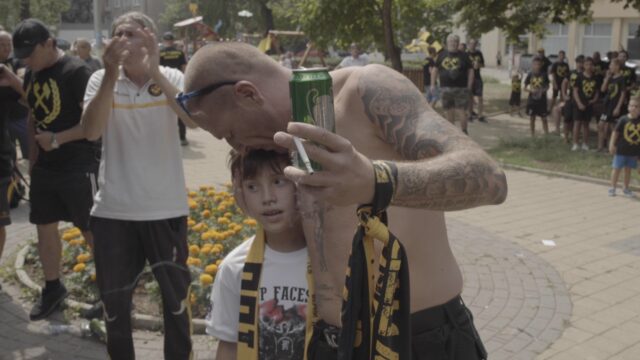
It’s not the greatest football team in Bulgaria. FC Minyor is now in the second tier of Bulgarian football. Its declining fortunes are mirrored by those of the inhabitants in the town, Pernik, in western Bulgaria. This is a mining community, the “town of the black gold” as it was once called, but now the community is struggling. Where once the team would attract 15-20,000 supporters to the ‘Stadium Of Peace,’ now average gates are likely to be 1000 or even less.
In his feature documentary, No Place for You in Our Town (screening in the Latitudes section at Visions du Réel and presenting at Movies That Matter following its world premiere at CPH:DOX), director Nikolay Stefanov looks at the lives of some of the football club’s most die-hard supporters.
“I’ve had the idea for this film for more than 10 years. It’s my symbolic return to my hometown. I knew that going back to Pernik, I’d find a lot of stories to tell. When you mention the name Pernik in Bulgaria, everybody knows what you’re talking about. There are a lot of jokes about the aggressive and macho attitude of my fellow citizens,” the director reflects.
Stefanov was determined to go beyond the clichés and lazy stereotypes that exist about Pernik. “I decided to do this in an observational form and to offer the process that I went through myself to the viewer. At the stadium, all emotions and tendencies are a hundred times stronger. By looking at them, one can explore important trends in our societies which otherwise wouldn’t be so visible.”
The filmmaker also had his own nagging questions about his hometown which he hoped making the documentary would help him to answer. He was born and grew up there – and knows the community from the inside. Some of the main characters in the documentary have been his acquaintances for more than 30 years.
“If I was an outsider, it wouldn’t have been possible to tell this story. Some litres of beer that we shared helped too, as well as the time I spent with the people without turning on the camera. I think it’s important that the filmmaker has a deep understanding of the topic that they’re tackling.”
On the one hand, Stefanov was very much an insider. On the other, he had been living away from Pernik for many years and so could look in on life there with an objective eye. He was striving to see his subjects “beyond their political views” and not to pigeonhole or stereotype them.
Stefanov pays tribute to his film team – producer and writer Ralitsa Golemanova, the writer Mariana Sabeva, and the editor Stoyan Velinov – for helping him strike a consistent tone.
In his determination not to come to “easy and superficial conclusions,” the director spent two years with the hardcore fans.
It was at the football stadium that he first met Tsetso, the fervent supporter who would become one of the documentary’s main protagonists. Their first encounter was a little tense. The director was wearing an ‘Anarchy’ badge which Tsetso “didn’t appreciate.” Nonetheless, the two men formed a bond. “He turned out to be my main character, and I’m grateful he let me into his personal space.”
When Tsetso and the other supporters join in chants together, they make an intimidating force. They’re always ready to take on opposition fans. Nonetheless, the director makes it very clear that not everyone who goes to the stadium is a hooligan. There are plenty of normal supporters. Nor is there necessarily anything sinister in fathers passing on the words of their chants to their kids, he maintains.
One point the director makes is that in places like Pernik, “countercultures mix because there aren’t enough people to create separate ones. This may lead to people who have very different convictions to get together just because they’re against — against the established order, social inequality, and so on. I think it’s a form of protest.”
Stefanov believes that subcultures and countercultures were suppressed during the communist period in Bulgaria. “The end of the totalitarian regime unleashed them, but also brought the closing of the mines and factories in industrial cities like Pernik. The link is apparent and unavoidable.”
The film will soon be shown in Pernik itself. After the premiere in Bulgaria, some screenings are planned in the town. (The main protagonists have already seen the documentary as Stefanov felt that was “only fair” given the trust they showed to him).
No Place For You In Our Town is also likely to be enjoyed far further afield. Hanka Kastelicová, Executive Producer of Documentaries for HBO Europe and one of the execs behind the phenomenal success of Alexander Nanau’s Collective, was an early champion of the project.
“We’re happy to have a big partner like them on board, allowing the film to reach a vast audience,” the director says of HBO.
Now, the film’s festival life is taking off. It will have its Dutch premiere at t Movies That Matter in The Hague on April 11. After that comes the Krakow Film Festival and HBO MAX will release the film in the autumn.
The director’s work shooting the documentary may now be complete but Stefanov is still following the scores of FC Minyor and going to matches at the Stadium Of Peace whenever he can. He remains in touch with the other fans. The team may not be in the top division but the fans’ passion for following the players remains as fervent as ever. As Stefanov puts it, “both the city and the football club have had some rough years. But for the film’s characters, the club is the biggest in the world. Actually, the only one…”