“Too much togetherness kills desire…Deadlines are dead.”
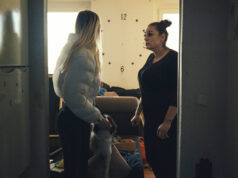
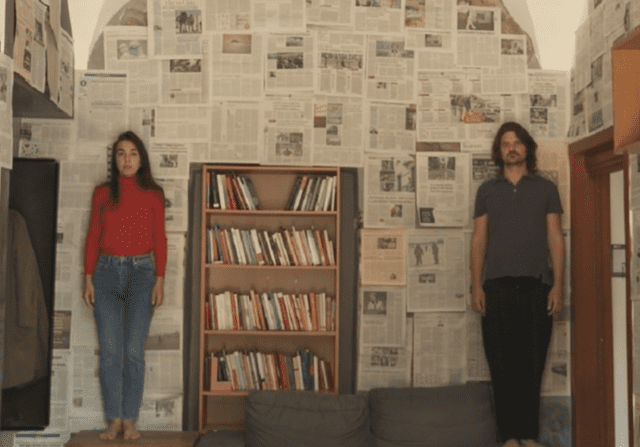
These are just two of the remarks made by Daniel and Laura, the couple cooped up together in an apartment in Rome during the first Italian Covid lockdown. They exercise in the garden, running round and round the yucca tree. Sometimes, as day turns into night, they forget to eat. Laura has stories about vicious rows at the supermarket where people are very sensitive about social distancing. Once or twice, Daniel ventures out to film on the empty streets.
This is the premise behind Daniel Kemény’s new feature doc Supertempo (screening in the National Competition at Visions Du Reel). He is one of his own subjects. His real-life girlfriend Laura Marzi is the other.
“We were three in there, Laura, me and the camera. The camera was always with us,” Kemény remembers of their relationship during lockdown. Most of the time, he was holding the camera. Occasionally, she would take it (although she is not an experienced cinematographer and wasn’t always quite sure how to hold it). The director had also ordered a tripod but that wasn’t delivered until shooting was already well under way.
Laura, who is a writer and teacher, was completely “open to the creative process.”
Supertempo is the director’s follow up to his autobiographical 2020 documentary Sone, set in the small town of Pietrapaola in Calabria, where he had grown up. This film actually screened in Visions Du Reel during the pandemic as Supertempo was being shot, but the festival was held online so he wasn’t able to visit Nyon for the screenings. (The new film shows Daniel and Laura dressing up for the online premiere of Sone with and Laura going to great lengths to style Daniel’s hair).
Originally, Kemény “wanted to do something short” but then he and Laura started to “dig inside our life.”
“I thought we were making 40 minutes but when we started to edit, we realised that actually we had set up a good story,” the director says of how the project grew to feature length. “Dramaturgically it works.”
This had started as a film about the pandemic but the emphasis changed. The relationship between Laura and Daniel was foregrounded. At times, as they are cooped up together for weeks on end, the tensions between them becoming very apparent. “We wanted to tell the story. It didn’t matter if good or bad…we also always agreed on respect for the creative act.”
In the short interlude when Daniel leaves home to film on the streets, matters take a surreal turn. He comes across a busker who is performing in order to be able to afford lettuce for his pet rabbit. The streets, though, are completely deserted. The only people around are a handful of the homeless.
“In the beginning, we wanted to set up the story relating ourselves to the outside. In the end, we excluded [almost] all of that. We said, no, the main point is our relationship,” the director explains. Nonetheless, he went out three or four times into the empty city and included a little of the footage. “I had this feeling that these were just these phantoms of the society left…there was this absence of life that was really dramatic.”
The garden with its yucca in the middle features prominently. “I was really happy to have it, really lucky. Still now, the garden is great. The relationship with this tree is fantastic. Laura actually is really in love with this tree. She speaks with this tree, she has a really strong relationship with it. It was the centre of her life during the pandemic.”
As the
lockdown continued, Laura and Daniel began to live in a far looser, more Informal way. They didn’t need to go to work anymore or answer the phone. He was fascinated by the changing soundscape of the city. He became, though, increasingly conscious of the “fragility” of their normal lives. “It’s so complex…it’s composed of little mechanisms. Something breaks and we’re fucked!”
One key scene in the documentary is an outdoor meal with the neighbours. “In fact, this lunch was illegal and so Laura was really worried,” Kemény remembers. The event summed up for him just how badly “normal life had crashed. You couldn’t think any more about inviting someone to lunch. This is something really destroying our normal habits of social life.”
As for strangers seeing such private moments in the couple’s life, he has no embarrassment at all about that. “I am really not worried about this…I tell stories that are often really intimate and close to my person,” Kemény reflects.
The director pays tribute to his producer, Michela Pini of Cinédokké. “She’s a really great producer, really young and patient with me.” Pini trusted Kemény and wouldn’t interfere with his creative decisions. “And I also trust her.” This was a project which needed time but she saw the potential in it from the outset.
“Now we are both really happy with the outcome.”
Kemény’s next project will be shot far further afield, in Cuba, where the director’s father and younger brother live. “It’s a personal story of me being 40, my brother being 15 and my father being 70…there is a confrontation between different generations and different stages of life.” The working title is Sons Of Icarus.