

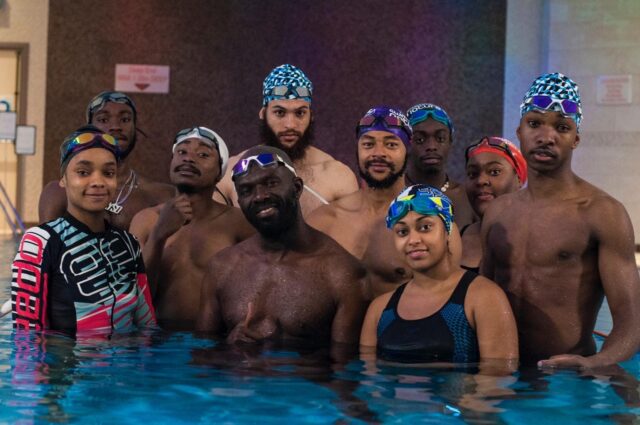
It is just over a year now since Ed Accura, producer of new documentary feature Blacks Can’t Swim: The Sequel (trailer), co-founded the Black Swimming Association (BSA), set up to encourage black and ethnic minorities to swim. He gets in deep with Business Doc Europe.
Accura, a rapper and songwriter (and who also has a day job in IT), has been on a relentless one man mission to address a question which many others have preferred to ignore: namely why is it that 95% of black adults and 80% of black children in England do not swim? He told his own story in A Film Called Blacks Can’t Swim (2020, directed by Mysterex). Now, in the new documentary, again directed by Msyterex, he focuses on the aquatic experiences (or lack of them) of others in the black community.
“The first film was based on my inability to swim but when I released it, I realised the picture was so much bigger than just me. There is a big issue out there that needs to be addressed,” Accura reflects.
Before starting the new film, the producer conducted extensive research, dividing the black community into three age groups: 0-15, 16-25 and 26 and above. He quickly decided that the new film should focus on the 16-25 year olds.
“Black youths drown at a horrendous rate. Hence the reason why I am focusing on that age group because they have the highest drowning rate,” he points out.
Ask how he set about convincing youngsters to change their mindset about aquatics and he immediately replies. “Fun is what will change the narrative. If they are enjoying it, they will swim.”
He adds that employment opportunities might help too. Charities like the Royal Life Saving Society and The Royal National Lifeboat Institution, which have lent their support to the BSA, have made it clear that there is currently a general shortage of lifeguards and swimming teachers. “They [the charities] will train them [the younger generation] and they will guarantee them a job at the end of it.”
The subjects in the new documentary include many kids and young adults from disadvantaged backgrounds. When they were approached to become involved in a film about swimming, most were far from enthusiastic. They’d say they couldn’t swim themselves and simply weren’t interested. “So we had to turn it around. We said we are doing a film, there is going to be music in there. It’s going to be about hair. Straight away, they said ‘I am interested’.”
The filmmakers were attempting to tell their subjects that swimming was a life skill, good for their mental and physical health but realised they needed to capture the subjects’ imaginations first.
At the end of the documentary, the final scenes were shot in a local swimming pool. Again, the subjects were extremely reluctant to participate and most came up with excuses why they couldn’t be there. Again, Accura and his team had to convince them they’d have fun. “They finally got into the pool. Some could swim, some couldn’t.” After four hours, he had to leave for another appointment. Thirty minutes later, when he received an urgent call from the director asking if there was any chance the booking could be extended, he feared the worst. The director, though, told him that the “young ones were having so much fun, they don’t want to get out.”
Reflecting on his own experiences, Accura remembers that when he was growing up, his mother would tell him that swimming was not a priority. “You need to study your books. Your maths, your English, that is where you need to put in your time, not [in] swimming.”
“I started hearing about these stereotypes…the heavy bones and such. When people asked ‘can you swim,” I said ‘of course I can’t. I am black.”
At this stage, he was perfectly happy not swimming. It was hardly an issue. However, he married and had a daughter. The family lives in a village in Buckinghamshire. “At the back of my garden, there’s a river. It’s more like a stream but it’s still fast flowing. I am thinking to myself that if my daughter ever falls into the water and I can’t help her, I will never be able to forgive myself. That was one of the reasons that pushed me to learn how to swim.”
In 2018, Accura recorded a song called ‘Blacks Can’t Swim’. He was then approached by an organisation called Swimming Nature which offered to teach him how to swim for free. He was suspicious and asked them what was the catch. They told him: “we are an all-white organisation. We are aware of the issue that there are a disproportionate number of black people who do not swim but we can’t talk about it for sensitivity reasons. Since you are talking about it, we want to work with you. We want to prove to the world that it [blacks not swimming] is not a physical thing. It’s a cultural thing.”
Mysterex, who had directed many of Accura’s music videos, agreed to help with a documentary. The moment the trailer for ‘Blacks Can’t Swim’ was posted online, the response was “crazy.”
“It was almost as if I had given people the opportunity to have a conversation about something that was previously very uncomfortable to talk about,” the producer remembers. His next step was to start a podcast, ‘In The Deep End with Ed Accura’ in which he interviewed influential figures within the black community about their experiences with swimming. One of his interviewees was Alice Dearing, the only black swimmer in Team GB and someone who shared his passion for encouraging the black community to take up swimming.
Accura is now planning a third film which will explore the parents’ perspectives and ask why they’re not encouraging their kids to swim.
“Our aim is not to exist,” he says of the long term ambitions for the Black Swimming Association. Soon, he hopes, those old discussions about why so few in the black community are able to swim will no longer seem relevant. The documentaries, he hopes, will help in that process.
Blacks Can’t Swim: The Sequel will be released on Apple TV, Sky Store, YouTube, Rakuten and Amazon on May 10.





