There is a very uncomfortable moment midway through American director Anthony Giacchino’s Oscar-nominated short documentary Colette. His subject, the 90-year-old former French Resistance fighter, Colette Marin-Catherine, is visiting the Nazi concentration camp where her elder brother, Jean-Pierre Catherine, died.
She is there with Lucie Fouble, a teenage student carrying out a wartime research project. Suddenly, Colette breaks down. She realises she hasn’t brought flowers for the brother she adored, and feels deeply ashamed. As she cries, so does her young companion.
Watching the film, you wonder if Giacchino felt intrusive in capturing such an intimate and distressing scene on camera.
“When this moment happened during the filming, it was at [the end of] a long process. We had built this bond of trust with Colette, this atmosphere of security. She trusted us to be careful with her voice and with her emotions,” the film’s French producer Alice Doyard explains.
“We couldn’t have had those moments unless that bond of trust was built – and all of that was done off camera in the months leading up to this,” director Giacchino says of the exhaustive preparation for the documentary. “She (Colette) may have been surprised herself she had this reaction. As she says, for so many years, she had been holding this inside, trying to forget it. Maybe it was stashed away so deep that she didn’t think she would be able to reach it…I think this was also a moment of revelation for her.”
Colette is a formidable character, resourceful, strong-willed and plain-spoken. The toughness that she must have possessed when she was part of the French Resistance all those years ago still remains. She had never been to Germany. In the documentary, she agrees to visit the country in what turns out to be a cathartic but painful pilgrimage.
“We knew we couldn’t just take her to the camp. What would be the point of that?” Giacchino says. It was obvious that Colette could only make the journey on her own terms. One reason she finally agreed to visit the camp was to accompany and protect Lucie, the young researcher for whom she felt an immediate responsibility.
“During their journey through the camp, you don’t really know who is helping who,” Doyard says of the affection and mutual dependence between the old lady and her teenage companion.
The documentary shows their first meeting. The moment Lucie walks through her door, Colette is already fussing over her, worrying that she might be tired from her journey and in need of strong coffee. They make an appealing and surprising odd couple.
“There was no guarantee that it was actually going to work. We didn’t know that they would become so close over that week,” the director muses on the relationship that blossomed between Colette and Lucie over the course of the journey to Germany. If you didn’t know better, you would imagine that Colette was the protective grandmother and Lucie the granddaughter devoted to her. However, they have very different perspectives and intentions. Colette has spent most of her lifetime trying to blot out the wartime memories. She needed to forget in order to survive. Lucie, though, was determined that what happened in the camps should be remembered, both to honour those who died and to ensure that nothing like this happened again.
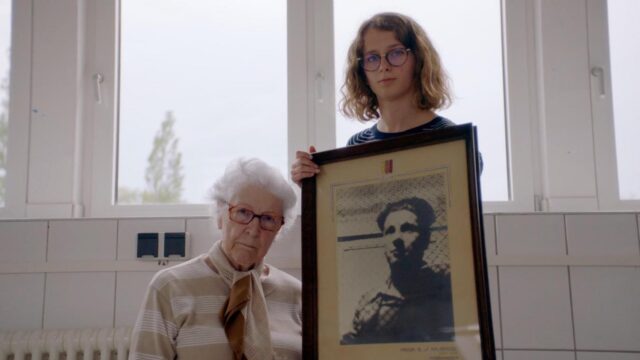
One image that looms very large in the documentary is a photograph of Jean-Pierre Catherine. Colette keeps it on her wall and brings it with her when she journeys to the camp. There is a beautiful and eerie shot at the end of the film in which Lucie is shown holding it in a whitewashed room with Colette sitting beside her. This, the filmmaker explains, “is the space where Jean-Pierre died.”
Prisoners too sick to work in the Mittelbau-Dora concentration camp, sometimes referred to as Dora, were sent to an “infirmary” where they were left to starve to death without food or water. This was where Jean-Pierre ended up. “That scene you see with the three of them, Colette, Lucie and Jean-Pierre, Colette saw that as [meaning] ok, Jean-Pierre may have died here but, in a way, this journey brought him back to life.”
The photograph itself has a painful history. When Jean-Pierre was under arrest in France, before he was moved to Germany, his family were still able to visit him. His father took the photograph even though it was strictly forbidden to bring cameras to the prison and he would have been shot instantly if he had been discovered with one.
“Did he [the father] think maybe he would never see his son again? That’s possible. If they were risking being shot by sneaking a camera in there and taking a picture, I think that’s a pretty good bet,” Giacchino speculates as to why he dared take such a picture.
There is also dark family psychodrama simmering below the surface. Colette confides at one stage that her mother once told her she would have preferred for her daughter, not Jean-Pierre (the son she adored), to have died.
After the war, Colette dedicated her life to her mother but, as she says in the documentary, she also “spent 74 years trying to forget” what the mother had said to her all those years before.
The documentary may deal with traumatic events in wartime but producer Doyard points to its contemporary resonance. For her, it is a film about “solidarity” between countries and between generations. It was made by an international team. She is in France while Giacchino is in New York.
Colette was produced by Oculus Studios and Respawn Entertainment, and released by The Guardian. It qualified for its Oscar run after winning awards at the Big Sky Documentary Film festival in Montana in February 2020 and at the St Louis International Film Festival.
The filmmakers were with Colette [on zoom] when the news of the Oscar nomination came through. Her response was telling. She told them that, thanks to this film, her brother Jean-Pierre “was no longer lost in the night and fog of Dora.”