

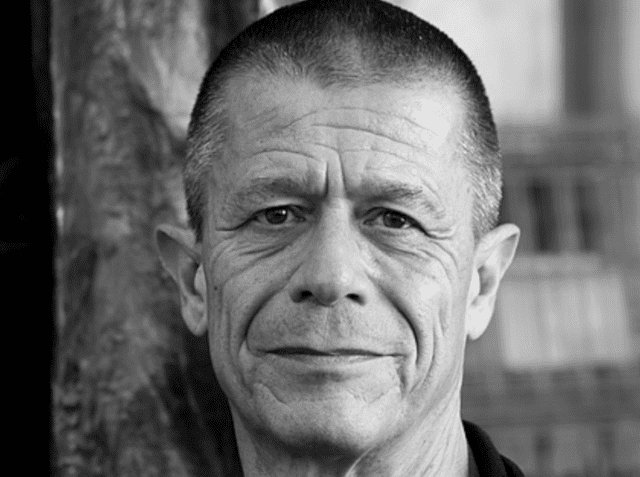
Emmanuel Carrère is guest of honour at Visions du Réel and will be giving a masterclass on 20 April. He will also be awarded him the prestigious Honorary Award (previously named the Prix Maître du Réel). But on the face of it, the distinguished French novelist, biographer, filmmaker and screenwriter doesn’t seem an obvious fit for a documentary festival like the one in Nyon. However, as he points out to BDE, he has always been passionate about the documentary form.
Before he became established as a writer, Carrère spent around 10 years as a film critic. His first book was about the maverick German director, Werner Herzog, as well known for his documentary work as for his mind-bending narrative features like Aguirre Wrath Of God, Nosferatu and The Enigma Of Kaspar Hauser.
“Documentary has always been one of my favourite fields,” Carrère pronounces. “Writing this first book about Herzog, it was also writing about documentaries…and I think his greatest feature films are also, in a way, documentaries. That is what makes them so great.”
No, Carrère doesn’t yet know yet what he will discuss during the masterclass. The session will take the form of an interview and is bound to touch on his extraordinarily wide ranging career: the film adaptations of his novels (for example Claude Miller’s Class Trip), his venture into true come biography with his masterpiece ‘The Adversary’ (made into a film by Nicole Garcia), his love of sci-fi writer Philip K Dick and his new drama-documentary Between Two Worlds, which he has adapted from Florence Aubenas’ book and with Juliette Binoche in the lead role.
“I think it will be a comparison between what is in the movies [considered as the difference between] documentaries and feature films and what could be the equivalent of the distinction in literature. Are there some books that can be considered as documentary books and that are distinct from fiction books? That may be one of the lines of the discussion which I think will be basically improvised,” Carrère speculates on one of the likely talking points for the masterclass.
The loose structure of the masterclass is, Carrère suggests, entirely fitting as “improvisation is the mark of documentary.” He is always baffled when commissioners and financiers ask documentary makers to provide a script for their new projects. “Providing a script for a documentary seems to me the exact contrary of the spirit of documentary. When you begin a documentary, you don’t know what it will be.”
However, the French author isn’t dogmatic about “what you can and can’t do” in documentary. “I think everything is permitted as far as you don’t hurt people.” He agrees with Werner Herzog’s notion of “ecstatic truth” that transcends mere, dry facts.
Ask Carrère if he ever considered tackling the story of ‘The Adversary’ in a documentary rather than a book and he immediately says ‘no.’
This is his account of the strange case of Jean-Claude Romand, the fantasist and impostor who, in 1993, massacred his own family.
“I spent about seven years of my life writing, preparing, researching, being unable to write the book and procrastinating,” he says of the work. “It was a long and not only tedious but very difficult process…writing the book was really enough for me.”
Carrère describes himself as both “film buff” and devoted reader. He relishes the chance to skip between difference disciplines: to make movies as well as to work on his books.
“Writing is a very, very solitary process. You can feel not only alone but sometimes very, very lonely. Making films is a collective work. Even though it is very demanding because it is exhausting, in a way it is, on a psychological level, far more comfortable because you are with people,” he reflects on the way he splits his time between writing and filmmaking. “When you are alone trying to write a book and its doesn’t come off well, it is not only tedious but it is very difficult. So I really enjoy the privilege of being able to do both these things.”
Ask him why he perseveres with writing when he finds it so challenging and Carrère replies (apologising if it sounds pompous) that he feels this is what he is “on earth” to do. “He “loves” to make films but writing is his real “mission and vocation.”
Growing up, Carrère was a big sci-fi fan. “I was quite a science fiction reader when I was a late teenager in the early 70s. At that time, I think science fiction was an extremely creative field, I think more so than now,” he says, rattling off names of authors he admired, Philip K Dick, JG Ballard, Norman Spinrad, Ursula K Le Guin and Michael Moorcock among them. “It was some kind of avant-grade. It was not only entertainment. It was very stimulating from a literary point of view.”
The first Dick novel he read was ‘Ubik’, a tale about psychic powers being used in espionage that was originally published in 1969. He went on to read everything written by Dick. Years later, when he was suffering writer’s block, his agent told him one solution might be to write a biography. That is why he embarked on his study ‘I Am Alive and You are Dead: A Journey Inside the Mind of Philip K Dick’.
“I spent two fascinating years researching and writing this biography. You know, Dick as a human being seems to have been a pain in the ass and neurotic but, you know, he was not a bad man. He was like a big child, a big and unhappy child. There is a great risk when you write a biography that you begin to hate your character…and this never happened with Dick. I had this strange feeling that wherever I was, he was looking at me from beyond my shoulder, saying ‘go on, go on, it’s OK.’”
Carrère finished the Dick biography just before he embarked on ‘The Adversary’, his true crime book, and not long before he wrote ‘Classe De Neige’. He acknowledges Philip K Dick may unconsciously have affected his approach. “Both [non-fiction] ‘The Adversary’ and [novel] ‘Classe De Neige’ are realistic books. They take place in everyday life but, in a way, they are very close to this universe which is Dick’s universe in the science-fiction field.”
The author is phlegmatic about seeing his books turned into films by other directors. He praises both Claude Miller’s version of ‘Classe de Neige’ and Nicole Garcia’s adaptation of ‘The Adversary’ as “very good films” but suggests the former is far closer to the original than the latter.
“Honestly, if the film is very, very different from my book, it’s not only that I don’t care but that I prefer it,” the author adds. “I prefer the director to appropriate for himself for what I wrote…if you are a screenwriter, as I am sometimes, and you are disappointed by the film, that is very sad for you. You know you have written something you are proud of and that you like and it has become something you are not proud of and that you don’t like. Nobody will know what you’ve written. It can be a very bitter experience. But when there is a film adapted from your book, even if the film is disappointing for you or the audience, your book still exists – and so there is no reason then to be very sad.”
Carrère’s new film Between Two Worlds is now finished and may well surface in Cannes (if the festival goes ahead) later in the summer. Release plans are subject to the vagaries of the pandemic. This is an adaptation of Florence Aubenas’ bestselling non-fiction ‘Le Quai de Ouistreham’. “It’s more interesting to make a film out of someone else’s book. You discover something…the book is very, very good.”
In the book, Aubenas recounts her experiences as a journalist pretending to be a struggling housewife in Normandy looking for a job, and living in desperate economic circumstances. The movie version is dramatised but contains documentary elements. Juliette Binoche stars alongside a cast otherwise made up entirely on non-professionals.
“This is an interpenetration of documentary and fiction which was very exciting,” the author turned filmmaker enthuses.
Carrère expresses his relief that during the worst of the Covid lockdown, he also had a book to finish.
“I know some writers or directors writing scripts. It was very difficult for them to begin…starting projects during the lockdown was very difficult. But for those like me, who were at the end of the project, you felt lucky because you had all the time to concentrate on it.”





