

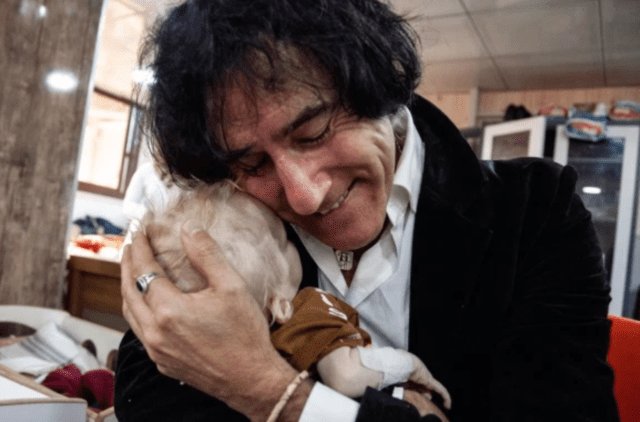
As a Chilean living in Sweden, Gothenburg-based filmmaker Gorki Glaser-Müller was a friendly acquaintance of Patricio Galvez, a musician who had similar Chilean roots. They weren’t particularly close but Glaser-Müller liked Galvez’s band. He never imagined therefore that he would end up accompanying Galvez on a journey to Syria to rescue Galvez’s seven grandchildren, nor that he would make a film about it.
The kids’ mother, Amanda, had moved to the Middle East in 2014 to join Isis. She and her husband, fellow Isis member Michael Skråmo, had been killed in 2019.
The events which led to Glaser-Müller making Children Of The Enemy (a world premiere in CPH:DOX and sold by Cinephil) began when he began to film Galvez’s band at gigs and sessions they put on at schools. He didn’t have any background in documentary. “I usually do fiction and I had made some [music] video clips. I was following his band when they were out on the road.”
The two men were both Latin-Americans living and working in the arts. They had friends in common. “I liked him. Most people did. But I was not in the circle of people who knew what Amanda had done; that she had radicalised and had married this very well-known Swedish Jihadist.”
The film came about in haphazard circumstances. Patricio called him one day out of the blue. “He said I have something to tell you. I could immediately sense there was something in the tone of his voice. He’s a very joyful person who likes to joke but this time it was different,” Glaser-Müller remembers. They met and Galvez told him the whole story about how his grandchildren had ended up “alone in Syria, orphaned, sick and in danger of not being found.” It was then that Galvez suggested the film.
“Even if he did not know for sure that they [the kids] were alive, Patricio is very spiritual. He said ‘I sense that they are alive. They have to be.’” Time, though, was running out. Swedish government agencies had provided no help. Galvez was therefore determined to travel to Syria himself and said to Glaser-Müller that he should come along too. “I want a film, I want this to be documented. The world has to know,” Galvez declared.
Glaser-Müller freely admits he was initially “terrified” at the prospect of the trip, fearing for the safety of both himself and of his friend. He was also very conscious that he wasn’t an experienced documentary maker. Nor was he a journalist. “I am getting all cold telling you this. I am getting the feeling like I got then.” However, eventually, he decided to go.
Galvez set off first. It took Glaser-Müller a day or two more to sort out his permits and papers. Both men were very conscious that the trip might go very badly wrong. There was no guarantee at all that the kids would be found.
The journey took place in the spring of 2019. Glaser-Müller entered Syria via the north of Iraq. It was an eerie and uncomfortable experience. They were entering a conflict zone. Glaser-Müller made sure that all his gear could fit into a single bag “that I could run with.”
He tried to think efficiently and logically. “I came up with the solution that this film will have to be made by me myself – me holding the camera, me doing the sound – following him [Galvez].”
He hoped that the audience would “root” for Galvez in the same way that he did. The grandfather was embarking on a quest that seemed from the outside to be “impossible.”
“It was very chaotic. I was very afraid. I couldn’t sleep. I tell you my knees were shaking,” the director remembers. However, he was also conscious that this was a project which “mattered,” a film that could affect lives.
During shooting, Glaser-Müller was thrown together with his subject. They spent many hours in hotel rooms together. Their friendship strengthened. “He gave me access. He trusted me to be there in very emotional moments and decisive moments.”
At the same time, Glaser-Müller didn’t want to ”put more weight” on his friend, who was undergoing a huge emotional ordeal anyway. “I didn’t wear him out because I saw him every day on the verge of cracking down, but he didn’t – he had a wonderful strength in him.”
“Me and him got along, I think, because we are more or less the same age. We are both Chilean ex-pats living in Sweden. He is very easy to be with, I must say. He is easy to like.”
There were certain logistical challenges. Glaser-Müller couldn’t risk getting his gear confiscated. That meant he often wouldn’t shoot at checkpoints and always had to be very discreet. Certain moments therefore couldn’t be caught on camera. Nor did Glaser-Müller know in advance which contact would provide the vital clue or assistance to Galvez. He therefore filmed all the meetings and telephone calls that he could.
In the end, the trip was successful. The kids are back in Sweden, living with foster families but their grandfather, who went to such remarkable lengths to rescue them, is now able to see them regularly.
Children Of The Enemy Was produced by Kristofer Henell and Erika Malmgren through Cinenic Film. It had support from, among others, the Swedish Film Institute and the Doha Film Institute. The Swedish release is set for May through TriArt Film.
“As a filmmaker, I am very glad to be able to tell this story and actually would be more happy if it is shown in countries where this is an issue – what to do with the children of Isis,” Glaser-Müller reflects.
The kids rescued by their heroic grandad Galvez are still young but the director hopes they do eventually watch Children Of The Enemy. “I would love for them to see this film so they understand what their grandfather went through to get them out.”





