

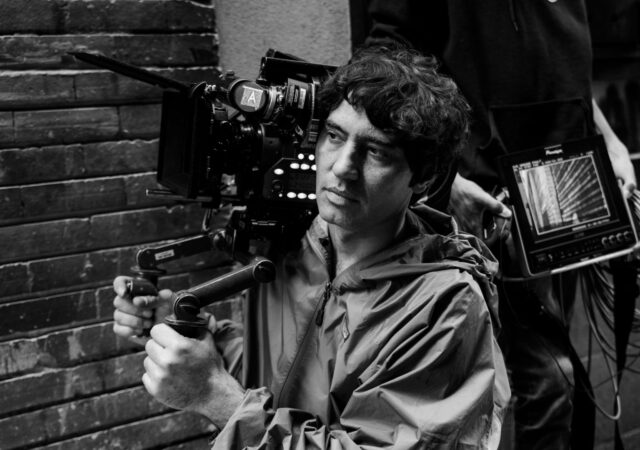
Pietro Marcello (photo: Francesca Errichiello)
In advance of the his 2021 VdR masterclass, Pietro Marcello spoke to Business Doc Europe about why, after his success with the Jack London adaptation Martin Eden, he returned to documentary with his new film, Per Lucio (For Lucio), about the maverick Italian musician and singer-songwriter, Lucio Dalla.
Travel restrictions and the curfew in Paris meant that Italian director Pietro Marcello wasn’t able to make it to Nyon for his Visions du Réel masterclass this week, instead giving his talk by live stream. Marcello is currently in France where he is due to make French-language drama L’Envol, starring Louis Garrel and Noémie Lvovsky.
However, in advance of the VdR event, Marcello discussed why, after his success with Jack London adaptation Martin Eden, he returned to documentary with his new film, Per Lucio (For Lucio), about the maverick Italian musician and singer-songwriter, Lucio Dalla.
“Lucio Dalla is my love,” Marcello declares emphatically. “I started to listen to him when I was very young, five or six years old…I grew up with him.”
Per Lucio was launched at the Berlinale earlier this year although the director says he has re-edited it slightly since then. The film is sold by The Match Factory who describe it as a portrait of “an underground and nuanced Italy, a free narration of the country’s history through tragic events and economic boom. This is the Italy of the underdogs and the marginalised: Dalla’s Italy.”
For Marcello, Dalla (1943-2012) was a ”unique” figure who managed both to be “popular” and to tell home truths about his country. “He was never in the middle.” He could croon like the best of them but his songs always had bite and meaning.
The director likens Dalla songs to mini-movies in the scope of subjects they covered. Dalla’s music was “about love stories, about daily life, about immigration, about poverty, about rich people, about Agnelli (the family whose business interests include Fiat, Ferrari and Juventus FC), about industry…he was like a sort of Hemingway. I grew up with his songs and it was important for me to make a portrait of him.”
Marcello’s film explores its subject’s friendship with poet Roberto Roversi, who wrote lyrics for several of Dalla’s albums. That connection linked the singer to the world of left wing politics and Italian cinema. Roversi was an associate of legendary Italian writer and director Pier Paolo Pasolini. The director was also able to draw on interviews from Dalla’s manager, Tobia Righi.
By telling Dalla’s story, Marcello was able to chronicle key moments in the popular history of post-war Italy.
Furthermore, the director says his passion for Dalla is similar to that he had growing up for the writing of French crime novelist, Georges Simenon, a writer with “a small vocabulary but who made great romance and psycho-drama.”
The pandemic caused complications for Marcello and his team as they scoured the archives from RAI, Istituto Luce and elsewhere for the material they needed. Nonetheless, the director is happy with the job he has now done. “I am satisfied I managed this homage to him. It was my mission.”
Marcello describes himself as an “artisanal” filmmaker who loves the “craftwork” of making movies. He is involved in almost every aspect of the process and is an experienced cinematographer as well as a director. He has been working recently on documentary project Futura in which he has been working alongside Francesco Munzi and Alice Rohrwacher. It is a film “about youth in Italy,” he underlines.
Now, the director is preparing for L’Envol which is produced by Charles Gillibert (Mustang, 2015). “It’s a challenge for me because it is the first time that I work in another country but, for me, it’s OK,” he reflects on the move abroad. Avventurosa is the name of the Italian production company through which he makes his films and (he jokes) “an adventure” is what he looks for whenever he starts a new project.”





