

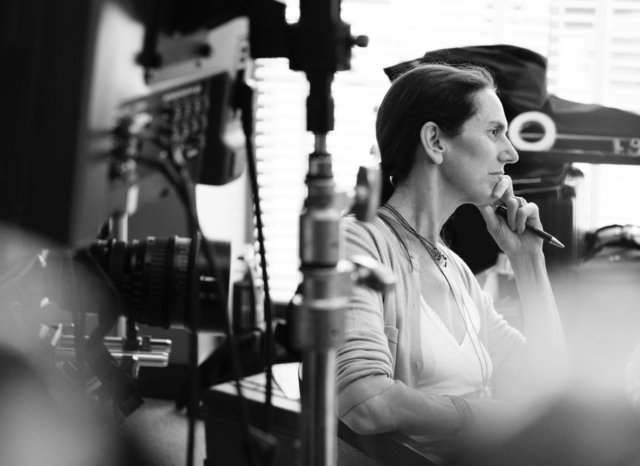
Lisa Immordino Vreeland (pic: Anne Joyce)
Truman Capote (1924-1984) and Tennessee Williams (1911-1983) were two of the greatest, and most flamboyant, American writers of their era. Their lives and careers often seemed to run in tandem. Both were the children of alcoholics – and both became alcoholics themselves.
They first met when Capote was still a teenager and Williams was just short of 30. Both had southern roots. Both were gay. Both were inveterate gossips. Both tasted early success and huge celebrity. Both then suffered a backlash from the critics. And both were interviewed on TV by British broadcaster David Frost, who asked the kind of personal, probing and insightful questions that no chat show host would put to their guests today.
Capote and Williams are the subjects of a new documentary by US director Lisa Immordino Vreeland (Love, Cecil; Peggy Guggenheim: Art Addict; Diana Vreeland: The Eye Has to Travel) which is released in the UK this week and sold internationally by Dogwoof.
“With a lot of my work, I am really trying to re-define these personalities for a new generation,” the director says of her cycle of documentaries about key cultural figures of the 20th Century. These have included personalities from fashion like Diana Vreeland (her grandmother-in-law), and art, photography and high society (Cecil Beaton and Peggy Guggenheim). She has recently been shifting her focus to writers – and is currently developing a new film about novelist and modernist guru, Gertrude Stein.
The world has not exactly been lacking for films about Capote in recent years. Ebs Burnough’s The Capote Tapes, which explored the fall-out from the writer’s unfinished novel ‘Answered Prayers’, was released earlier this year. In 2017, documentary stalwart Joe Berlinger made Cold Blooded: The Clutter Family Murders, a series looking at the story behind Capote’s classic 1966 non-fiction novel ‘In Cold Blood’. The Maysles brothers filmed him. There have been biopics about Capote (Infamous and Capote) and he pops up regularly in films and books about other celebrities of his era.
Even so, Immordino Vreeland had been planning to make her own Capote film for a considerable time.
“The story had initially started just as a Truman Capote film,” she explains. However, she knew that The Capote Tapeswas being made and would be released before she could complete her project. Her producer suggested: “why don’t you throw Tennessee into the mix?” She saw immediately that this could work.
“What I had always wanted to do was to make a film about the words – a film about Truman Capote’s words. But then, with the coupling of Truman and Tennessee, it was this bonus gift of being able to tell a fabulous story of [their] friendship.”
Both authors were regulars on the chat show circuit. That was how they came face to face with David Frost – and ended up speaking to him as if they were on the psychiatrist’s chair. Immordino Vreeland marvels at the Englishman’s body language during the interviews.
“He [Frost] was bent over, touching, getting close, getting intimate. It really allowed these men to talk about things.”
In the documentary, the archive footage is combined with readings from actors Jim Parsons (as Capote) and Zachary Quinto (as Williams).
“Covid did help because their schedules were a little bit freer,” the director says of the two in-demand actors. (Not that the pandemic helped with the launch of the doc. It was originally chosen for the Telluride Festival but the screening there didn’t happen.)
Immordino Vreeland insists that Truman And Tennessee is “not positioned as a biopic.” It is very different in tone to all the other biopics about Capote. Its focus is on their work and also on how “they climbed up that ladder of success and then – crashed!”
It is well chronicled that both men had messy, even tragic, ends to their lives. “That’s not the business I am into,” Immordino Vreeland says of their years of decline. “I want to redeem these characters. I want the world to be able to see them in the light [of] when they were really at their most prolific moment.” Nor did she want to dwell too long on embroiled social lives and their friendships with the rich and famous.
“I really wanted to create a spirit between these two men,” Immordino Vreeland say of the main drive behind the project.
Viewers will learn from the film that Capote wanted Marilyn Monroe, not Audrey Hepburn, to star as the call-girl heroine in the film adaptation of Breakfast At Tiffany’s (1961), but that Paramount double-crossed him. Capote was quickly reconciled to Hepburn but the film would have been completely different with Marilyn at its heart.
There were differences between the two subjects. Williams was a compulsive creator who continued writing new plays even after the critics turned so viciously against him. Capote, however, became markedly less prolific after ‘In Cold Blood’. He was thought to have been working on ‘Answered Prayers’ but the long waited manuscript never turned up. Excerpts were published amid much scandal and anger in Esquire but he was “in a prolonged downward spiral” and his best years were clearly long behind him. Immordino Vreeland talks of “the continuous sacrifice” both had to make in order to create their best work and the suffering this caused them.
“I think Capote had such an ego already at a young age that I don’t think he looked at Tennessee as a mentor. But I knew there was this friendship. That’s what the great story was,” the director reflects. “Tennessee was the grander person without a doubt. He was not on the make as Capote was. I was very familiar with Capote since he has been lurking in the background in all these other films. There has been so much more done on him. [But] I really discovered Tennessee in the making of this film,” she says of the high wire literary double act at the centre of the documentary.
Truman & Tennessee: An Intimate Conversation available on Dogwoof on Demand and other platforms from 30th April. Trailer here





