

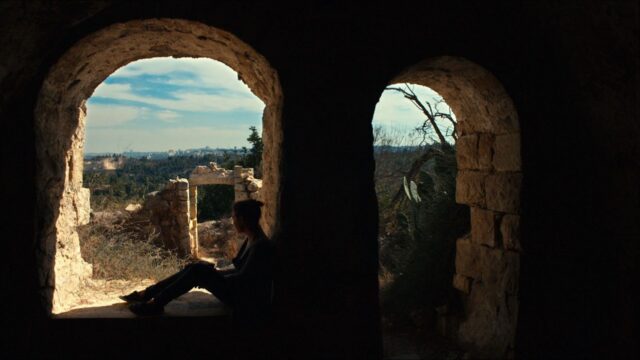
When Israeli director Michal Weits showed her father her new documentary Blue Box (a world premiere in Hot Doc in the World Showcase), he had to sit alone in his car to gather his thoughts after seeing it.
“It was important for me that he would see that it is not a provocative documentary. I wanted him to see that I did a lot of research,” Michal says of the project on which she has been working, in one form or another, for 14 years. “He saw the film. It was not easy for him. After the screening, he asked to sit in the car and think. He sat in the car for an hour. After, he got out of the car, he told me he really loves the film and he thinks it is really important.”
The film (sold by Cinephil) is about Yosef Weitz, the director’s great-grandfather. Weitz is considered an important figure in the creation of modern-day Israel, He was head of the Jewish National Fund’s Lands Department, which procured Palestinian land for the new Israeli state. He was also behind the Blue Box campaign which raised money for planting trees. Kids would drop coins into the boxes as part of the national fund raising drive. Weitz earned the affectionate nickname ”the father of Israel’s forests.”
But the spark for the film came when Michal discovered that her much-loved great-grandfather was also nicknamed by some as “the architect of transfer.”
“For me, it was a huge shock,” she says of her reaction when she first came across this damning phrase. She was in her early 20s at the time. That was when she started to read her great-grandfather’s voluminous diaries, which stretch to over 5000 pages. She discovered another side of his story which deeply disturbed her. She began to realise that this revered member of her family had been heavily involved in removing Palestinians from their homeland.
Over the years, after she studied at the Sam Spiegel Film & Television School in Jerusalem, she began to think about the film in earnest. Producer Assaf Amir, the owner and CEO of Norma Productions, supported her from an early stage. “He was really a good partner.”
Yosef Weitz didn’t try to hide his behaviour. In his diaries, he was always very frank about what he had done. “Now, I can say that he came back to be my hero but in a different perspective. I really appreciate him for writing the truth and not trying to hide it – and for writing about all the moral issues he felt.”
In one diary extract, quoted in his film, Joseph talks about his “scream” of conscience over his part in the evictions of the Palestinians. Somehow, though, for the sake of his own people and his own homeland, he was able to suppress this scream. His family had endured persecution in Europe and he was desperate to “find a safe place for the Jewish people.” That was what mattered most.
The director agrees with the interviewees in her documentary who tell her that it is difficult to judge the actions of men like her great-grandfather from the vantage point of today, 80 years on. They are a long way removed from the bitter reality of the Middle East at that time. “I totally agree with them. It is difficult to be judgmental when you are living on safe ground and you have a house and a city and a state,” she acknowledges. “But the one thing is that we are living in an unending conflict with a big question mark for our future. I think it is important to ask questions about the past and to be critical in order to shape a different future here [in Israel].”
In Blue Box, the interviews are combined with some extraordinary archive material. This includes personal family photographs as well as footage from old newsreels. The director herself is shown on camera patiently opening box after box in the Zionist Archives in Jerusalem but her research took her far further afield than that.
“Canada, the United States, France, Germany and the UK,” she ticks off the countries beyond Israel where she and her team tracked down their material. This may have been her debut feature but she pays tribute to her producers and co-producers, who come from Canada and Belgium as well as Israel, for the time and support they gave her.
The director acknowledges that it will be “difficult” for her other family members to deal with Blue Box. Their revered ancestor is being shown in a very unsettling new light. “But I think they know that I placed some really important facts in the film that you cannot dismiss. They will feel uncomfortable but they will appreciate it.”
As for Michal herself, she has had to come to terms with what she has learned. During the making of the film, she worried that if Yosef had still been alive, he would have been “very angry” at her for turning up this incriminating information about his actions. However, she now believes that her great-grandfather was hoping all along that his descendants would study his life and work. “In one of the paragraphs in the diary, I found a sentence that he wrote: ‘I am writing this diary for the generation to come.’ Then, I understood he wanted me to read the diaries – and I am glad I did it!”





