

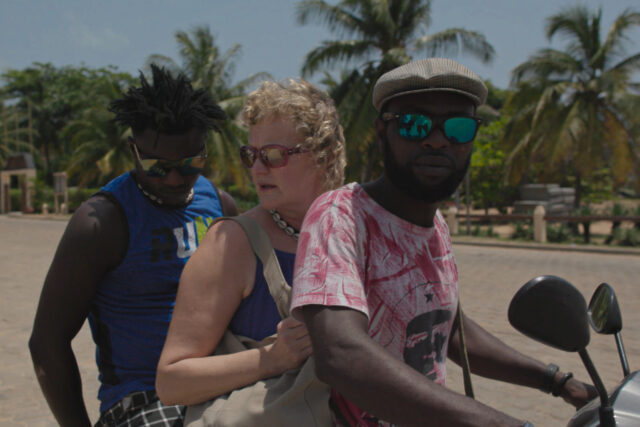
It’s not the typical package holiday but when the opportunity arose for Finnish tourists to travel to Benin in West Africa as volunteers for a new vaccine study to counter diarrhoea in the region, there was no shortage of takers.
Hundreds of thousands of kids die every year from diarrhoea-linked illnesses. The tourists would very possibly be saving lives – and they would be having a good time too. Professor Anu Kantele was behind the study – and filmmaker Mia Halme was there to chronicle what went on. Her documentary People We Come Across, produced by napafilms, is an international premiere at Hot Docs this week.
Halme read about the experiment in the Finnish press and immediately thought “this is something crazy.” Seven hundred Finns were flying all the way to Africa “to have diarrhoea and to be examined.” The premise was tantalising, even potentially hilarious. However, the more Halme thought about it, the more curious she became. When she finally contacted Professor Kantele, she was swept away. “She (Kantele) is really like a genius and visionary – a really creative person, not at all what you are used to seeing in a doctor. “
The director (who co-founded her own production company SAHADOK in 2009) didn’t propose a film at once. She told Kantele, with full honesty, that she was very curious about the experiment and keen to find out more. The doctor invited her to come to Benin and see for herself.
Kantele’s study was taking place in Grand-Popo, a relatively small village. “It’s hot, extremely hot,” the filmmaker remembers her first impressions on arriving there. It doesn’t even cool down during the night. “It’s never easy in that way.” However, Halme felt very comfortable being there. The local people had a sense of humour very close to that of the Finns. “It was easy to be with those people, really relaxed.”
There was obvious potential satire in the idea of these affluent white westerners travelling all the way to Africa in order to experiment with holiday tummy (one of the many euphemisms for diarrhoea). You might get the skits by accident when you go on vacation but you don’t normally expect it to be the main purpose of your journey.
“I tried not think these are wealthy white people and these are the poor black ones living in Benin. I tried to treat them all in an equal way. That is how I work as a director,” Halme reflects. “Of course, that is difficult in this type of film or topic where it is so obvious some of the characters are rich and some are poor.”
The director adds, however, that she felt some license to poke fun at the tourists because they were also very willing to laugh at themselves.
Shooting was “really fun” even if it was tough work carrying around the equipment in such a hot and humid environment. The Finnish tourists were in relaxed groove. Their Benin hosts were easy going as well.
Halme and her cinematographer Ditte Uljas were aiming for a visual style which reflected the mindset of their protagonists. If they noticed something curious or strange on the streets, they would include it. They wanted to capture the laidback quality of life in Benin. “You can take a nap whenever you want, maybe under a tree.” Nonetheless, there are also constant visual reminders of the devastation the bacteria is causing, for example a cut-away to a dead bird or a shot of a grasshopper on the water.
While the filmmakers followed four different groups of tourists over the course of a year, in the edit the story was built to focus on the final group.
Plans are afoot for screenings of the film in Benin, once Covid restrictions ease. The director remains close to Professor Kantele. “Now I can say we are friends because the film is finished, there isn’t any more the work between us,” Halme says of their regular phone conversations and occasional meetings. The professor saw an early cut of the film (she “really likes” it) and so did the Swedish company manufacturing the vaccine. They’ve confirmed that the science on screen is all accurate.
Now Halme is turning toward something completely different. She is preparing a new documentary called Fabulous Cow Ladies. “It’s about three cows, a granny, a mum and a child, that live in the wilderness. That’s quite rare nowadays. And it’s about their three owners, who are all doctors, ” the director says of the project which has already been shooting for a year and which examines humans’ relationship with the natural world.





