

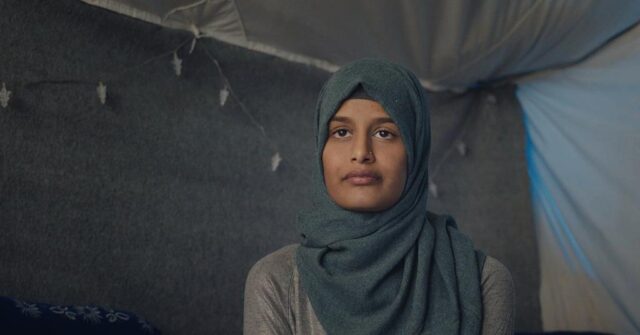
Spanish director Alba Sotorra talks to Business Doc Europe about her doc in which she explores the plight of the so-called ISIS brides, including the divisive Shamima Beguma from the UK and the American Hoda Muthana.
When she was in her 20s, Spanish director Alba Sotorra travelled across the world – and made a documentary about her experiences. She hitchhiked all the way from Barcelona to Pakistan. It was during this epic journey that she first came to the Middle East.
“I lived in Iran, in Turkey and in Kurdistan,” Sotorra remembers. “I got a very strong link with the region and with the people.”
Years later, when war started, she was there to chronicle it. In her 2018 film Commander Arian, Sotorra followed female Kurdish resistance fighters battling against Isis. “I dedicated many years of my life to tell the story of the Kurdish struggle through the story of the Kurdish female fighters,” she says.
The director freely admits that, before making her new documentary The Return, Life After Isis (screening in Sheffield June 6), she detested ISIS. They were responsible for the deaths of people she knew well. “Because of my previous film, I have a lot of friends in the army, female Kurdish friends” she says. “I lost some of these friends. I lost close friends in this war.”
Nonetheless, she explores the plight of the so-called ISIS brides and their kids with considerable sympathy.
Her subjects include Shamima Begum, the teenager from Bethnal Green in London who ran away to marry an ISIS fighter and has been a figure of hatred and contempt for the British tabloid press ever since. Also featured is Hoda Muthana, the young American woman notorious for her inflammatory tweets, calling for Muslims to “spill American blood.”
The main focus of the film, though, is Sevinaz, the young Kurdish woman who runs workshops for the ISIS women in the detention camp in which they are currently languishing.
In spite of the huge suffering her family endured at the hands of the Isis killers, Sevinaz is more interested in healing and reconciliation than revenge. “The first purpose for me and our film crew was to film Sevinaz’s story,” says director Sotorra.
“In this film, I wanted to focus not on the pain of the Kurdish but on how they, after all what they have been through, are able to give a hand,” she says of the “astonishing” generosity and forgiveness that people like Sevinaz show to the women in the Roj detention camp. In almost every case, their countries don’t want these ISIS women back. Their passports and citizenship have been revoked. They and their children are stuck in limbo.
In a recent article, British foreign correspondent Anthony Loyd (the journalist who “discovered” Shamima in the refugee camp after the fall of ISIS) praised Sotorra’s film but questioned its “absence of tough questioning” of the ISIS women.
Sotorra counters that making a film like The Return required “a lot of self-responsibility.” These women are in a very delicate situation legally and she was determined not to put them at further risk. “As a journalist, a filmmaker, you really need to think. Everything you say and put [in the film] will stay there forever and will affect the life of that person,” she explains. “Every single step I took in this long journey with these women, I took this into account.”
The focus, the director continues, was on the journey these women have made: who they once were and “who they are now.” The aim of her film is to encourage “healthy and well informed dialogue on the issue of repatriation. At the moment, it is not healthy, the way this issue is being approached by the media….the narratives that come from hate and fear.”
The documentary has an early scene in which kids are shown playing. They are very young, maybe four or five years old, but one little boy is already talking fervently about Jihad [holy war] and going to heaven. The implication is clear. If the children are left to fester in the camps, they will become radicalised. Some already are. “To let these kids grow [up] there is really, really dangerous. That is what I am trying to say with this [scene].”
When the director first encountered Shamima, the British woman was in a deeply traumatised state. She had lost all three of her children. It wasn’t the right time to interview her. Besides, the director adds, during that period, she “hated” the Isis brides. “They were part of a group [Isis] that killed people I really loved.”
However, ten months later, when Sotorra did speak to her, Shamima was in a much better frame of mind. She comes across on camera as calm and articulate. By then, the director and her crew (many of them Kurdish women) had also overcome their own revulsion toward the women.
“When it comes to fear, ISIS’ strength was that they were able to spread fear around the world…they hit Barcelona, they hit London, many cities,” Sotorra notes. “Fear leads to hate and anger. All these feelings, hate, fear, anger, they aren’t a good basis from where to start the solution of an issue that is out there, that is really complex and that we really need to work hard to stop.”
The women in the camps have been deprived of their liberty. Many have been disowned by their countries of origin. However, they haven’t yet faced a trial. Keeping them in the camps is depriving them of their basic human rights and storing up trouble for the future. “It is not helping anybody,” the director states.
The Return, Life After Isis is sold by Met Film Sales. The film will launch on Sky Documentaries and streaming service NOW on 15th June at 9pm after premiering at Sheffield DocFest June 6.





