

The Silence of the Mole is the second South American documentary in recent months about someone going undercover to expose injustice. But the tone of the two films couldn’t be more different. Whereas Chilean director Maite Alberdi’s Oscar-nominated The Mole Agent was a playful, whimsical affair following an OAP detective in an old people’s home, Guatemalan director Anais Taracena’s film (a European premiere in Sheffield this week) is altogether more hard hitting.
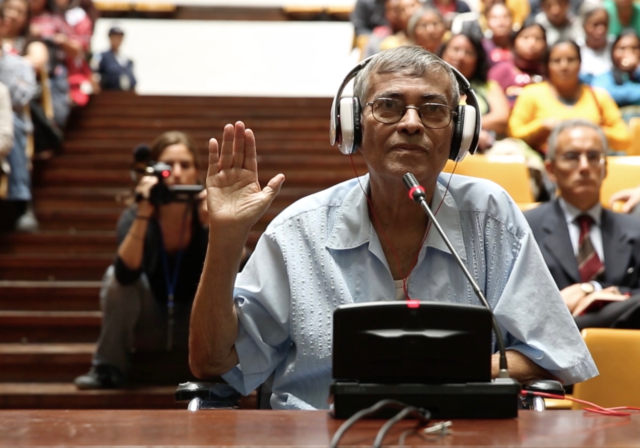
Its subject is Elías Barahona, a journalist who went undercover as a press officer for the military regime in Guatemala in the 1970s. This was a period when the government was waging war on its own citizens, torturing and killing thousands through its infamous death squads.
In 2014, Barahona gave evidence in a trial for crimes against humanity. By then, he was an old and ailing man, a few days away from his death. Taracena knew him in the final stages of his life. She had met him in 2011. The introduction had been made through his brother, who was a political refugee in France. “We became good friends. He started to tell me everything about when he was infiltrating the government,” says Taracena.
Before the trial, Barahona called the director to tell her he would be giving his testimony. He asked if she wanted to film him there. After his death, Taracena began her research in earnest.
The events the film focuses on may have happened 40 years ago but Taracena still encountered resistance to her project. A lot of potential subjects didn’t want to be filmed. “It is still a very conservative and anti-communist country.”
Even today, to speak out about human rights is to risk being labelled as a terrorist or as a communist agitator. That is one of the reasons why there has never been a proper reckoning for the crimes the state committed in the 70s.
Eventually, Taracena found some people ready to talk to her about those horrific events. She herself was born in 1984 and is in her mid 30s. Ask how her generation deals with what happened during the time of the death squads and she suggests there is still a veil of silence. “At schools, they don’t talk about that,” she notes. “Of course, the government doesn’t talk about it either.”
Old-timers who support the government still speak as if Guatemala is caught up in the Cold War. Taracena’s father was in the revolutionary movement. She is from a left wing family and has therefore been told a little bit about the human rights abuses. However, even her father has been reticent about saying too much – and when he does discuss such events, it is in a whisper.
“I think that people of my generation don’t have all the information about death squads and everything,” the director suggests. “They know there was a war and that there were people who disappeared but [they think] maybe more in the rural areas.” As her documentary makes clear, indigenous people were being massacred in the countryside but the killings were happening in the heart of the cities too.
Partly because of the pandemic, The Silence of the Mole hasn’t yet been shown in Guatemala. Taracena expects that when it is finally screened there, it will cause plenty of anguished discussion. Her father is scared about what might happen to her and some friends have advised her to get out of the country.
“I think they are exaggerating a little but it shows the paranoia…”
Guatemala remains a violent place today. There are gangs and drug dealers. However, Taracena draws a line between the problems today and what happened in the time of the death squads.
One of the most shocking incidents in the civil war was the Spanish Embassy fire in 1980. Taracena sees this incident as a turning point, a moment when the government said “OK, we are going to kill everybody who is leftist and we don’t care if it is public.” The Government had support from the US which was also ardently anti-communist. However, the outside world was beginning to realise that genocide was taking place in Guatemala. US filmmaker Pamela Yates made her influential film, When The Mountains Tremble (1983), which highlighted human rights abuses in the country.
For many years, the “mole” Elías Barahona was regarded as a traitor by his old friends. They didn’t realise that he was working against the government. Even when they discovered what he had really been doing, suspicions remained. He lived in exile and didn’t have much money. “It was one of those decisions that mark you forever,” the director says of his decision to go undercover. “Nobody trusts anybody…it is so sad. Also, this story is not known in Guatemala. Maybe in the 80s, it was a little [bit] known but now, in our days, nobody knows this story. There are a lot of stories like this that nobody knows.”
The Silence Of The Mole premiered in Hot Docs. After its Sheffield screenings, it has various other festival dates. Taracena is currently handling the distribution herself. She and her team have strong contacts in Latin America but she hopes to find a sales agent to help with Europe and North America.





