

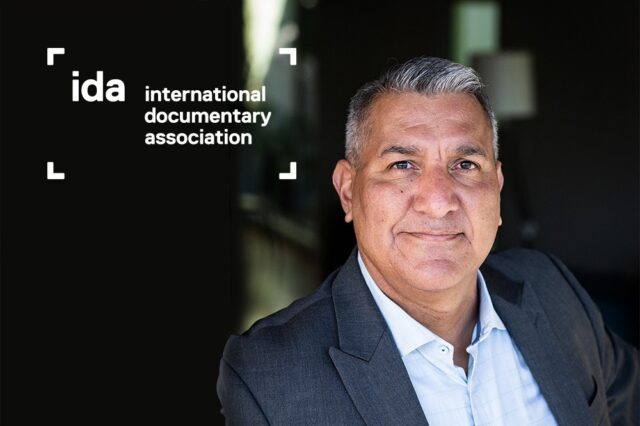
It’s just over a month since Richard Ray Perez took over from Simon Kilmurry as executive director of International Documentary Association. An experienced doc filmmaker himself, and former Director, Creative Partnerships of the Doc Film Programme at the Sundance Institute, Perez tells BDE of his desire to create more opportunities for more filmmakers, and the need for more documentary voices to be heard.
Founded in 1982, IDA is one of the most influential documentary organisations in the US. It funds films but also has a strong research and advocacy role while publishing its own magazine and staging a prestigious awards event.
“It has certainly been an attempt to hit the ground running…or the ground is hitting me,” Perez jokes of his first few frantic weeks at the helm. He comes to IDA having made award-winning documentaries himself (notably 2014’s Chavez’s Last Fast, about leader of the United Farm Workers’ Union, Cesar Chavez). He has also had several key jobs in the US documentary world, for example serving seven years as Director, Creative Partnerships for the Documentary Film Programme at the Sundance Institute.
“We’re such a multi-faceted organisation with a lot of moving parts,” Perez says of IDA which has a staff of over 20 people. He has taken up the reins at a point where, as he puts it, “much of the field is starting to emerge from the pandemic.”
“A month in, I am realising how much there is to grasp,” the new exec director says as he tries to acclimatise himself to the many different ways in which IDA engages with the documentary world.
It helps, he suggests, that IDA has a “very talented senior level staff.” He can call on trusted colleagues like Poh Si Teng, Director of IDA Funds & Enterprise Program, and Tom White, who edits Documentary Magazine.
“The good thing for now is that many of the programmes are humming along. They don’t need my immediate attention. But there are emerging areas that have been incubating within the IDA for a while that are becoming much more critical,” Perez sums up his immediate priorities. “It’s a combination of ensuring that what we do well, we keep doing well (the funding, the magazine, the IDA awards, our really robust screening series) and then examining and fully developing an advocacy programme.”
Perez cites the murder of George Floyd last year as a tragic and seismic incident whose reverberations are being felt everywhere, including within the IDA.
“As a storyteller, a media professional and the leader of a non-profit, I would say the events from last year around George Floyd, they’re symptomatic of a larger social issue, specifically here in the US, around police brutality.” The incident has led (he suggests) to an intense questioning of “the role African-Americans play in society as a whole, their participation in creating…their narrative, a narrative of people of colour here in the States.”
Outside the US too, Perez believes there is now far more awareness of communities that “are far under-resourced when it comes to telling their non-fiction stories.”
“All this is to say that I saw the events of last year as a symptom of a disparity and an inequity in many facets, not just of society here in the States but globally around resource distribution. Sometimes, on a social level, it is just quality of life but, as you know, documentary is a reflection of society. It is in constant dialogue.”
Perez insists “more voices” now need to be heard within documentary. However, he is wary about being “reactive” and rushing to put in new measures that haven’t been properly thought through.
“There’s an impulse to panic and immediately try to put a fire out. [But] these are very long term, complicated issues. I really want to devote the time to come up with thoughtful, long-term solutions. That’s the key. These problems did not emerge overnight.”
In other words, this will be a process of evolution, not revolution.
IDA has been building close relationships both with smaller, grassroots organisations and with the streamers. Netflix supports the IDA Global Emerging Filmmakers Award which offers a $25,000 grant to an emerging documentary maker from Brazil, Mexico, South Korea or India.
Perez, meanwhile, has, made it one of his goals to “create more opportunities for more filmmakers.” He thinks the streamers can help the IDA with this but is determined to ensure that any joint ventures remain “really rooted in equity and sustainability.”
Given his own distinguished documentary career, it might seem surprising to some that Perez has opted to work at organisations like Sundance and IDA rather than pursue his own projects.
“I describe myself as a former filmmaker in some ways,” Perez wryly observes. He knows well from his own experiences just how difficult it is to finance documentaries.
When Perez started working at Sundance, he was given “a behind the scenes” insight into “how competitive the field is, who are likely to get the funds and who are likely to sustain careers.” He realised there were “a series of systemic barriers” that meant, in essence, that many filmmakers really didn’t have a chance. Instead of pursuing his own career as director, he has become much more interested in trying to fix the structural problems that prevent so much talent from flourishing.
These problems (lack of resources and opportunity) aren’t just confined to the US. He realised they applied everywhere, “and particularly in the global south.”
IDA already has strong relationships with European documentary festivals and organisations. Perez talks of “continuing and deepening the collaboration.” However, unlike its European equivalents, IDA receives very little in public funding. There is some support through The National Endowment Of The Arts and the Corporation For Public Broadcasting but the organisation is dependent on private support from foundations, donors etc as well as from earned revenue.
The Association remains very careful about what sponsorship opportunities it pursues. It won’t take money if its independence and integrity are undermined in any way at all. Nonetheless, IDA remains a key resource for filmmakers in the US and internationally. Its production grants range from $25,000 to as high as $70,000 to $100,000. It also helps connect filmmakers with other funders.
During the pandemic, the organisation has lengthened its digital reach. More than 3,000 documentary professionals from 54 countries joined its virtual Getting Real conference last year.
In spite of the obvious challenges, Perez strikes a generally optimistic note about prospects for the documentary sector. “It’s great that there’s an explosion in the audiences [for documentary],” he says. One nagging question, though, is “who is deciding how the story is told?”
Perez himself supports documentary in all its forms. He doesn’t want IDA to confine itself only to championing hard hitting docs on stories of social and political importance. There’s room for crowd pleasers too. Ask him if IDA would support a film like this year’s Oscar winner My Octopus Teacher and he replies: “The answer is, of course, yes. Really, one of the beautiful things about our field is the range of storytelling and the storytelling styles. Some of my favourite films have very little to do with social issues and politics. We really do support the whole range of vibrant creative storytelling. That is what makes our universe rich!”





