

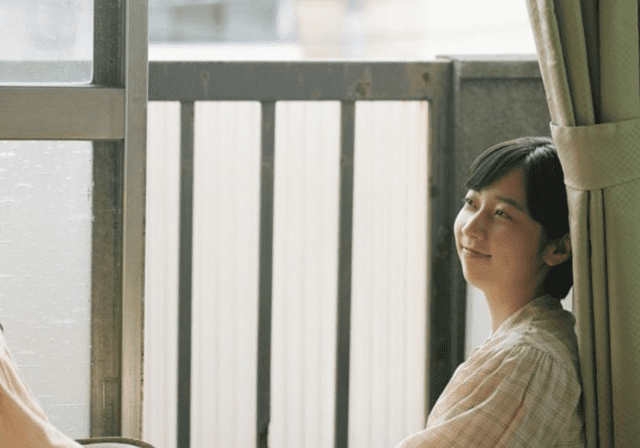
Through a series of tableaux inspired by a tanka (a 31-syllable one line poem) of the same name, and written by the revered Naoko Higashi, we follow the character of Sachi after she moves into a new apartment. As she entertains friends and family and agrees to be the muse for a young filmmaker, in essence what Japanese director Kyoshi Sugita is recording is a series of complex and moving existential moments, all presented within a satisfyingly plot-free structure.
We observe Sachi as she eats (lots of cake) and drinks with friends, as she sympathises at the lachrymose outpourings of relatives, or as she indulges in her own calligraphic artistic pursuits by creating a banner containing the symbols for Wind, Forest, Fire, Mountain. She is filmed (or recorded) and photographed by friends and acquaintances. It is delicious, slow cinema in which Sachi is both object and mirror, driving our curiosity through a series of gestures, reactions or movements, at the same time embodying the calm of the world she inhabits.
“Chika is a stage actor, calligrapher and contemporary dancer at the same time. In fact, this is the first time she has appeared in a film,” Sugita explains to Business Doc Europe. “What I noticed through the filming is that she looks like water on the surface of a lake. She always responded reasonably to the wind, what happened, and the people around her, accepting them, and layering ripples. I think she has acquired that ability as she has experienced various types of expressive activities. The script for this film was born because she starred. I was looking forward to seeing what she would look like during the shoot.”
The director decided to work with Chika after she made the supreme effort of leaving the hospital where she was about to undergo major surgery in order to attend a screening of his previous film Song of the light. Sugita tells how he spontaneously suggested to her that if she were to get through the operation successfully then they should celebrate by working together. Six months later they met again and agreed to collaborate, and on the way home the tanka entered the director’s head.
“My films tend to have such chance starting points. That’s why everything I did after that had Chika at its center. My way of making films is probably different from the general method. I think most people start their different preparations after having originally completed the script, but in my case, I write the script at the end, after having settled the casting, the location scouting, and the shooting schedule,” he explained to FIDMarseille in advance of the festival.”
Within a film of such delicate equilibrium and patience, it is surprising how many art forms are invoked, such as lyric, dance (as evidenced by her vigorous movements in creating the large calligraphy), photography and of course the process of tangible cinematic exhibition as we see the efforts of a young filmmaker, for whom his muse Sachi performs, projected onto a high window for an audience of her and her friends.
“I think all art forms are there to ask what [is] this world or universe we spend our days with,” comments director Sugita. “I think that the approach and tools required to pursue it differ depending on each art. Among them, I happen to choose to make films, but every art is important to me.”
In his FID interview, Sugita further notes of Chika on set. “It seems she thoroughly enjoyed every day of it. Later, she often slept on set. As I saw that she would fall asleep in some corner of the set as soon as I took my eyes of her, I thought, isn’t she relaxed? I even started filming the scene with her like that once. She woke up at some point, sensed in an instant that the camera was rolling, and went on with her performance.”
Nevertheless, it is a film that infused with a deep melancholy, in which characters are responding to traumas or events that are not directly alluded to, that exist outside the time frame or terms of reference laid down by the film. That said, Sugita explains that external forces have a bearing on what we see on screen.
“The production of this film was cancelled due to the pandemic,” he tells Business Doc Europe. “The first scene of this film was the last scene that we could barely shoot just before the cancellation. To start the project again, I decided to write the continuation of the story. During the pandemic, I myself lost a friend and had to face that sadness. I think that has an effect on that [sense of] melancholic. I also write novels, so someday I might turn the story I couldn’t shoot into a novel. Regardless of the pandemic, people who have lost close friends or family also always appear in my films. I think life is always with loss.”
“Every choice we make in our daily lives, whether conscious or unconscious, has reasons,” he continues. “Even a momentary action, such as suddenly dropping the eyes, is related to the person’s life. A film can’t portray every [event] of someone’s life, but it can capture that moment exactly. I always pay close attention to that.”
To some extent, the ‘recorder’ of the film title is something of a MacGuffin as it relates to a musical instrument left behind in the apartment by the previous tenant. Nevertheless the object’s naming serves to remind us of that this film itself is a recorder of a series of significant moments, as experienced and recorded by those on and off screen. “Films have a role [to] record in this world, regardless of genres such as fiction and documentary. In this film, through a person named Sachi, it should be the record of Chika herself who played [the role] in the summer of 2020. What’s interesting about the filming is that at the same time, it’s sure to be my own record, [from] behind the camera,” says Sugita, adding with some satisfaction, “I also like this [film] title.”





