

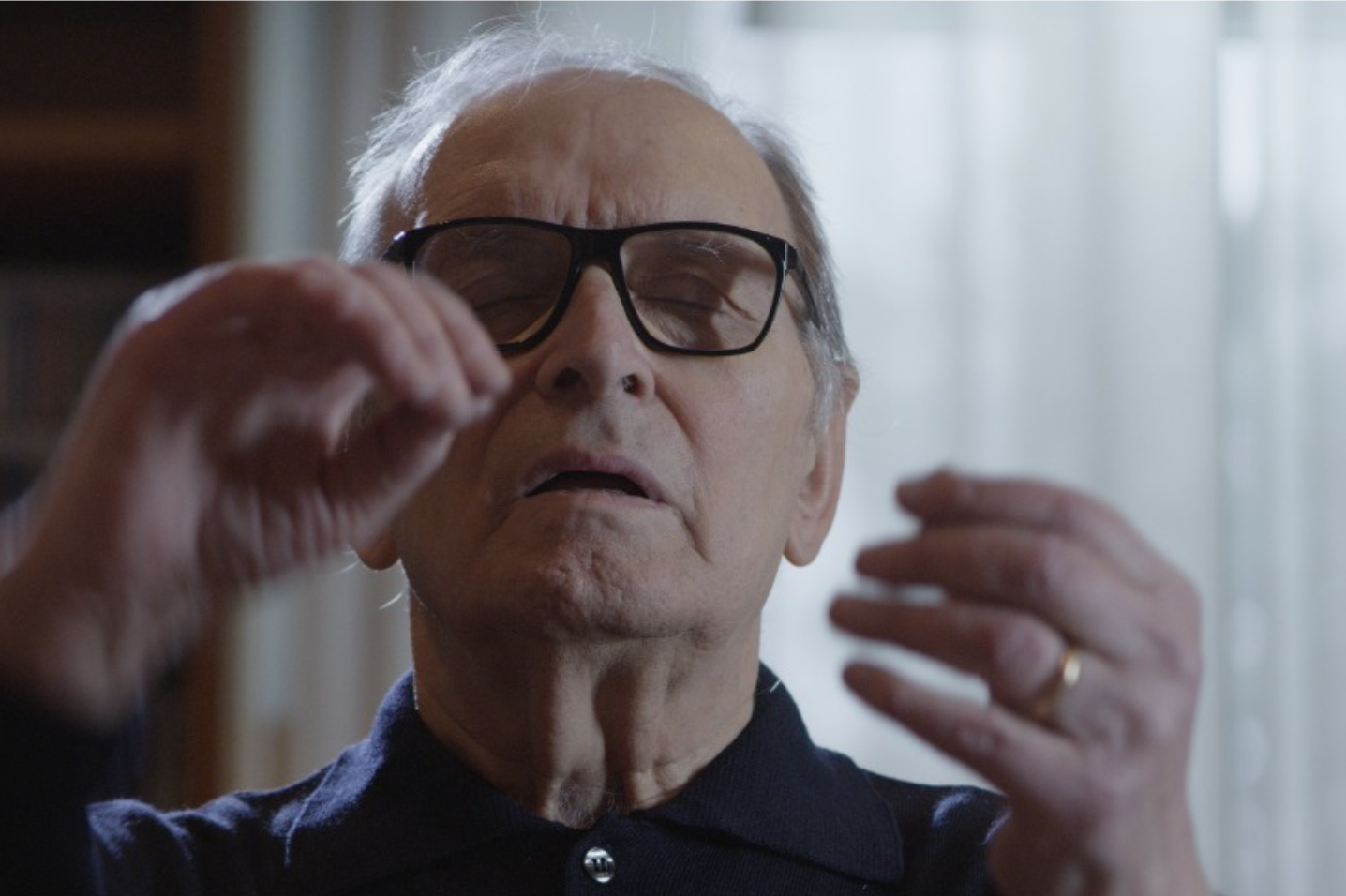
The “maestro” Ennio Morricone (1928-2020) wrote the scores for hundreds of movies. He is the one cinema composer whose name is easily recognised even by those who know next to nothing about film music. Just play a few bars from the beginning of Sergio Leone’s The Good, The Bad And The Ugly or Once Upon A Time In America and they will immediately picture Clint Eastwood as the man with no name or Robert de Niro as the Jewish gangster, Noodles. Now, Morricone is the subject of a new feature documentary premiering this week in Venice, a festival where many of his pictures have shown over the years.
Ennio, directed by Oscar winner and frequent Morricone collaborator Giuseppe Tornatore, was initiated by Italian company Piano B, run by Gianni Russo and Gabriele Costa. Looking for a partner with experience of the international film market, they contacted Belgian producer Peter De Maegd of Brussels-based Potemkino (a company with extensive co-production experience on films ranging from Iron Sky: The Coming Race to Terence Davies’ A Quiet Passion).
Potemkino has often worked with Italian partners, for example on Igor Tuveri’s gangster thriller Five Is A Perfect Number(2019) starring Toni Servillo.
When the project began, Morricone was still alive. Many other big name filmmakers had already tried to make a film about him but he turned them all down. He was a private and reclusive man who gave the impression he didn’t want to be disturbed. However, the “maestro” had scored several films for Tornatore including Cinema Paradiso, Malena and The Legend Of 1900. They were friends and colleagues.
When Tornatore proposed the project, Morricone immediately replied: “I was waiting for you to ask me.”
“There was a very strong and deep relationship between Morricone and Tornatore because they had been working together for over 20 years, on more than 10 films. You could even go so far as to call it a father-son relationship,” De Maegd observes.
Unlike other recent documentaries, among them Asif Kapadia’s Amy and Maradona, Ennio is made by someone who knew his subject intimately and could talk to him on equal terms. “That’s what makes the film unique to my opinion,” the Belgian producer says.
At the same time De Maegd joined the production, so did veteran producer and distributor San Fu Maltha of Amsterdam-based Fu Works.
“San Fu and I teamed up to structure the international financing of the project,” De Maegd remembers of how they brought in distributors, cleared rights and secured a sales agent (Block 2 Distribution). “He [Maltha] brought in the Benelux [distributor] partner Periscoop with an MG [minimum guarantee] and I brought in NonStop Sales for the Nordic and Baltic rights, also with an MG. That was the first step. From there, we started moving forward.”
Other big distributors, among them Lucky Red in Italy, Gaga in Japan and Le Pacte in France, also soon signed up, sight of the film unseen. Eurimages has also supported the film. The version screening in Venice this week isn’t fully complete but all these companies had faith that the combination of Morricone and Tornatore would work.
“It’s an Italian-Belgian-Chinese-Japanese co-production,” the producer explains the very complex structure. “It was also great to have other producing partners like, of course, Wong Kar-Wai who is a living legend, and Tom Yoda [from Japanese company Gaga and former Chairman of Tokyo International Film Festival]. You get into a very interesting network when you are working with all these people!”
This was a passion project for the Belgian. Growing up, he had loved spaghetti westerns. Later, in his film student days, he would watch Leone’s Once Upon A Time In The West again and again at the Cinematheque in Brussels, close by where he lived, and says he learned just as much about cinema from this movie as from his teachers’ lectures.
“When you look at Morricone, what I absolutely adore is that the music which everyone recognised started from experimental roots. It started from a composer who was inspired by something completely out of the mainstream,” De Maegd observes. In his own filmmaking, he aims to make films with a strong personal vision and artistic edge but that (like Morricone’s music) can always be enjoyed by a broad audience.
One of the attractions about the documentary for general cinema goers is the extraordinary range of interviewees that Tornatore and his team have assembled. Rock star Bruce Springsteen spoke to the filmmakers when he was giving a concert in Italy. The great and good of Italian cinema are also all on hand. Bernardo Bertolucci (who has since passed away), Marco Bellocchio, Dario Argento, the Taviani brothers and Carlo Verdone share memories of the great composer. Quentin Tarantino and Oliver Stone feature too.
“If you’re passionate about cinema, you’re passionate about Morricone, there is no other way around it,” is how De Maegd describes the fervour which has driven him and so many others to support the film.





