

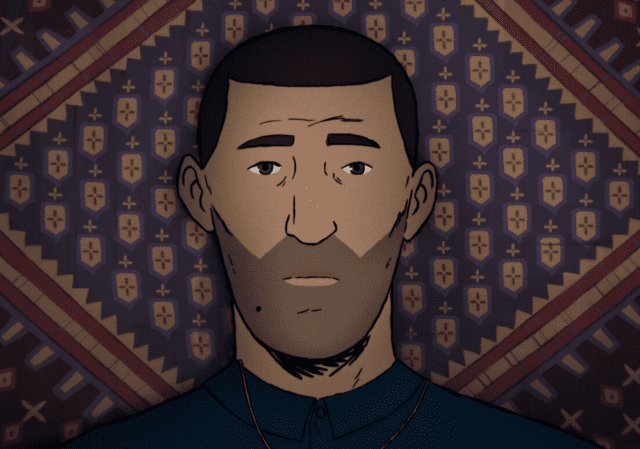
Danish director Jonas Poher Rasmussen’s animated doc Flee Documentary Competition at Nordisk Panorama 2021. The film tells the extraordinary story of Amin, an Afghan refugee who came to Denmark at an early age as an unaccompanied minor. He has since created a successful new life for himself and is shortly to marry his long-term boyfriend. However, a secret from his past threatens to unravel his world.
Why use animation for a documentary? “First of all, it takes places in the past,” Rasmussen says of his film (sold internationally by Cinephil). His challenge was to make the Afghanistan of the 1980s and the Moscow of the 1990s feel “alive,” something that would have been a struggle with live action. The film is seen through the eyes of a kid, another reason for a more expressive storytelling style.
Amin wished to remain anonymous. This was the first time he had revealed the trauma he experienced earlier in his life. He agreed to share his reminiscences with Rasmussen but didn’t want his face in the movie.
The director and his subject go back a very long way. Rasmussen was 15 when Amin turned up in his home town in Denmark. “He was 16…he arrived all by himself from Afghanistan. He stayed in this foster home around the corner from where I grew up.”
Amin and Rasmussen started high school together. They used to meet every morning at the bus stop and quickly became firm friends. However, at this stage, Rasmussen had no idea at all of what his new pal had experienced before arriving in Denmark.
“This is 25 years ago now. In all those years, he never told me or anyone else actually about his past,” the director remembers. The two friends lived in the present. They went to the gym and “talked bullshit together…it was just a teenage friendship. For some reason, I didn’t think about his past that much.”
There were rumours, though. Someone said Amin had “walked all the way to Denmark.” People speculated that his family had been killed. When Rasmussen finally asked, Amin stonewalled and wouldn’t answer. “I of course respected that.” They went back to their teenage friendship which was based around “hanging out” together.
Rasmussen was subsequently startled when he finally heard his friend’s story.
When he started making Flee, the director worried that the documentary might get in the way of the longstanding friendship. He was delving into very intimate parts of Amin’s life. However, he kept Amin close throughout the filmmaking process, letting him read early drafts of the scripts and showing every rough cut.
“He (Amin) was very generous. He said, ‘it is your film and you have the freedom to interpret my story as well.’”
As part of his research, Rasmussen visited the parts of Moscow where Amin had lived. He had also planned to go to Afghanistan, but the trip was called off at the last minute after a terrorist attack there. The director and his art director spent long hours looking through old archive footage of the two countries during the 1980s. He read books and spoke to any Afghans he could find who had memories of the era.
Yes, using animation was a much more painstaking process than making a conventional live action documentary. “What’s funny about animation is that you do it the other way round. You edit the film first and then you shoot,” Rasmussen says of the exhaustive storyboarding.
The flip side was that animation allowed him to be more expressive. If he needed a close-up shot for a scene, he could just draw it. He talks of the enormous freedom he had and also of how precise he could be in his use of imagery.
Flee was produced by Monica Hellstrøm and and Signe Byrge Sørensen for Danish production outfit Final Cut for Real.
Rasmussen has known Hellstrøm for 20 years. Their challenge was to “fund an animation film in a documentary world where you don’t have a lot of money.” However, many different backers were ready to support Flee. It was co-produced by Sun Creature (Denmark), Vivement lundi ! (France), Most Film (Sweden) and Mer Film (Norway), in collaboration with broadcasters ARTE France and VPRO in Holland.
Financing came from, among others, the Danish Film Institute, the Swedish Film Institute, the Norwegian Film Institute, Nordisk Film & TV Fond, Copenhagen Film Fund, West Danish Film Fund and the Creative Europe Programme.
The English-language version is voiced by British Pakistani actor Riz Ahmed (as Amin) and Game Of Throne’s Nikolaj Coster-Waldau as Rasmussen.
Flee was chosen for the 73rd edition of the Cannes Festival but wasn’t screened because of the pandemic. Its world premiere was therefore at Sundance 2021.
Rasmussen is hatching a new animated project based on graphic novelist Halfdan Pisket’s autobiographical “Dane trilogy” about a Turkish army deserter who built a new life in Denmark. This is being made in collaboration with Benelux outfit, Submarine.





