

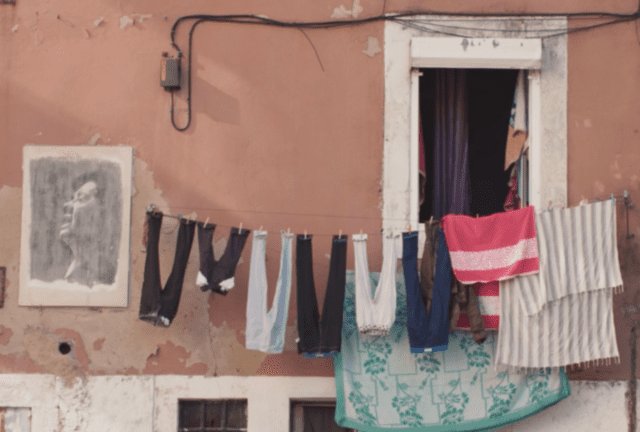
Ever since dream domiciles within Lisbon’s bairros have been let out to Airbnb tourists, neighbourhood cohesion has suffered. So when, in 2020, the pandemic put the brakes on tourism, considerable tracts of the Portuguese capital were turned into a ghost town. “That’s what this is, a film about ghosts,” explains the director to Business Doc Europe.
From the Neighbourhood is a film laced with melancholy as locals lament the passing of a golden age of community as exemplified by the fado, the marchas (festival processions) and the social and sporting clubs which were the hub of activity for adults and youth alike up to the end of the last millennium. “All we have now is old people,” says one of the locals, who has seen a steady stream of residents leave stage left as flocks of tourists enter stage right.
But the film’s remaining protagonists are a chipper lot, nevertheless, rarely speaking to camera or the filmmaker, instead gathering in groups of three or four to talk, laugh and reminisce about old times and characters, such as the Cat Killer who carried stones in his pockets, ready to smash a window or dispose of a passing feline.
And all of them can hold a tune, as they demonstrate when representatives from (not so) rival bairros come together to sing a fado in which each takes turn to riff on life, both past and present.
Director Silva isn’t from one of the bairros himself, but has known them intimately since he was a kid, even learning the various slang that differentiates one neighbourhood from another (an unrecognisable patois designed to bamboozle any stranger who finds him or herself in the vicinity.)
“I’ve been going there since I was very, very young and I’ve noted all these transformations, but more important than the transformation of the habits of the people was the huge effect that mass tourism was having in the neighbourhoods,” confirms Silva. “That was what got me to dive deeper into those issues. Why were the neighbourhoods changing and losing their habitats? It was mainly because of that.”
One can see the appeal of the bairros to tourists, with their Montmartre-like aspect, even down to the cobbled streets, elevated steps and steep climbs. Filmed during the first lockdown in 2020, the emptiness serves enforce the elegiac sense of times past.
The film also underlines the political role played by some of the social clubs (such as the 21st March Club, Boa Uniao Club, Adicense Club) in harbouring socialist radicals before the 1974 Carnation Revolution that overthrew the extreme right-wing regime. It also emphasises the left-wing bias of the fado but also the previous Fascists’ determination to appropriate it (and its popularity) for political gain, hence the post-Revolutionary intellectuals’ non-embrace of the musical form.
“The truth is that the regime used fado but you cannot say that fado belonged to the regime,” Silva insists. “It was a people song. And in the end, that’s what prevailed. Today it’s the most important song or the most important music that you have in Lisbon.”
The residents may bemoan the changes that they witness and experience (and a minority express racist sentiments about the hoods’ “loss of character because of cultures that have nothing to do with ours”) but Silva sees demographic change as part of a continuum that should be welcomed and embraced.
“Moraria is the most multi-cultural neighbourhood in Lisbon. They have like people from 70 countries living there,” he points out. “So I think it has to be what Lisbon always was, a melting pot of cultures. And I think that will be the secret for those neighbourhoods to survive, to continue to adapt and endure and to appropriate the ‘new’ that comes. It’s what always happened in Moraria and Alfama (another neighbourhood) since the Moors, and they were here a long time before us.”





