

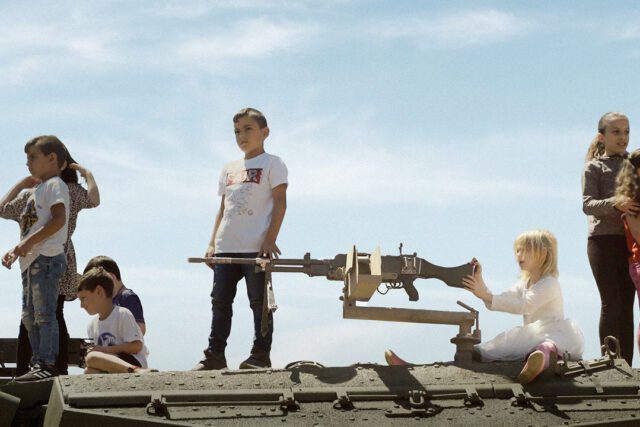
The old cliché has it that two things in life you can’t avoid are death and taxes. In Israel, you can add military service to the list. Oscar-nominated Guy Davidi’s new feature documentary Innocence, sold by Autlook and which has been screening in competition in Orizzonti, looks at the human toll this policy takes.
Regardless of your temperament, your state of mind or your political beliefs, you’re brought up in Israel to believe that becoming a soldier is your destiny.
“Maybe it is good to start with the personal,” Davidi (whose previous documentary Five Broken Cameras won awards all over the world) begins the interview. He is sitting in the beach bar of Venice’s most exclusive hotel, the Excelsior, reminiscing about how he, as an 18-year-old, enrolled in the military. He had a “lot of doubt, a lot of consideration whether I want to serve.” This was in the 1990s. His political awareness about issues like the occupation of Palestine was not deep but he knew intuitively that the “military was not something I want to take part in.”
“Even in spite of that, I did decide to enrol. It was not so much because of pressure but out of the lack of understanding of what else I could do when everything around me is aimed toward enrolment,” he adds. His family’s attitude, like that of most others, was that “you have to do military service, no matter what.” Nonetheless, Davidi was already “pretty rebellious” and used to taking his own decisions.
Where you’re 18 in Israel, there isn’t much else to do other than to put yourself in uniform. “For me, it was let’s give it a try.” He felt he could turn the experience into a positive. “I already wanted to be a filmmaker then. I had some experience. I had made a small fiction film when I was 17.” He hoped he might be put in a unit documenting the war rather than fighting it. He had lost his father and this lifted from him the obligation to become a combatant. “But the minute I enrolled, it was a huge shocking day…already I felt ‘what the fuck have I done to myself.’ I have put myself in the wrong place. This is crazy.” He knew instantly that he wasn’t cut out to be a soldier and that he would never sacrifice his identity and beliefs in order to fit as a cog in the Israeli military machine.
It took Davidi three months to wriggle out of the military. He was supposed to serve for three years but, eventually, he was discharged on psychological grounds. When he subsequently went to university in Tel Aviv to study film, he felt that “everybody’s eyes were looking at me” and that people were wondering why he wasn’t doing military service. “I felt that the film school was a continuation of military service in many ways.” He eventually dropped out, leaving Israel to live in France.
“I think that maybe the biggest reason I wanted to make this film is that I wanted to go back to that period when you are facing all that pressure to do your military service.”
Instead of telling the story of somebody like himself, who was able to “come out of it,” in Innocence he decided to chronicle the experiences of those who were destroyed.
The film took 10 years to make. The director talks of his determination to make a documentary that was “epic” in its span, covering early childhood and adolescence and “letting you experience as an audience what it means to grow up, rather than talk about [it].” There are no interviews. Davidi mixes different footage. He and his crew shot some of the material themselves. The director also drew on archive videos made by the families of some of the dead soldiers.
Davidi was responsible for the kindergarten scenes which share the magical, child’s eye view of the world caught in Nicolas Philibert’s classic 2002 documentary, Etre Et Avoir, set in a sleepy rural school. The difference here is the “sneaky way the military approaches to you from a very young age.” The tiny kids are already being indoctrinated and prepared for their military futures.
The director deliberately chose to film in a kindergarten near to the Gaza border. “They live a little bit more than usual the life of the conflict,” he says. The authorities knew what the film was about but still let Davidi in.
Innocence was researched over many years. Davidi discovered the stories of 700 families whose children had suffered in tragic fashion in the military. He met 50 or 60 of them. Out of these, he selected his main characters. It wasn’t always easy to get permission to use diaries, letters and film material. Sometimes, the families hadn’t read the material written by their loved ones before their deaths.
“Then I needed another layer which was to get an experience of the military itself. Israeli military didn’t collaborate with me easily. They didn’t want to be part of the film. They have been putting a lot of difficulties [in the way of the project],” the director recalls. He is a high profile figure with an Oscar nomination behind him but, even so, the military authorities were deeply suspicious. He suggests they only collaborate with filmmakers “serving their propaganda.” They demand control of the films on which they work.
However, the soldiers themselves often filmed their training. Davidi was able to draw on this footage. Many figures working within the Israeli film industry have done their military service.
“For me, what bothers me is people nowadays, filmmakers who are left wing, they are still sending their kids to the military,” the director cautions. “The cycle continues and that maybe is what Innocence is all about. It is a film that is made for parents worldwide – parents who are not aware how much social pressure is ruining young people…especially in Israel and in countries where there is military pressure.”
One of the main characters in the documentary is Halil Givati Rapp, a young man with the courage and intelligence to express openly his doubts about military service.
“Halil is a wonderful person, inspiring to me, someone I could never be at his age, a leader,” Davidi says in admiration. “I met his parents. They were the same, inspiring people…what broke my heart that even people like them failed to protect their child from that kind of pressure.”
The director now lives in Denmark with his Danish wife Maja Friis (co-editor of the documentary) and their young son. “I didn’t want to have children when I lived in Israel,” he acknowledges.
No, Danish society isn’t perfect but he is glad to be there. “I see it through my son…I am just so thankful he is there and that he is not in Israel,” he stresses.
Innocence was made through Medalia Productions, run by Hilla Medalia, and Danish Documentary in co-production with Real Lava, the new company founded by Sigrid Jonsson Dyekjær, Helsinki-based Making Movies. Icelandic outfit Sagafilm and Guy DVD Films.
“I knew I needed an Israeli producer. Previously, I’ve produced my own films in Israel but I wanted to have an Israeli producer because I need another face other than my own to deal with the Ministry of Education, the military and with all these people who are not going to want to deal with me,” the director says of his collaboration with Medalia.
The film was tough to finance. Its director believes that Israeli government is trying to suppress voices too critical of the authorities. “I don’t think Israel is an open, democratic place for financing film,” he says. Filmmakers themselves are being encouraged to “self-censor.” Innocence received a small amount of Israeli funding but Davidi believes financiers were suspicious not just about the politics of the film but its aesthetic approach. It was considered too poetic and intimate in its form for backers who were far used to a more conventional storytelling style.
In spite of his Sundance prize and Oscar nomination for Five Broken Cameras, Davidi thinks that “Americans have problems with my films…” He also worries that it will become harder and harder for him to make films in Israel.
Now, he is beginning work on a new project which will look at climate and environmental collapse. “It will be looking at how it is to be a parent in a world that is collapsing.” Don’t expect to see the new documentary any time soon. It took him a decade to complete Innocence and he envisages the new project will require just as much time and dedication. “It is not going to be ready in two, and not in three years…” he concludes.





