

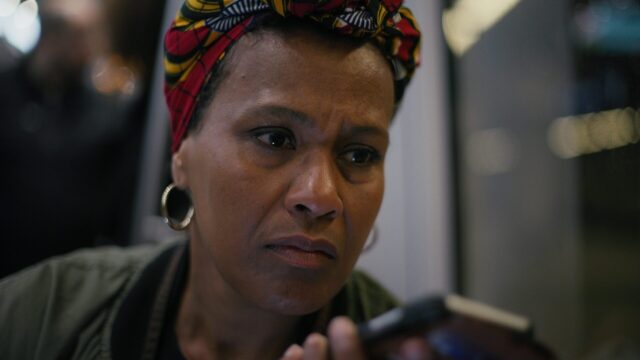
For some mothers caught up in the system, it’s a Kafkaesque nightmare. Their sons are placed on a crime prevention list drawn up by youth care personnel, police, data analysts and behavioural scientists. The moment this happens, the sons become viewed as criminals in waiting. They may be young teenagers who’ve never done anything seriously wrong but the stigma still sticks.
Some of these mothers are profiled in Nirit Peled’s new film, Mothers, a world premiere in IDFA’s Frontlight section. On screen, they’re portrayed by actresses but the words they use are taken from interviews which Peled conducted with real-life mums whose kids have landed on the lists.
“I started by having these long conversations, which was fabulous. That was the first thing that happened,” the director remembers her initial encounters with the mothers. She soon decided not to show the real characters. She had too many concerns about their safety and that of their sons, as did the mothers themselves. “I filmed with them in the beginning,” she explains. “The audio is real…everything you see is not real.”
In hindsight, Peled feels that the “limitations” placed on her enabled her to develop the documentary in a more creative way. “I like making films with one hand tied behind my back,” she jokes.
The actresses playing the mothers – and speaking their actual words – are shown as they go about their daily lives, on trains or in their cars or in their own homes.
Covid helped when it came to the casting. The actresses were sitting at home. Everything was closed. They reacted positively to the opportunity to “experiment” on the project. It helped too that they knew about the lists and felt as indignant about them as Peled herself.
The director had originally discovered the story on her own doorstep. She lives next to a noisy coffee shop in Amsterdam and sometimes finds customers sitting on her stairs to smoke. “I heard them talking about being on the list. Then I discovered there was not one list but several lists,” Peled remembers.
As Peled points out, these are “surveillance systems.” There is the danger of bias in the way the lists are put together. The authorities don’t seem to consider the plight of the mothers who are blamed for raising [supposedly] criminal sons. Nor were the mums and their kids properly informed why and how they ended up on the lists. The irony is that most of the boys had committed only the most minor misdemeanours, but were on the database next to hardened criminals.
There have been countless dramas and documentaries about kids getting into trouble but very few have been made from the point of view of their mothers. “Intuitively, I felt there was something very interesting and very filmic in looking through parental eyes at youth criminality,” the director suggests. “I am a mother also. It made it much closer to me.”
Peled is a writer as well as a filmmaker. She is known for using journalistic techniques in her films to dig deep into stories about systemic abuses of power.
In her film, the kids on the list are all boys. They come from a wide range of backgrounds. “I have not found, as a journalist, a way to identify race and gender on this list. It is kind of known it is mostly men and it is kind of known that it is a lot of people of colour, but I am afraid to say that because I like facts and I cannot prove it,” the director says.
Peled originally started developing the film with broadcaster VPRO. She later came together with production company Baldr who supported her in her ambition to give the film a cinematic sweep.
One dilemma now facing the filmmaker is whether or not to include the real mothers during the IDFA premiere of the film. She deliberately kept
their faces out of the documentary to protect them.
“I do hope they do come. I am looking for ways to make them safe,” Peled says. “They agreed to share their experiences in a very honest way…for me, it’s important that people watch this film with an open heart and that they listen.”
This article was published in See NL, a collaboration between Eye Film Museum and the Netherlands Film Fund.





