

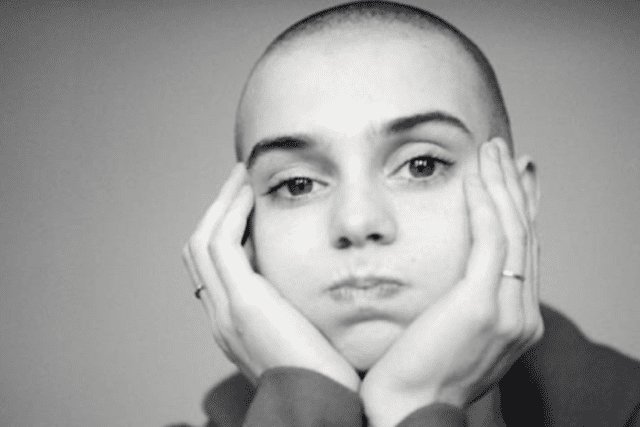
Northern Irish director Kathryn Ferguson’s feature documentary Nothing Compares has its subject, the brilliant Irish singer-songwriter Sinéad O’Connor, as its narrator. ‘Powerful’ and ‘heartrending’ are among the terms that reviewers have used to describe the film, which premiered at Sundance 2022. Since then, the film has screened at a plethora of international festivals, winning a slew of gongs in the process, most recently the BIFAs (British Independent Film Awards) for Best Feature Doc and Best Feature Doc Debut.
The archive-driven doc covers O’Connor’s difficult and traumatic childhood, her rise to fame as a pop star in the 1990s and the vicious backlash against her. Below, the director explains to Business Doc Europe how and why director Ferguson was drawn to the life and work of the mercurial artist.
BDE: When did you first become aware of Sinead O’Connor’s music?
Ferguson: I first became aware of Sinéad’s music through my father. I was still very young, only five in fact when her album ‘The Lion and The Cobra’ was released, but he was a huge fan and I remember many a rainy car journey driving around Northern Ireland in the late 80s with songs like ‘Troy’ and ‘Jackie’ providing the soundtrack. This was obviously very influential on me later as a teenager and at that point I became a bona fide fan of both her music and her as a person.
What did she mean to you when you were growing up?
A lot. I grew up in Belfast, Northern Ireland, during the 1980s and 90s. It was a very divided country to grow up in with the ongoing violent conflict in the North, and the Catholic Church still very influential in Southern Ireland. Women and their rights, particularly their reproductive rights, were very low down the pecking order. When Sinéad burst into my consciousness, it felt like a door had been kicked open. Here was a bold Irish woman who said the things others didn’t feel they could say and she said them loudly. Both she and her music were galvanising.
Which song or songs of hers mean the most to you? What led you to make the film?
‘Troy’ made a huge impression early on, it still does. Initially, of course I had not really understood fully what it was about, but the storytelling within the lyrics and the intensity alone firmly rooted it as one of the tracks that made the most impression on me. The accompanying music video by John Maybury also really influenced my own filmmaking when I first began creating music videos and short films many years later.
As a teenager, and by then a huge fan of her music, I was deeply saddened and confused by how she was treated for putting her head above the parapet, it felt very demoralising and something that has stuck with me my entire adult life. When I began making films in my twenties, my instinct was to focus on telling women’s stories and Sinéad was always at the forefront of my mind. It’s been a long and complex process to get to this stage. I’m still pinching myself that we’ve managed to make this film and that it’s currently being shared with festival audiences. I hope I’ve done her and this part of her powerful story justice.
Could you say something about the voice over?
It was extremely important to us that we had Sinéad tell the story in her own words. We did one interview conducted over a couple of days and used every last drop of it in the film.
Why do you feel the media was often so cruel to Sinéad?
I think some media outlets enjoy building people up very quickly and, when they don’t play ball, they tear them down just as quickly. We’ve seen it happen repeatedly over the years and are quite used to it now. What makes Sinéad’s experience quite exceptional is that she was one of the first superstars to essentially be cancelled and this was in an era without social media. She was outspoken and often talked loudly about subject matters that were unpalatable at that point in history, and it became easier to mock her and reduce her than actually take in what she was communicating. It’s a trope that has happened to many women over the years and still happens today. Hence why we felt an urgency in getting Sinéad’s story out there.
Was it sexism?
Sinéad definitely endured an element of sexism throughout her entire career. She pushed back on all forms of sexism and control at every opportunity and that made her less and less popular with the mainstream as time went on. Essentially, the overarching feeling was that she should just “shut up and sing” and the more she stood up and spoke out about subjects she felt needed attention the more she appeared to be ridiculed.
What does Sinéad mean to younger audiences in Ireland and abroad today?
She is finally being recognised for her huge contribution to music, culture and activism. Ireland as a country has seen tectonic shifts occur, particularly with regards to the relaxation of control the church held over the country, reproductive rights, LGBTQ+ rights etc, and Sinéad personifies the struggle that’s been going on in the country for years. What’s really blown my mind is the response at both Sundance and CPH:DOX. Many younger viewers have told me it’s left them feeling emboldened and more determined than ever to speak out for change. That’s certainly how she inspired me when I was young so it’s heartening to see that she still has that effect on the younger demographic today.
Could you say something about the archival research for the film. How straightforward was that?
It was an intensive deep dive that lasted years. We worked with a fantastic archive producer called Jo Stones who went the extra mile in finding unexpected sources of archive. It was essential to the visual tapestry we had aimed to create and made up 70% of the film itself, so really it was the rushes we had to play with. What made it complex is that, unlike normal rushes, ours kept arriving right up until we locked so there was a constant reshuffling in order to include them.
What about the poetic and abstract footage that runs alongside some of the voice over?
From the off I wanted the film to be completely immersive. As our archive only really existed from Sinéad’s arrival in London onwards, we had to work out a device to visually represent the earlier years. So I went about creating a visual style that echoed the aesthetics of the rest of the film to keep the viewer immersed in the storytelling. I wanted to create footage that blended in and even could pass as archive, but also subtly nodded to the iconic visual language used in John Maybury’s many music videos for Sinéad.
How easy is it for you as a filmmaker to balance your more personal projects with your commercial work for brands?
I have lived and breathed this film for the past four years, so there hasn’t been a balancing act as I gave it everything.





