

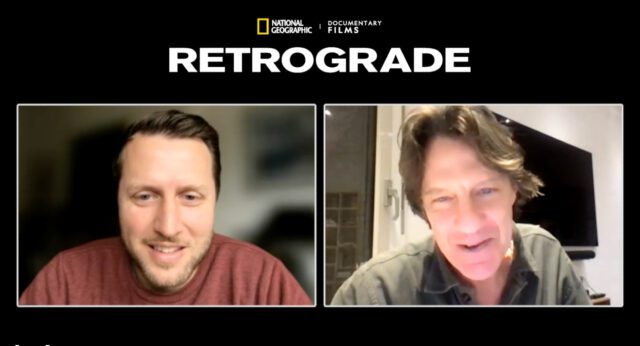
Oscar winner James Marsh (right, Man On Wire) talks to Matthew Heineman about the powerful documentary Retrograde which captures the final nine months of America’s 20-year war in Afghanistan from multiple perspectives: one of the last U.S. Special Forces units deployed there, a young Afghan general and his corps defending their homeland from the Taliban, and the civilians desperately attempting to flee as the country collapses.
At the beginning of their conversation Marsh complimented Heineman on his docmaking modus operandi. “I tend to make constructed films, and you tend to make – or have made – observational films when you’re in the thick of everything. And I think they’re much harder, to be honest. I tried those and, and wasn’t good at them. I don’t have the patience or maybe even the courage for them,” he observed, before asking what were Heineman’s objectives while embarking upon the project, and what was he looking to achieve?
“My dad has been asking me to sort of retire this quote, but it really holds true with every film I make. When I was 21 years old, I heard Al Maysles speak and he said that if you end up with the story you started with, then you’re not listening along the way. Which I think is good advice for life and it’s good advice for filmmaking. Don’t be dogmatic. Be open to the story changing. And certainly that was the case with Retrograde. It morphed and evolved and changed many times,” Heineman comments.
“The original intent of the film was to sort of do this holistic portrait of a deployment, both from the soldier’s perspective on the front lines and then their families back home,” he adds. “And, you know, it took a long time to gain the trust of the Green Beret community [who] worked hand in hand with my amazing producer Caitin McNally who had deep ties in that community as well. You know, they were quite reticent on letting us film. So it took several years to gain their trust, to get permissions. [Then] Covid happened, and by the time we actually deployed it was January, 2021 and it became clear that actually maybe we were documenting the last US deployment to Afghanistan, and through the prism of this deployment we can explore this final chapter of the longest war in US history.”
“Three months later, Biden pulls out our troops, and again we’re left with this question of what is the story we’re telling,” Heineman continues of the sudden change of events. “Because we had, you know, a first act, we had a beginning of a story, but by no means did we have a film. And so we reached back out to (Afghan) General Sami Sadat, who had been working hand in hand with the Green Berets. He was in charge of southern Afghanistan and [I] asked him could I come back and embed with you and shift the lens of the story. And so that is in fact what happened, obviously. And we went back and spent the remaining portion of the war documenting it through his eyes…”
Click here for the whole conversation between James Marsh and Matthew Heineman.





