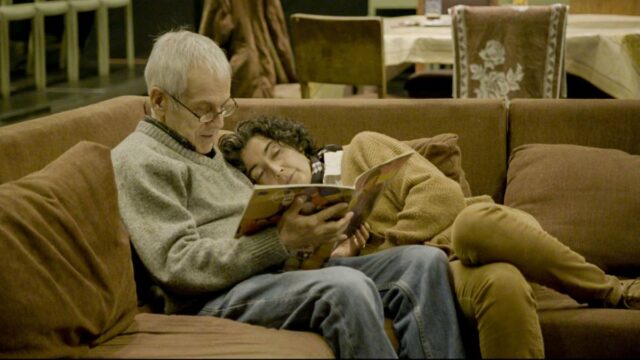
Chilean director Maite Alberdi’s The Eternal Memory (recent winner of World Cinema Documentary Grant Jury Prize at Sundance, and sold at the EFM by Dogwoof) is a companion piece of sorts to her previous feature, the Oscar-nominated The Mole Agent (2020). The new film is also an investigation of old age.
This time round, the subject isn’t an elderly man doing undercover detective work in a retirement home. It’s the marriage between Augusto Góngora, the brilliant journalist and author, and his wife, Paulina Urrutia (an actress and former Minister of Culture). They’re a devoted couple, still madly in love after over 20 years together, but Augusto has Alzheimer’s. His memory is fading.
At first, his condition seems to add a magical new element to their relationship. There is a sense of Groundhog Day as Augusto rediscovers his love for Paulina again and again.
This is a very intimate account of the couple’s relationship. Paulina herself shot much of it. Director Alberdi notes how, “I spent time trying to connect with them and to try to have intimacy but as both of them are working in a cinema and television a lot, they feel comfortable with the camera from the first moment.”
From the outset, the couple behaved as if the filmmakers weren’t there. “And the most intimate scenes of the film were scenes she shot, not scenes that I was shooting, all the night scenes…” Alberdi adds of Paulina’s involvement.
Footage filmed by Augusto himself before his Alzheimer’s took hold is also included.
Much of the documentary was made during the pandemic lockdown. Alberdi would give Paulina filmmaking tips over the phone. “We sent her an easy camera to use and she started shooting and sending me material all the time…my job during the pandemic was to see this material and speak with her.”
Alberdi remembers being entranced by Augusto and Paulina from the first moment she met them. They were warm, funny and welcoming. “They are all the time trying to live their love.”
Now, Augusto is bedridden and very ill but the tenderness between them remains.
“You can be living in super-painful situations but you can have a good day,” the filmmaker observes of the resilience her subjects show in very adverse circumstances, and the way they manage to seize moments of happiness even at the darkest moments. “You can have a bad day but you can have a good moment – and then, an hour after, you can feel terrible. And then something happens which makes you feel more comfortable.”
Movies, she continues, are in “different genres” but “life is mixed…you live a comedy and a tragedy at the same. Everything happens at the same time.”
Early on, Alberdi considered shooting The Eternal Memory as a dramatic movie. Paulina was reluctant to commit to the documentary and felt it might be too intrusive. However, in his own career as a broadcaster and writer, Augusto had looked very closely at other people’s lives and he felt it was only right he should now reveal his own world up to the camera. So many people had “opened the doors” to him that he now wanted to do the same.
The Eternal Memory is produced by Pablo Larrain, one of Chile’s top fiction filmmakers (whose credits include films like Spencer, No and Neruda).
“He [Larrain] got involved because I told the story to him at a moment when Paulina didn’t want to do it [the documentary]. We said OK, if she doesn’t want to do it, let’s make a fiction [version] of it because it is so powerful.”
Larrain’s company Fabula [which doesn’t generally do non-fiction] came on board because this was going to be a dramatic movie. In the end, it was made as a documentary – but Larrain remained part of the team.
Augusto’s most famous book, ‘Chile, The Forbidden Memory,’ explored the events and dark legacy of the Pinochet dictatorship. Alberdi originally intended to deal just with the personal side of the couple’s lives, not their careers or political involvement. She quickly realised, though, that everything was intertwined. At one stage, she was filming Augusto as he watching archive footage on TV.
“Augusto said ‘my friend was killed’ and he remembered the name, and how he was killed.’” Suddenly, in spite of the Alzheimer’s, memories of painful historical issues came flooding back. “I saw him forgetting numbers, forgetting dates, forgetting names but not forgetting what the [political] pain was,” Alberdi recalls.
“And you have to understand why they love each other. You love people for what they are but also for they were and what they do. As a filmmaker, my work is my identity too. She [Paulina] fell in love with him [Augusto] because of what he did in his job…their careers were not disconnected from their relationship.”
Augusto would talk about his work “shooting an invisible country” and chronicling the “fragility and pain” endured in Chile during the Pinochet years. Those memories never faded. Nor did his “pain” over Paulina’s decision that they should not have kids together (although he does have children from a previous relationship). “It was a big issue in their love and he remembered that. There are some things that remain in the body,” Alberdi says of emotions so deep-rooted in Augusto that they defy his fading memory.
Now, Alberdi is looking to make her first non-Chilean film. She won’t reveal precise details but does confirm that the next documentary project will be shot in English.