

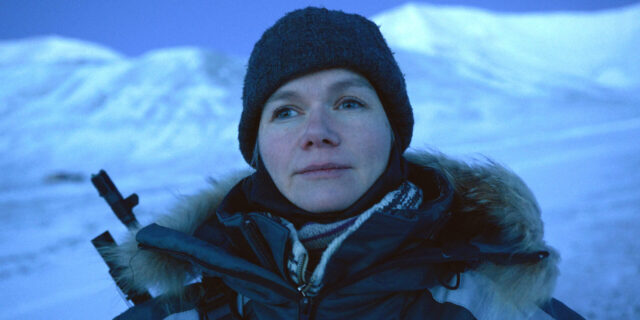
It could be a place out of some sci-fi movie, or from one of those Scandinavian noir stories in which macabre events happen after dark. The settlement of Longyearbyen in Norwegian-owned Svalbard, close to the North Pole and deep in the Arctic, has a population of over 2400 drawn from 22 different countries. It used to be a mining town but other industries have now grown up. There is a university. Scientists, students and tourists all flock here. So does the occasional filmmaker.
Czech director Veronika Lišková made seven visits to Longyearbyen over a period of around two years. She was coming there to film the work of social scientist, Zdenka Sokolícková, who was studying the local community, exploring the impact of climate change on the local people. (This is one of the fastest warming places on earth). Sokolícková also uncovered surprising amounts of social anxiety and tension. Some of the Norwegians living here feel their identity is being eroded as the town changes. The Visitors (screening in the Hot Docs Changing Face of Europe programme and sold by Taskovski Films) lifts the lid on the place.
“I also studied social anthropology before going to film academy,” Lišková explains why she was so drawn to this story. As a student, she knew Zdenka. They had friends in common and stayed in touch over the years. “One day I received an email from her and she was asking me if I could recommend to her and her husband some kind of camera they could buy for their trip to Svalbard.” Zdenka had just received a grant to go and live and work in Svalbard for two years. She was about to move there with her family (including her three young kids) and wanted to record the experience for her family archive.
Lišková started to “Google a bit” and became intrigued by what she discovered about this far flung community. The town of Longyearbyen looked to her like “a moon colony.” She asked Zdenka is she and her husband would allow her to come along for the ride and make a documentary about their Arctic experience.
What did the director herself make of life in Longyearbyen? She talks of her initial awe at the landscape and how tiny she felt standing within it. “My first experience of this place was really physical. It is a very special feeling…you are surrounded by those beautiful mountains. You see a different spectrum of light you don’t seen anywhere else.”
As she spent more time in Longyearbyen, Lišková began to pay more attention to the human factor – and why some of the residents were feeling so insecure. This is a transient community. People come and go. Your close friends may suddenly leave the town – and then you can feel very isolated. People who want to live here, in such an isolated community, are also often trying to escape something in their past life.
Reflecting the many different nationalities of the inhabitants, the film is shot in different languages – in Czech (Zdenka’s mother tongue), in English (the most commonly used language) and in Norwegian. Zdenka is a brilliant linguist. Within three months of arriving, she had taught herself to be fluent in Norwegian. However, Lišková wasn’t so comfortable in that language. It was therefore decided that Zdenka’s interviews with her subjects would be done in English.
At first, Lišková felt Longyearbyen was a warm and welcoming community. The people were used to international visitors and attentive to their needs. It was easy to make friends. “But when you start digging deeper and asking what does it really mean to live there and what obstacles you meet when you start to settle down there, it is a different kind of story.”
In the documentary, the director had to balance some very different elements. The place itself has a transcendent beauty but there is bitterness and ugliness here as well.
“From the very beginning, I knew I wanted to tell a rather an intimate story seen from the perspective of Zdenka. I wanted to combine both her private and professional experience. But I couldn’t know at the time how the story would develop.”
Lightness and humour is provided by Zdenka’s very endearing young children as they adjust to life in the frozen north. They’re sometimes very rash. For example, they might lick the ice – and the discover to their dismay that their tongue has become stuck.
“I think it’s important to allow the audience to take a breath when they are watching something quite complex. You have a lot of subtleties in this film,” the director explains why it was important to cut away from time to time from Zdenska’s research to show the children getting up to mischief.
The film premiered in Locarno last summer. It has now also been shown in Longyearbyen. “It was really an emotional experience,” Lišková says of showing it there. “I think people very much appreciated the fact that someone tried to touch their story from the individual perspective, from the point of view of how they felt.” Her documentary was focusing on elements of their lives to which no-one had paid attention before. The screening was packed and there was a long discussion afterwards. The director hopes now the film eventually provoke a similar debate in Norway.
The Visitors is now in Czech cinemas. The director, meanwhile, is at work on her next project – which this time is a fiction film, Year Of The Widow, also being made through Czech production outfit Cinemotif Films. It’s a psychological thriller – and so, perhaps, not so far different from The Visitors after all.





