

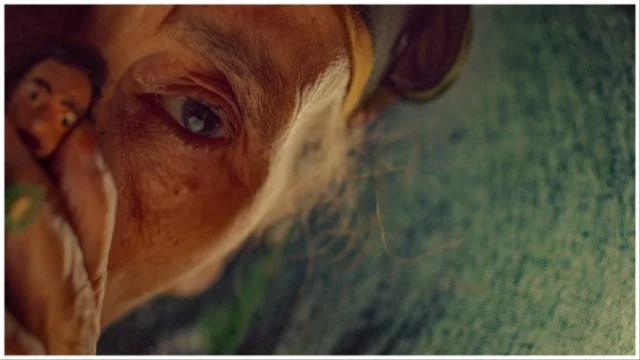
In The Mother Of All Lies, selected for Un Certain Regard and sold by Autlook, young Moroccan filmmaker Asmae El Moudir rebuilds the Morocco of her childhood using hand crafted models as she tries to unravel long concealed family secrets. She discovers small lies when she asks why the family has only one picture of her as a child. This leads her to disturbing revelations about the entire society.
The film shows her father painstakingly building the miniature version of the neighbourhood, painting the house numbers, checking the lights and creating an astonishingly detailed facsimile of the real place. It took eight months to complete the model town. Other technicians also helped with this construction.
“In this film, there are a lot of missing things. I have no archive for this story. I have no pictures,” El Moudir explains why she and her father went to such lengths to recreate their old home.
“Everyone knows about The Missing Picture by Rithy Panh but it is not the same thing,” El Moudir distinguishes her film from Panh’s classic documentary which used clay figurines to depict the experiences of his family during the Khmer Rouge genocide. In The Mother Of All Lies, the miniature models are just part of the film. The director’s close relatives also feature prominently, in particular her formidable grandmother. She was the one who “forbade pictures in the house.”
“I can understand why she was hard with us but I cannot hate her. Also, the people watching this film will not hate her,” El Moudir says of the very stern matriarch of the family who, at one stage, gets so angry with a picture of her done on glass by one of the director’s artist friends that she smashed it to smithereens.
The lack of archive in the documentary isn’t just because the protagonists want to suppress painful memories. During El Moudir’s childhood, there were no cellphones and it was almost impossible to have your photo taken unless you went to a special camera studio. Here, the photographers would ask subjects to pose against incongruously exotic backgrounds of far-away places, such as Hawaii.
A key event referred to in the film is the bread riots of the early 1980s when police fired into the crowd, killing protesters. The director searched hard for images of these tragic events. “I was looking for a long time for pictures in France especially, in the Pompidou Centre.” She read old articles in newspaper Le Monde which referred to the riots. Eventually, back home in Morocco, she found one of the only images of the riots that still survives. It’s a chilling picture showing bodies and abandoned bicycles on the streets.
El Mourdir also discovered that not far from her house there was a cemetery where some of the victims of those riots were buried. It used to be a football field. This was where her father, a top goalkeeper, used to play.
There is a distressing moment in the film in which one of her relatives peers uncomfortably at the recreation in model form of the prison cell where he was locked up in suffocating conditions with many other prisoners. He becomes very emotional as he re-lives his nightmarish experiences.
“It was really hard for me as a filmmaker. I didn’t say any words,” El Moudir makes it clear that the relative’s reactions were spontaneous. This was the very first sequence she edited. She knew that if she didn’t deal with it immediately, she would become too upset to cut the scene properly and would end up dropping it from the movie. She is claustrophobic herself and therefore has an understanding of the agonies her relative endured.
“There is a lot of pain here but there is a lot of laughing also in the film. We can laugh, we can cry, we can have every emotion in this film. For me, cinema is emotion,” she emphasises.
The Moroccan filmmaker can’t hide her pride in The Mother Of All Lies being selected for Un Certain Regard at Cannes 2023.
“I am looking forward to be film being in Cannes…it is a very special thing. It is not easy to get there as a Moroccan filmmaker, an emerging filmmaker. It’s a big thing for me. In the Maghreb, we know one big festival – and that is Cannes,” the director declares.
“Cannes for me will bring this story into the world. All directors dream of Cannes. I am looking forward to discuss this film with professionals and with press and to see if the audience will understand it or not. This is what is really important to me,” she says of a project which has taken her many years to complete.
The director hopes her film will enable Moroccan audiences to talk about their past – and to become “reconciled” with it. She hopes it will now be selected for the Marrakech Festival which she sees as a perfect platform for it.
“I grew up with this project. I did a lot of writing residences for it,” the director lists the many workshops and summer schools she attended. She received backing from such organisation as Doha Film Institute, IDFA Bertha Fund, The Netflix Creative Equity Fund and Final Cut in Venice. CNC, Île de France, The Red Sea Festival, Hot Docs and Al Jazeera have been among her many other supporters.
Without the support, El Moudir would not have been able to complete the film. ”I have no money from Morocco.” She produced The Mother Of All Lies through Insightfilms, the company she formed in 2015. That allowed her to take the time she needed.
In her next film, El Moudir will “tell my story in the 1990s, when I was 12 years old.” She won’t share many details about the project but it is likely to be just as personal as The Mother Of All Lies. “It’s my voice-over. I edited it. I produced it,” the director concludes of her involvement in every aspect of her Cannes 2023 contender.
Asmae El Moudir will discuss her film together with DAE’s Marion Schmidt during a Cannes Docs Talk on Monday 22 May at 14.30 at the Palais Stage (Palais 1).





