

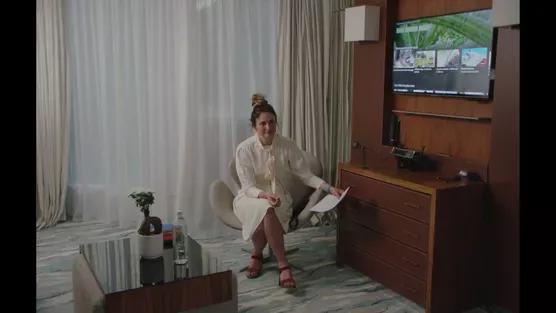
A man walks into a hotel room, looks around shiftily, pulls on a new shirt and a pair of shades, turns up his collar and suddenly breaks into a dance. A woman sits staring at the camera lens and talks passionately about the now daunting expense of cinema – the parking, the tickets, the popcorn. “It’s a pastime of the rich,” she suggests. An old auteur in his tuxedo reflects on the “lethal” impact of the digital revolution on cinema.
These are just some of the filmmakers that Lubna Playoust has corralled together for her new documentary, Room 999, produced by MK2 and screening in Cannes Classics. The film picks up where Wim Wenders left off with his 1983 film Room 666, in which he invited 16 of his fellow directors to speak about the future of cinema. Playoust is asking her 30 subjects, who include Wenders, David Cronenberg, Audrey Diwan, Joachim Trier, Shannon Murphy, James Gray, Arnaud Desplechin, Lynne Ramsay and Ruben Östlund among many others, the same question: is cinema a dying art form?
It’s often said that getting filmmakers together is a little like herding cats – a futile and frustrating endeavour. Playoust proves the opposite as she elicits all kinds of different but always impassioned and insightful responses from the various auteurs left alone in the hotel room with the camera trained on them. Playoust has assembled a far more diverse group than Wenders (who had very few female directors in his doc).
“I couldn’t really remember when and how I bumped into this film,” Playoust says of the Wenders original which, in recent years, has become hard to find. It’s one of those movies more likely to turn up as a bonus item on a DVD than to be released in its own right. “What I can remember is that has always been a film I was coming back to regularly, that is something like a little mantra that I wanted to hear again or see again. The way that it was directed, the fact that the directors are alone in a room, facing the camera all by themselves, the combination of elements, was creating something particular…for me it was like having a coffee with these directors alone. It creates an intimacy.”
Playoust shot her documentary in Cannes last year, the 75th edition of the festival. “I was really curious about what would happen if I do it again,” she says about repeating the Wenders experiment. It was a timely moment for such a project. In the wake of the pandemic with the rise of the streamers, many within the industry were talking darkly about the “end of cinema.”
The festival was happy to help with the production. The director also wrote Wenders a letter, explaining the project to him. “Having his approval was really important for me.”
Neither Wenders nor Cannes put any pressure on Playoust about how she should approach the documentary. She filmed the directors in a room in the Marriott Hotel. (The Wenders doc had been shot in the Martinez Hotel). She didn’t want to make a carbon copy of Room 666 and so wasn’t worried about being in a different location.
What were the biggest technical and psychological challenges? Playoust admits that she was uncertain whether all the filmmakers would agree to participate in the documentary. “It was stressing but it was really exciting.” She met Kirill Serebrennikov at a lunch and pitched him there. She bumped into Nadav Lapid at a cocktail party. “I’m kind of shy but because of the movie, it was clear for me that I had to go to see the people and explain [the project] to them.” She didn’t want to be too pretentious about her plans but emphasised to the filmmaker subjects that she wanted them to respond “really honestly” to her question about the future of the medium.
Some of the directors didn’t “feel good’ about being left alone in a room in front of the lens. “I discovered how powerful the camera is,” Playoust notes. Alice Rohrwacher made a telling observation, saying to Playoust that when something is as powerful and potentially dangerous as the camera, you are better advised to go behind it rather than in front of it.
It was important for Playoust to make sure that her filmmaker subjects didn’t feel as if she was directing them. She wanted them to feel free to express themselves in whatever way they saw fit.
“Everybody reacts really differently because they have their own relationship to this empty space and facing this camera…they don’t really know what is going to happen. Some of them are overwhelmed by that. Some others play with it.”
Playoust didn’t watch the footage during shooting. She wanted to keep at a safe distance from it until it was time to cut it together. When Serebrennikov left the room after his section was shot, he apologised to her. She couldn’t understand why. “I thought maybe he had broken the camera. I was really intrigued by what had happened.” The Russian, it turned out, had taken a very offbeat and physical approach to his interview, one that was provocative and funny. “I am really grateful he did that…in a way.”
Others were far more earnest.
Does making Room 999 leave Playoust optimistic about the future of the celluloid muse or is cinema now in its death throes? She responds that she doesn’t want to be “binary.” It is far too simplistic to be either positive or negative about such a complex question.
“People were talking about very different aspects: about film history, about storytelling, about the relation to [cinema] theatres,” she says of the multiple responses. “It’s almost like being in the middle of a big conversation.”
Like Room 666, Room 999 is bound to be become the cinematic equivalent of a time capsule. In future years, historians and critics will look at it as a barometer to measure how cinema was regarded as an art form by some of its most accomplished practitioners at a specific time.
“I was really surprised by how the directors are exactly [like] their films. Socially, it was a very interesting thing to see, what the person gives you in front of the camera and what she gives you when she is doing films. It was really moving in a way,” Playoust reflects on her subjects. Some are in celebratory mood. Some strike a pessimistic note. “But everyone gave me something really precious…”





