

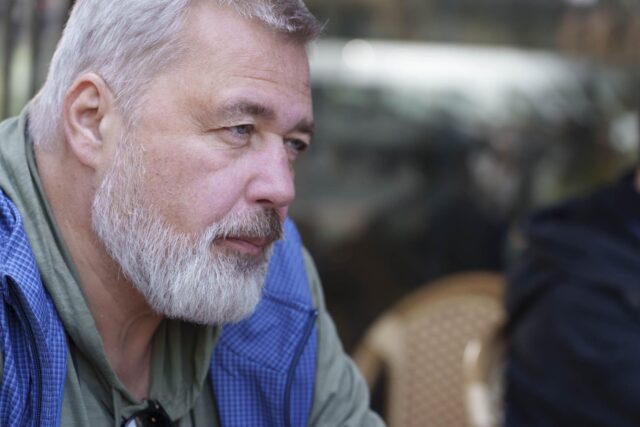
“I had been making a series about the National Trust in England and got tired of being lied to, and I thought I would go and make a series in Russia about the oligarchs,” filmmaker Patrick Forbes remembers the unlikely sequence of events more than two decades ago which led to his first meeting with Novaya Gazeta editor Dmitry Muratov for the first time.
Forbes arrived in Russia expecting to find “football, blondes and billions.” Instead, he stumbled into a power struggle for control of the country between oil magnate Mikhail Khodorkovsky, business tycoon Boris Berezovsky, Moscow mayor Yuri Luzhkov and a certain Vladimir Putin.
“There I was in the midst of this extraordinary fight and I bumped into Dmitry who was a friend of my Russian producer,” Forbes recalls. “We then spent a long whisky-fuelled evening. He dissected the power politics of Moscow with an honesty and a rigour that was completely absent elsewhere. That is how the friendship started.”
Forbes has stayed in touch with Muratov ever since, regularly visiting him in his newspaper’s offices. “You can normally hear him before you see him. He has this thunderous tread. Then you’re suddenly enfolded in a bear hug.”
“Patrick, we must drink,” would be Muratov’s customary greeting to his British guest. Forbes would “feebly” reply, “but t’s 10 o’clock” before they both cracked into the whisky.
Now, Forbes has made a Channel 4-backed documentary about Muratov, The Price Of Truth, a world premiere in International Competition at Sheffield DocFest.
One hook for the project was the 2021 Nobel Peace Prize awarded to Muratov in acknowledgement of the crusading, independent journalism he has overseen at Novaya Gazeta. However, the Russian invasion of Ukraine has lent the film an added urgency. Muratov has been forced to suspend publication of his newspaper and he has auctioned off his Nobel Prize to raise money for Ukrainian refugees.
The documentary includes footage of an attack on Muratov on a train, apparently orchestrated by the secret service, in which he had paint thrown in his face. His eyes were badly damaged by the acetone in the paint. Over the years, many of his colleagues at the newspaper have been murdered, including the brilliant reporter Anna Politkovskaya. Their photos hang on the office walls, reminders both of their courage and of their grim endings. Nonetheless, the ebullient journalist has remained in Russia and has refused to be cowed by the threats against him. As he says in the film, he’s “not ready to be a Western agent…I want to remain a Russian journalist.”
Do his status and celebrity protect him from assassination? “The honest answer is I don’t know, and I am not sure hedoes because Russia is such an unpredictable place day to day, moment to moment,” the director answers. “You would be a very foolish person to say he’s safe because he is a Nobel laureate.”
Forbes regards Muratov as the polar opposite of Putin. Whereas the President stands for state control, the journalist stands for the rights of the individual. Whereas the President stands for coercion, the journalist stands for freedom of speech. Unlike imprisoned opposition leader Alexei Navalny, Muratov doesn’t seek to run Russia. He’s not a politician. This may be another reason why he remains free.
Muratov’s charisma remains intact. “He’s an extraordinarily resilient, charming, funny, black humour man,” Forbes says of his friend. “He can tell a joke as well as the next woman and man…I think that resilience comes from knowing who he is and what he stands for. He knows exactly what he is doing and who his allies are.”
The newspaper editor also has a surprisingly wide frame of reference. Describing Navalny’s imprisonment, he compares his plight to that of a character in a JK Rowling Harry Potter novel being preyed on by a ‘Dementor.’ Forbes talks of his voracious appetite for literature.
Politicians clearly respect the journalist. Muratov was very close to the former President Mikhail Gorbachev (who died last summer). The two men used to meet regularly.
Forbes acknowledges that he has faced “nightmarish” logistical challenges in making the new documentary. He was desperate not to risk the safety of Muratov or that of his team. At the same time, he needed to keep his own crew safe.
“There are some very brave people within Russia without whom this film would not have been made,” the director notes. “There was no shoot which didn’t take place without a 50-page high security protocol being sorted out between us and Channel 4. Nobody was taking this lightly. It was something that, at every stage, we went through minutely because the risks on either side were horrendous.”
Channel 4 is expected to broadcast the film later this year. It’s possible that a theatrical release will take place before then. Forbes hopes The Price Of Truth will show viewers that the notion that “all Russians are bad is nonsense. There are millions of ordinary Russians who did not sign up for this [war in Ukraine] and are not backing Putin.”
On the other hand, the director acknowledges the film is “a picture of a society sliding helplessly and relentlessly into autocracy as a result of one man’s disastrous decision. It’s such a tragedy for a brilliant country full of remarkable people.”
Forbes’ sons recently taught in Russia and were startled by the pro-Putin propaganda pumped out even to youngsters. Nonetheless, the President is in a vulnerable situation. Forbes talks of “the absolute loneliness of power…up there you trust absolutely no-one.” He also warns of the danger when leaders begin to regard themselves as demi-gods.
In the film, Muratov reflects on how Putin’s isolation intensified yet further during the pandemic. Forbes believes the president’s paranoia was fuelled yet further by terrible counsel from his advisers. “He just rolled the dice one too many times…Ukraine is the one time where he just went too far. I think Covid is responsible for a lot of that.”





