Christopher Morris lives just a few miles from Land’s End in Cornwall. He moved to the area from Wales in 2015 to run the film school at Falmouth University. One day not long after he arrived, he went out for an early morning walk. Morris was looking for the coastal path but somehow became hopelessly lost.
“I found myself in a field with a standing stone,” Morris recalls the unlikely course of events which eventually led to him making his feature documentary A Year In A Field (a world premiere at Sheffield Doc Fest on 16 June and which will be released in UK cinemas by Anti-Worlds on September 22).
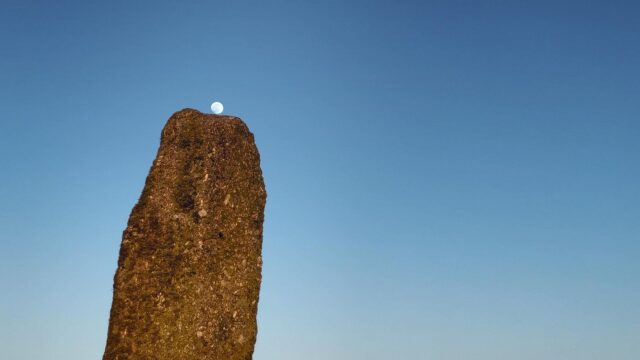
“I can’t describe why but there is something about that field, something about the position of the stone in relation to the sea and the surrounding landscape,” the director observes of the uncanny power of the place.
Cornwall is full of ancient sites with standing stones which tourists flock to visit. For some reason, the field that Morris discovered is rarely on their itinerary. He had it almost to himself. “It is virtually unvisited,” he confides. At first, he posted images of the field and its Longstone, the 4000-year-old standing stone – on his Instagram account. Then, during the Covid period, from the winter solstice of 2020 to the same moment the following year, he began to film.
The field belongs to Roger Jenkin, a local farmer whom Morris credits on the film as “guardian” because he tends it so carefully.
There’s a lot of scientific information and arcane wisdom within the documentary. Watching it, you will be given insights into everything from barley growing to how the lichen stuck to the rock has survived for centuries. Morris also reflects on the symbolic significance of the planets Jupiter and Saturn aligning in the night-time sky.
The director insists he is no expert in any of these matters – but simply curious about all of them. “I’ve always been interested in ancient monuments but it is not like I know a lot about them. Certainly in terms of science, I am a GCSE student…but I do read the New Scientist every week,” he volunteers. Whenever there were gaps in his own knowledge, he would call on local experts for advice.
There is no direct reference in the doc to climate crisis but this is still one of the key themes of the film.
When it came to photographing the field, Morris set himself a few simple formal rules. He would shoot in a square format for Instagram and made sure always to have the stone in shot. He ended taking “hundreds and hundreds” of images but no two were ever the same. The changing seasons and shifts in weather patterns ensured he was always depicting something new.
By the time Morris began work on the film, he was “back to teaching part-time” but because of the pandemic, everything was being done online. That meant he now had plenty of time to spend in the field. He calculates that he spent 280 days there.
How much material does he have? Morris laughs ruefully at the question. “A lot…I shot some time-lapse so that took hours of film. Toward the end of November, I would be there for six hours at a time!”
Snickers bars, Jacob’s cheddar packets and underwear packaging featuring a female model all blew into the field over the months that Morris was filming.
“There were all sorts of things that didn’t make it in [to the film]. For example, at one point a banana skin…I nearly got that in. I did some research and thought, oh my god, that has come from a field in Costa Rica over to us. But I didn’t put that in in the end,” Morris says.
The female model has tattoo on her arm saying “today I am grateful” in Italian. The director uses this as a slogan to express joy at the coming of spring.
The documentary was shot in deliberately low-tech fashion. “I had a tripod but my tripod was pretty ropey and it was impossible to do panning and tilting shots with it. It meant I couldn’t move the camera. That dictated the aesthetic within the film – which is that there are no moving shots at all,” the director explains a rule that was only broken once when he accidentally nudged the camera as “a bunch of starlings flew over.” He got “down into the grass” in order to show the landscape from an angle you don’t normally get when you are walking through a field.
It was a “very ordinary” field but if he looked closely, he could always spot something magical. “Everybody has got a park. Everybody has got a balcony or a window box or a plant pot…within everything there are incredible wonders,” he says.
Morris also draws a sharp distinction between his home-made documentary and the high-tech natural history films made by streamers and big broadcasters and which, to him, often seem like science fiction.
“There is something about being in a field and finding the ordinary wonders,” the director enthuses of such simple pleasures as noticing the alignment of the stars or speculating as to why, all those years ago, somebody decided to put up a stone monument.
The film wasn’t entirely solitary work. Early on, Morris had his ageing dog Ted as his companion – and gives him a credit. “But in the end he couldn’t get over the stiles to get into the fields and so for the last eight months I was on my own. The solitary experience of being there was also part of the process. Usually when I am making a film, I am surrounded by a crew and there is interaction all the time with other humans. [On this] there was no interaction.” He was making the film “almost for myself…I am thrilled that it is getting the attention it is because it is a very quiet, little film – the most personal film that I have ever made.”
A Year In A Field was produced by Bosena Films in partnership with Stone Club and Falmouth University’s Sound/Image Cinema Lab.To his pleasure and amusement, the director is now up for a Best First Feature award. “That’s a real honour, especially when I am 60!”