

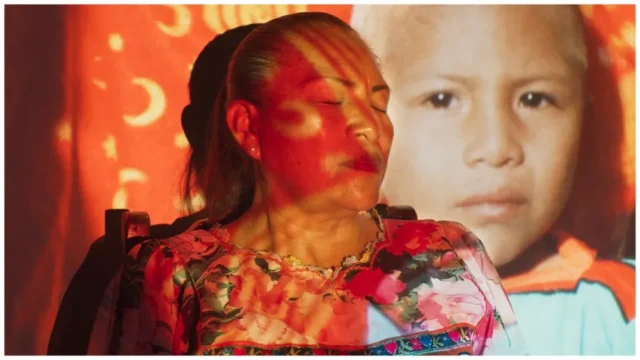
Almost 50 years ago, the Oscar-winning French filmmaker Pierre-Dominique Gaisseau turned up at the San Blas islands off Panama’s coast intending to make a film about the Kuna community there. The Kunas are a matrilineal society in which women are revered. His documentary was never properly distributed. He ran out of money and the print was taken away from him.
By chance, Swiss-Panamanian director Andrés Peyrot met Orgun Wagua, a filmmaker from the Kuna community, at a film festival in 2010. “After that, we became friends and he invited me to stay a few days with his family,” Peyrot remembers the event that eventually led to his own documentary God Created Woman (a Special event opening film in Venice’s Critics Week).
On his visit to the Kuna community, the director mentioned to his hosts that he would love to make a film about their world. “You’re not the first one who has wanted to do that,” they told him. That was how he found out about Gaisseau’s visit 50 years ago – a visit that had “ended very badly.”
The local people still let badly let down by the French filmmaker. “I asked different people about it [Gaisseau’s film] and everybody had different anecdotes that were sometimes a bit contradictory, but everyone had their own ideas, memories and speculations about what happened with this film,” the director says.
During that first trip, Peyrot didn’t even know Gaisseau’s name. Everyone remembered him as ‘Mr Akiko’ (which was the name of his daughter). “It took me some time to do some research and finally discover this filmmaker. What was intriguing to me was that he was completely unknown. When I mentioned him to my most cinephile friends, they had no idea who he was…it seemed he was a bit forgotten somehow.”
This is a paradox. Gaisseau won an Oscar for his 1962 documentary Sky Above And Mud Beneath which screened in Cannes – and yet his reputation has withered in the intervening years. Peyrot believes that his work “belongs to another era and certainly has lost relevance in today’s world. His movies definitely seemed to have an outdated colonialist outlook on the indigenous people that he portrayed.”
Although they felt betrayed at never being shown his film, there were others in the Kuna community still had fond memories of the French filmmaker and regarded him as a friend. He had maintained good relations with Arysteides Turpana, a Kuna elder and poet whose quest to find the old documentary is chronicled in God Is A Woman. Gaisseau had invited Turkana to look at the editing of the film in New York and had stayed in touch with him.
“There was this dichotomy between the films that he [Gaisseau] made and which made him seem somewhat distant and colonialist in their subject matter, and then the stories I heard about him…” the director reflects on the contrast between the French director’s work and his personality.
There is an extraordinary moment in God Is A Woman when Gaisseau’s footage is discovered in an archive in Paris. It has been kept for years in rusty old cans and is mouldering and vinegary. Nonetheless, it is painstakingly restored. “The people at the CNC were surprised at how well it had kept. I think they would have expected it to be in worse shape,” Peyrot says.
Ownership and copyright issues still needed to be ironed out. A bank had confiscated the film after Gaisseau got into financial difficulty. The bank had remained the owner of the film for 40 years, but then closed. The filmmakers followed a paper trail of letters which showed how the bank donated the film to the Ministry of Culture and renounced its copyright. Gaisseau had died in 1997. His daughter Akiko was involved in the new film early on and gave the project her blessing. (She died last year).
A screening was eventually organised in the community. This was filmed and became a key part of the documentary. It was an extraordinarily emotional occasion, a chance for the community to “re-connect…with family members, grandparents, people who have passed away, so many people who are now gone.”
The director says he still gets goose bumps thinking about it. “For them, it had been 50 years [waiting]. For me with them, it had been over 10 years.”
As a New York educated filmmaker based in Paris, Peyrot was aware that he came from the same privileged world as Gaisseau. “Of course, it was a worry but it was also a movie which took ten years to make. It was a long process,” he says. “I knew that I had an external baggage that was impossible to remove [but] the exercise was as much as possible to try to turn myself into a vehicle for them [the Kuna people] to express their point of view.” It became a point of principle for him not to have anything in the film that the Kuna people “didn’t want to say…my main goal was to tell the story as truthfully as possible.”
The Paris-based Peyrot was the producer as well as the director. He financed the film in the “classic” way, going to French national body the CNC and soliciting funds to develop the idea. The long gestation meant that he was able to “keep” Turkana in the film although the Kuna elder died before it was completed. Peyrot had met and filmed him during early scouting trips.
“The first people really to believe in the film was actually Pyramide. They came on board really early on, five years ago,” the filmmaker says of the leading French production, distribution and sales outfit. He established his own company, Industrie Films, for the making of the movie. Later partners to join the project include Upside Films and PS Productions.
Peyrot has had a long and successful career as a cinematographer and editor working with directors from Jonathan Caouette to Pierre-Paul Puljiz. However, he decided not to shoot or cut God Is A Woman himself. “I was really excited about collaboration…and also it would have been a bit much,” he said of the work it would have entailed had he taken on yet more tasks beyond directing and producing. He wanted to “interact” as closely as possible with his protagonists “and to worry less about the technical aspects of the film.
”And, yes, Peyrot will be organising a screening of his film for the Kuna community. This is set for December. There is bound to be a sense of Chinese boxes about such an occasion. He’ll be showing the locals a film about themselves which features them watching another film about themselves. “I will bring the film back to the community and project it in the same way as was done with Gaisseau’s film – and that will be just such an exciting moment as well, to add an extra layer of memory and emotion.”





