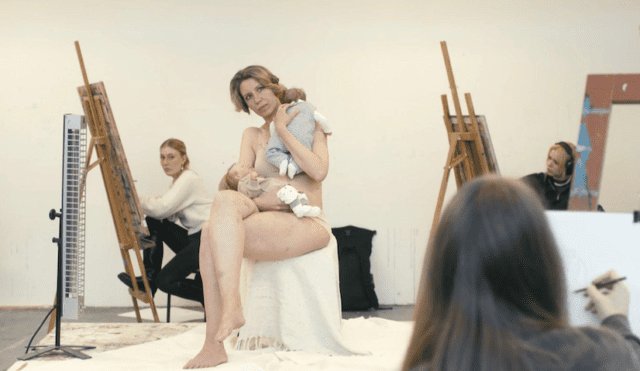
German director Katharina Pethke’s first full-length documentary feature Reproduction (which premiered a few days ago in the Berlinale Forum) asks probing questions about career, motherhood and feminism.
The film (sold by Pluto Film) touches on art, architecture and family history. It also has a strong autobiographical strand. In 2012, Pethke became a professor at Hamburg’s University of Fine Arts, teaching an ‘introduction to filmmaking course.’ Her mother and grandmother had studied there. They had expected that their academic accomplishments would open up new opportunities for them but that’s not what happened. Motherhood and domestic responsibilities got in the way of their careers.
“I have to admit it’s quite a lot,” the director acknowledges of the many different elements packed into the documentary. “I found myself entangled in different aspects of this life that I was living at the time when I was a professor, looking back at generations of mothers and families, and becoming a mother myself.”
The director was very conscious of what had happened to her grandmother who had studied art after the Second World War but ended up looking after her four children. She also knew what had happened to her mother who had rebelled against the sexism in society, insisting that she would never get married and that “no man should ever stay in her life.” She had three daughters (Pethke is the oldest) and raised them herself. She became an art teacher – but didn’t continue her career as an artist. As a single parent who had to make a living, she couldn’t afford to concentrate on her own work.
Now, as part of a third generation, director Pethke has her own dilemmas about art, work and family. “We see a lot of young mothers struggle with those questions…there are so many things you’re expected to do.”
There is still strong pressure on mothers “never to leave your children alone.” If you’re an aspiring artist, that puts you in an obvious bind. “You have to be self-involved if you want to be an artist…but where does the care work go?” the director asks. She includes a famous self-portrait made by female artist Marina Abramović who famously said she had had three abortions and that parenthood would have been “a disaster” for her.
“Great art is clear thinking about mixed feelings,” Pethke reflects on the challenge of remaining creative amid so much confusion and domestic upheaval.
“That’s something I want to address, to ask if it is still valid…The breaking point for feminism nowadays is motherhood, I would say. It is still impossible to be both [mother and artist],” Pethke comments. Why, she wonders, do people still always ask about her children when she is at a business event? Why do fathers never get asked the same questions?
The multi-layered film features beautifully shot black and white family films made by the director’s own relatives. “This film is also about privilege,” she suggests. “My grandmother came from a good background. They had money.” Their affluence allowed the grandmother to study art in a period when the German economy was still in a parlous state. A generation later, it allowed her mother to rebel. And it explains how her relatives were able to make such lavish home movies. These were mainly shot on 35mm and have astonishingly high production values. (She didn’t know this material existed but thanks to her uncle, was able to track it down. It hadn’t been seen for years. She describes it as “a present from the past.”)
Pethke has often had to combine her filmmaking with teaching to make a living. Her husband, Christoph Rohrscheidt, who is also her cinematographer, stayed at home so she could work. “We reversed gender roles. He wasn’t happy! We did this project together because it was his issue too. It was very interesting for him to understand that the person who stays home really is cut off from society.”
The director was born in the maternity clinic which is located right next to the art school. The buildings look almost identical. “I was wondering how did that happen? I had to introduce all these ideas into the film because it’s not only personal. It’s structural observation.”
Pethke adds that the film deliberately eschews emotion. Instead, it asks one central question: “where are we today with motherhood and artists?”
“It’s a complex film. I know that. I feel there are different aspects people connect to. Even non-parents understand some parts – and some parts they don’t.”
Aesthetically, Reproduction is a rich affair. The film is full of beautiful objects: murals, statues, drawings, paintings, old films. The director is also intrigued by architect Fritz Schumacher who became the building director of the city of Hamburg during the early 20th century. His approach to town planning was enlightened. “He thought of all of that,” Pethke says of his emphasis on green spaces and in designing cities in which no-one would feel alienated or isolated.
For obvious reasons, this was a tricky film to cut together. She was working with editor Simon Quack. “The basic structure was that we were doing this chronologically…he [Quack] did such a good job in helping me find the right rhythm.”
Pethke has made four films since 2019 and can now make a living from her documentary work. She is also finishing her PHD which is on ‘portrait film” but isn’t currently teaching. She cites German filmmaker and academic Harun Farocki, who made over 90 films and was renowned for his experimental approach to documentary, as one of her most important influences. “He has had such a great impact on my work, especially the essayistic approach…the idea of combining two aspects that don’t seem to match at first sight – but if you do combine them, you can make sense of it. That is what essayistic film is for me – it’s magic!”