

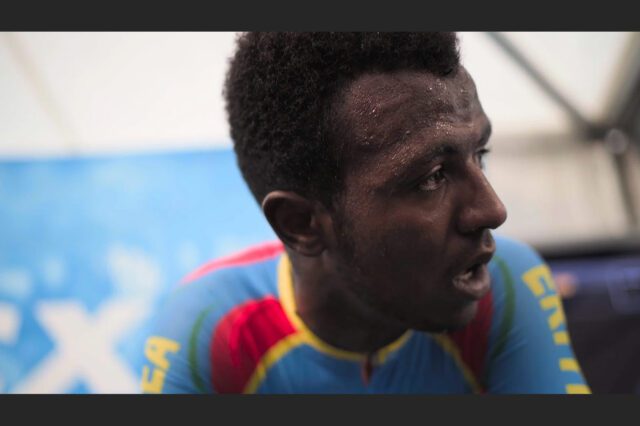
It’s a strange and disturbing anomaly that, until recently, only six Black cyclists had competed in the Tour De France, the sport’s blue riband event. In his latest feature documentary This Is My Moment, Lieven Corthouts tells the story of the seventh, the Eritrean cycling prodigy Biniam Girmay (currently setting this year’s Tour ablaze with his sprinting feats that have already won him several stages and seen him dubbed by the media as Africa’s new cycling king).
“It’s probably important to know that I lived in Ethiopia for nine years. I know the Eritrean culture, I speak a bit the language…and I love cycling,” Corthouts explains how he came to make his film (which had its world premiere at Docville in the spring, its international premiere at DOK.fest Munich and was then shown the day before the start of this year’s Tour De France at Bicycle Film Festival in Firenze, where the Tour started this year).
Corthouts had directed previous documentaries in Africa, among them Find Me In Kakuma (2017), set in a refugee camp in Kenya, and The Invisible City (2016), also made in Kenya.
The Belgian filmmaker first met his subject in Kigali. At the time, Corthouts was living in Rwanda. “He [Biniam] had been talking in the street about coffee and because I was living there, I took them [Biniam and his friends] to my favourite coffee place in Kigali.”
Biniam and his team then asked Corthouts to come to the race they were about to compete in. That marked the start of what turned out to be a lasting friendship.
“The only difficult part was getting a visa to go to Eritrea because it is not an easy country to get into but, for some reason, they let me in. Since then, I have been part of the team – and I have been part of all his teams.”
When Corthouts started filming Biniam, the cyclist was still a teenager and yet to hit the big time. The director, though, saw immediately that he had talent.
“I knew from the beginning he was good. I couldn’t imagine how good. I know that it is very difficult for African riders to come to Europe, but I knew because of his talent there was a chance that he could make it. Of course, I didn’t know that he would win major races.”
When Corthouts was first pitching the project to broadcasters and financiers, many were sceptical. He would tell them ‘no, no, he (Biniam) is good,’ but they had to rely on his word. Now, a few years on, he has been fully vindicated.
“The crew most of the time is only me. That helps to get embedded,” the director explains how he managed to secure such intimate footage of the African racers both on and off their bikes.
Corthouts has “a very good connection” with Biniam’s parents. When he was in Eritrea, he stayed with them. They trusted him. This helped him to get far closer to his subject than most directors making sporting documentaries.
The film touches on some bleak moments in Biniam’s life. When he first came to Europe, he knew no-one (other than Corthouts) and all his teammates spoke different languages. There were moments he came close to quitting – but he soldiered on and his times got better and better.
“It’s still difficult for him,” Corthouts notes of the challenges facing a Black African athlete in a sport still dominated by white Europeans and Americans but adds that the young Eritrean is “one of top names in cycling at the moment.”
“That’s why we made the film, so we can urge more African cyclists to give it [the sport] a try,” the director says. “If he keeps on winning, more and more people will be motivated to make the step and try to be a professional cyclist.”
Rwanda will host the 2025 Road World Championships, the first time for an African nation, and it could potentially be a transformative moment for professional cycling in Africa. Corthouts will be there filming and hopes that Biniam will be one of the leading competitors. For once, he should have a competitive advantage. He is used to the heat and to competing at altitude. He knows the roads. All being well, he will be among the favourites.
This Is My Moment was shot over a period of five to six years. It has an emotional depth you simply don’t find in most sporting docs and can also be viewed as a coming-of-age story. Viewers see Biniam transformed from a callow youth into a top international athlete. They follow big moments in his private life, for example his marriage, and learn just what challenges he faced during the pandemic.
The film has been attracting strong interest from cycling fans. After all, Biniam is now one of the sport’s fastest rising stars. “He’s the first Black African rider to win a stage, to win a classic,” the director notes. “It was very clear to everybody what we wanted to tell [in the story]…he is a huge talent but he is very down to earth.”
The Tour De France has endured many doping scandals in recent years but the director is confident that “the peloton is much more clean than before” and that Biniam won’t be caught up in any of the skullduggery. The young cyclist Corthouts met several years ago over coffee in Kigali has become a fully-fledged celebrity. Now, whenever they go out together, Biniam is mobbed by fans. Kids adore him. “It’s already a big sport in Eritrea but in the last images in the movie. there are hundreds of thousands of people coming to see him race. When he goes to Ethiopia, it’s the same. When he goes to Rwanda, it’s the same…you will see the effect. There will be more and more black riders. It is not only him, but he is the catalyst for it.”
This Is My Moment was made through Flemish Emmy Oost’s company, Cassette for timescapes. (Oost also worked with the director on Find Me In Kakuma.) The film will be available on Arte from July 22.





