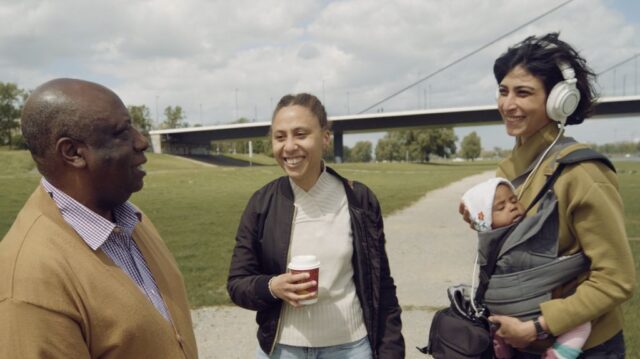
Director Mala Reinhardt is of Malaysian/Indian origin while her best friend Akosua (who identifies as demi-gender) is of half Ghanaian/half German heritage. Both were born and grew up in Germany, and what the two have in common is a “search for a home and a place where we can arrive,” the director underlines.
Mala, who gave birth during production to a child fathered by her African-American partner Philip, set out initially to follow Akosua alone in her film, but soon realised that she had to examine her own life as well in addressing these existential questions. Their racial ‘half-ness’ always seemed an issue to White Germans, she says. We are told how Akosua suffered discrimination as a kid and was almost forced to change schools. Her White mother suffered similar discrimination for being the lone parent of a child of colour.
“In the past I had no words for my identity,” Mala says in the film. “Being ‘a person of colour’, ‘BIPOC’, I first heard these terms in my 20s. And even then, I didn’t get to decide if I’m seen as German or not. That decision is made by others, simply based on my appearance.”
Nor is such codification confined to Germany. In Ghana, Akosua’s lighter skin determines that she is referred to as ‘oboronyi,’ which colloquially translates to ‘white person.’ This is a classification not at all to Akosua’s liking.
Mala experiences the same in South India. “I stand out. I’m way too fair, I’m way too tall,” she tells BDE. “In Germany, you’re not considered German enough to be German, but then you go to the place your ancestors are from and they also don’t consider you to belong there. Another thing that Akosua and I share is that we don’t speak our parents’ mother tongues fluently. I don’t speak Tamil. Akosua doesn’t speak Twi, so I think that’s also a huge identity marker. You are granted access to a community if you are fluent in their language. But we never learned those languages.”
Instead they are forced to speak English. “It’s absurd and makes me uncomfortable that we’re filming in Ghana and Akosua’s family has to speak in English. Both of our stories are shaped by colonial powers, yet it is us bringing the colonial language of English with us.”
The inherent duality in Akosua’s life is further emphasised by a complex love life shared with the cis Isaac in Ghana and the trans Nana back in Germany. But any inner harmony Akosua may feel is short-lived. Nana reproaches her when no mention is made of their ongoing relationship when Akosua visits Isaac in Ghana. “Relationships with transfeminine women are hidden,” complains Nana of their being sidelined. “The feelings of the cis person are more important than standing by [our] relationship.”
While in Ghana, Akosua also immerses deeply into Ashanti culture and sets out to explore its Queer and trans communities. By the film’s end she must determine the ongoing shape of her personal life, and who (if anybody) will populate it.
The film is, in many ways, small and very intimate, given how its focus is on two young people undergoing existential analysis of themselves and their place in the world, from the perspectives of gender, sexuality and ethnic origin. But of course this is exactly what makes the documentary so universal.
“I dunno if it is the right word, but it is maybe humbling to see how your own questions also relate to other people and to their lives and what they make of it,” says Mala. “And I guess for me it’s also been part of my personal growth to see how my friends deal with this, and how certain questions are maybe similar to all of us. But at the same time, we also have these differences and it’s eye-opening.”
“I also learned how blackness or non-whiteness is understood in different parts of the world. And that’s something I probably wouldn’t have gone into so much if, first of all, if I didn’t have a black child, but also if I didn’t make this movie and get all this exposure through different opinions on this.”
Mala didn’t set out to be the star of her own film. It was something she felt uncomfortable about and it took her a while to “find the openness that my protagonist [Akosua] has.”
“But I think in a way this film was asking for it because there are all these different views on how you define identity,” she adds of why her presence was necessary. “Some things we [she and Akosua] agree on, and others we don’t agree on. And I felt like this was actually an essential part of the storytelling. That we can both be BIPOC. We can both be born in Western Germany with certain experiences we had in our childhood and teenage life, and we can relate to each other on all that. But then there are differences, and I felt like I kind of needed to take in my opinion on this because it’s also this close friendship that is displayed in the film. It doesn’t really make sense to then find someone else who stands in and shows another view.”
Germany is regarded as a liberal multi-cultural democracy which has opened its doors to hundreds of thousands of immigrants over the past decades, hence producing a wider base of ethnicities among those claiming German citizenship. Does Mala agree? How does she assess the society that her mixed-race child will be growing up in?
“I would definitely hope, having a mixed background, that she’ll live in a Germany where she can just say she’s German and doesn’t get questioned about it. But I’m not too optimistic about that, to be honest,” she responds. “I feel there are strong nationalist views rising. I think it’s a difficult time we’re living in, and these questions have always been there.”
“But I think what’s happening now is that people who’ve grown up with experiences similar to mine are being very vocal about it and they’re claiming their space and they’re claiming their identity as being German. That’s maybe something that wasn’t as prevalent in the 90s or early 2000s or so. But still, it’s not as if it’s an easy path.”