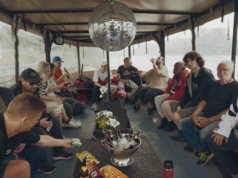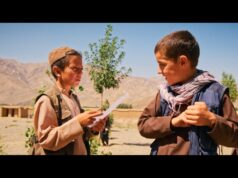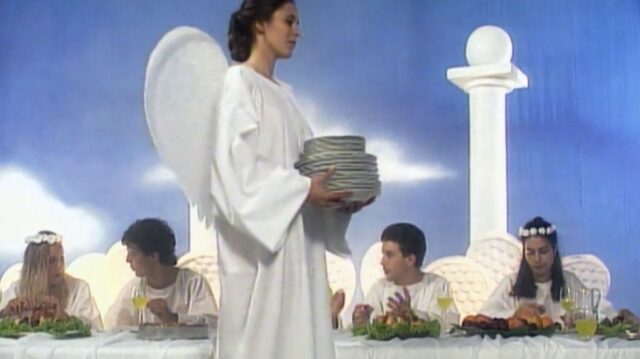
In his found footage documentary Eight Postcards From Utopia (world-premiering in Locarno Fuori Concorso), Golden Bear-winning director and arch cinematic provocateur Radu Jude casts a very quizzical eye on the world of Romanian advertising in the post-socialist years. Working with philosopher [and co-director] Christian Ferencz-Flatz, Jude explores the hidden meanings behind these commercials.
Some are witty and ironic. Others are plain camp. As Jude notes, one of the defining characteristics of advertisements is that they are “very heterogeneous.” They can be very “direct,” they can be “documentary-like”; they can “imitate other products, movies and TV things.” The ones foregrounded in Eight Postcards hawk everything from washing powder and laxatives to cars and financial products. Seen together, they provide a potted social history of Romania during a transitional period in the country’s history.
“After the brutal communist dictatorship, there started very directly and very violently a ‘Neo-liberal capitalistic society,’” the filmmaker explains the sudden change in social values signalled in these commercials. “In this transition, the advertisements had a very important social role, a very important role to play…”
Jude describes Eight Postcards (sold internationally by Greek outfit Heretic) as “a historical documentary using the most fictional material – which is the ads. We know already from sociology and philosophy that they are not so innocent. There are a lot of ideologies and views of life that are embedded into them. This was the perspective – to make a montage film out of these fictional elements but treating them as documents, which they are.”
Eight Postcards is split into chapters looking at such subjects as history, science, money and the supernatural, as well as birth and death. “They tell a story of a transition from a society in which these goods were not available to a society of capitalist consumerism…it’s a documentary about desires, of the imagination of the ideal Utopia,” Jude notes.
“The point was to have these eight different ways of organising the materials,” Ferencz-Flatz says of the eight chapters into which the film is divided. “We tried in each of these chapters to tell a different story.”
Jude had been thinking about making such a film “for a while” but then discovered Ferencz-Flatz’s work. The academic and author writes both film reviews and academic treatises. “I was very impressed not only by his obvious academic qualities but he has a certain humour and a certain taste for the avant-garde in his approach.”
When Jude proposed working together, Ferencz-Flatz quickly agreed.
Jude praises the “fearless” and “creative” approach of his collaborator, and credits Ferencz-Flatz with putting the film’s structure in place.
There is no official archive for advertisements. It was therefore a “very long process” to track down all the old commercials.
The project was produced by Alexandru Teodorescu at Saga Film – a company which itself has produced many ads over the years. Saga was one source for the material the filmmakers needed. A separate post-production outfit also turned out to have kept the ads on which it had worked.
“Some of the materials we found online. Others were from dedicated amateurs. There is one person who is bitten by archive-fever, collecting a lot of things, and he helped us. From all these sources, we decided at some point we had enough.”
There is a long tradition of established filmmakers working in advertising. For example, in Sweden in the 1950s, Ingmar Bergman directed several commercials for Bris soap. In the early 1970s, a whole generation of UK directors including Ridley Scott, Alan Parker and Adrian Lyne cut their teeth in the field.
Earlier in his career, Jude himself worked on commercials. “I made a living first as an assistant director for feature films but also for advertisements for five or six years. Then I directed advertising – I made a living out of this for more than 15 years…this is also why I needed to make this film.”
Some of Jude’s work features in the documentary. “Maybe 10% of what we see is made by me.” He confides that the ad featuring Romanian dictator Nicolae Ceaușescu and mobile phones ringing was made by him.
“In Romania, when I grew up as a filmmaker, there were no possibilities to make a living out of cinema. Everybody was…either producing commercials or directing television. Most of the Romanian directors had to do it at some point – and there are people who are still doing it. It was part of our work in a way.”
Legendary New Wave director Jean-Luc Godard once called advertising the most honest form of filmmaking. It is also a time-honoured way for young directors to prepare for their features. “For me, it was the perfect way to test actors, to test lenses and, when you were shooting on film, photo-chemical processes.”
Ferencz-Flatz points out that Jude’s commercials had “a grain of subversive in them from the beginning.”
For both directors, there was a nostalgic aspect to revisiting the advertisements. “There is a very complex emotional landscape that these commercials evoke especially for people who were children or were young in the 90s,” Ferencz-Flatz reflects. “They [the ads] had a huge allure back in that time. On the one hand, they were historical documents that flagged what was going on in that period – the crash of Romanian industry, privatisation, the beginning of corruption, political scandals and all of that…but on the other hand, these commercials were a huge lure. I remember people used to learn the slogans by heart. What advertising basically does is present social relations, emotions, lived experiences and so on in relation to products. This was something new in Romania in the 1990s.”
Jude has made other archive-based films. “It’s a branch of what I do…what’s interesting is that in the end, when you have the materials and start working with them, there is basically no difference with the materials I shot myself and the ones that belong to others. The decontextualisation and recontextualisation transforms them. It’s actually the same process. Of course, there is an element missing here which is the shooting and the scriptwriting etc,” Jude reflects. “Maybe this is my influence from [Russian director Sergei] Eisenstein who saw montage in everything around, from architecture to poetry and painting.”
The film is part of an ongoing research project that also involves film scholars and historians. Academic papers and a book will eventually be published.
Eight Postcards is one of two films Jude has in Locarno this year. The second is Sleep #2 which he describes as “a desktop film.”
The prolific director is now also midway through shooting on his new feature film Dracula Park for which he is drawing both on old B-movies and classic literature (he cites Balzac, Cervantes and Fielding).
“I don’t know what is going to be the result,” he says. “We are having a bit of a break in August and then starting again in September. It’s a film that starts with the origins of the Dracula myth. The origins of course are in Transylvania which is in Romania…I said some local guy should do a ‘Dracula’ one day.”
Eight Postcards from Utopia and Sleep #2 screen in Locarno on 10 August.