

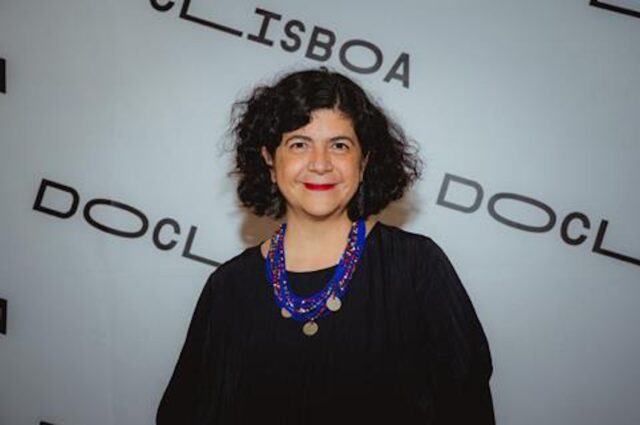
In her first year at the helm of Doclisboa, director Paula Astorga is in reflective mood. She talks of the “great honour” of steering “a film festival which knows pretty well its own identity.” Doclisboa has a distinctive “editorial line” that has stayed consistent throughout its existence.
“Its vocation is very clear. It’s a festival that understands very well its own mission – that aims for a political sense, a social sense, and that is devoted to cinematic language.” Astorga says. “Already this year was an amazing experience as I had the chance to work with the same programming team that have been working [here] for years.”
She pays tribute to such redoubtable figures as Cíntia Gil and Justin Jaeckle, the event’s associate programmers, who’ve helped to guide her. Gil was previously director of both Doclisboa and Sheffield DocFest.
The Mexican producer, director and curator has chosen Luciana Fina’s Sempre to open the Lisbon festival (now in its 22nd edition and running 17-27 October). The film looks at the 50th anniversary of the Carnation Revolution in Portugal.
“It’s the 50 -year anniversary since the start of democracy,” Astorga points out the significance of the events in April 1974 when the authoritarian regime in power was overthrown. “It portrays the contemporary story of Portugal in such a cinematic and beautiful way. We really thought it was such a great opportunity to open the festival [with the film]” she adds of the meticulously researched and “beautifully” crafted documentary.
183 docs chosen from more than 2000 submitted will be screening in Lisbon over the next 10 days.
One major coup for Doclisboa this year is securing the world premiere of Demmin Cantos, the latest film from Hans-Jürgen Syberberg, a near legendary figure in post-war German cinema (and best known for his epic work, Hitler: A Film from Germany).
Astorga acknowledges that programmer Boris Nelepo played a major part in securing the Syberberg movie, his first since 1995. She described the work as “super personal” and as “one of the jewels” in the programme. Screening in New Visions, it is about the town close to where he grew up. One of the largest mass suicides happened here at the end of the Second World War. As he looks back on those events, the director, now in his late 80s, is reflecting on the most personal aspects of his own life.
Syberberg is far from the only major figure from the past whose work is being showcased. The festival has a retrospective called ‘Back to the Future’ overseen by Jean-Pierre Rehm, former head of FIDMarseille. This section actually includes one of Syberberg’s older films, Ludwig, Requiem for a Virgin Queen, from 1972. (This was chosen before the festival knew it would be screening the director’s latest work). It also features work from such titans as Marguerite Duras, Dziga Vertov, Apichatpong Weerasethakul and Manoel De Oliveira.
Astorga says that coming in to Doclisboa has been “challenging from many points of view.” She doesn’t yet speak Portuguese. “Sometimes, I stop a bit and say why am I doing a film festival in another language!” She has run two festivals previously but she was “inventing” both of those from scratch. “It is like adopting a grown child,” she jokes. “A 22-year-old festival is still young – but it’s already a young adult! The festival knows exactly what it is and how to perform….it knows its place in the world, its place in Portugal and exactly what its objectives are.”
This year, the festival has a retrospective of the work of Mexican filmmaker, Paul Leduc (1942-2020), whose Reed: México insurgente (1970), based on John Reed’s account of the Mexican Revolution, is regarded as a pivotal title in the New Mexican Cinema. He also made an important film about artist Frida Kahlo – 1984’s Frida, Still Life.
“I was aware that all the films were being restored,” Astorga says of the ‘Dance to the Music of Time’ programme devoted to Leduc that she helped put in place. Rights to the director’s work have been secured. His films, including rare shorts, have been restored.
“Paul Leduc represents a lot of things that Doclisboa aims to…he is a good filmmaker who has his own narrative, his own language, his own voice. He was quite a rebel,” Astorga explains why she thinks he is the perfect filmmaker for the festival.
There are 12 titles in the international competition, five of them world premieres, such as Belgian director Jen Debauche’s The Anchor, in which a psychotherapist (Charlotte Rampling) recounts her own journey through psychosis.
Astorga points out that the Doclisboa programming team benefits from an extensive network of friends and contacts. In many instances, the filmmakers in competition already have very close links with the festival. They bring their new work to Lisbon as a matter of course.
“The way Doclisboa works is very horizontal. For the international competition particularly, there is no one head of programming. It is a team,” she says of the collective approach to selecting titles. When the programmers are all agreed that a film is “a no-brainer,” they’ll take it.
Astorga has talked in the past about her passion for nurturing new talent. She has recently been working as head of studies at the Locarno Film Festival’s Open Doors Producer’s Lab programme (her stint there finishes at the end of the year). At Doclisboa, it is little surprise she is taking special interest in Arché, the development programme that helps 12 film projects from Ibero-American countries and Italy, and sister initiative RAW, a residency programme for non-fiction films in development from Portugal, Spain, Italy and Latin American countries.
“It’s good to mention that my relations with Doclisboa started in 2020 with being a tutoress at Arché,” she says. “The projects I worked with were all really interesting.”
Look through this year’s Doclisboa programme and you will find many films from much vaunted names, several who’ve now passed on. Arturo Ripstein, Jean-Luc Godard, Anne-Marie Miéville and Marguerite Duras are just some of the titans whose work is again being showcased.
“Watching everything that is happening now, I think there is an urgency for memory, a real necessity for context,” Astorga explains why looking back can help the doc sector re-energise and plot its future. “If we want to be a festival that really aims to find a contemporary language of its own, it needs the historical context, the inspiration and the references…”
“That conversations build a great dialogue between the current cinema, the big names and the unknown directors who have been part of this festival,” she reflects. “It’s a tension that is permanently there in the discussions of the programming team.”
The festival director cites short film [anan] from Belgian directors Sirah Foighel Brutmann and Eitan Efrat as an example of contemporary filmmakers taking inspiration from the past. Set in the Negev desert in southern Israel/colonised Palestine, this is at once a work looking at displacement, war and occupation and a tribute to the late Chantal Akerman, the revered director who died in 2015.
Astorga repeats her assertion that Doclisboa is “film festival that knows its own identity.” The clarity of its editorial line remains one of the festival’s greatest strengths.





