Aussie filmmaker Justin Kurzel remembers vividly when he first had the idea to make a documentary about Warren Ellis (the Australian musician, wild man violinist and composer well known for his movie scores and work with rock groups Dirty Three and Nick Cave & the Bad Seeds). It was at the Cannes Festival in 2021. Ellis was attending with the snow leopard documentary, The Velvet Queen. Kurzel was presenting his new feature, Nitram, about Australia’s most notorious serial killer.
“It was a really strange Cannes in that Covid was still happening…you had to still do the swabbing to get into the Palais,” Kurzel remembers. “I hadn’t seen Warren for a long time and it was really lovely being there with another Australian and catching up.”
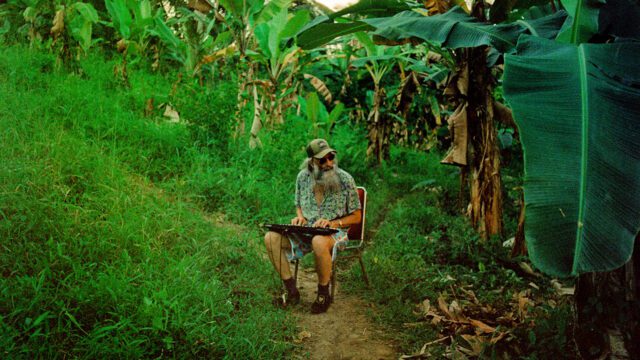
Kurzel asked Ellis what he was doing next. Back came the answer that he was recording albums, writing soundtracks – and then he mentioned in passing that he had just bought some land and was getting behind a new wildlife sanctuary in the forests of Sumatra.
“It was just the way he mentioned it [the sanctuary] in a very casual fashion. I was instantly intrigued…”
That initial chat led Kurzel (the director of such movies as new Jude Law thriller The Order and Macbeth with Michael Fassbender) to embark on the feature doc Ellis Park. The film, sold by Yellow Affair, has been screening this month at the London Film Festival.
Ellis had recently published his memoir, ‘Nina Simone’s Gum.’ He told Kurzel that he wanted to go to Sumatra with an 8ft marble replica of the piece of gum he’d picked up from the legendary musician when she had performed at the 1999 Meltdown Festival in London.
Kurzel was intrigued by the Ellis’ audacious idea. “I just thought it was so Werner Herzog-like and had this Fitzcarraldo-like feeling about it. I said if you’re really serious about it, I’d love to film it.”
Kurzel half expected that the project would fizzle out as other similar crazy ideas often do.
“But it actually grew. Warren helped me as I started to look into the park and what was being done there. I felt an enormous responsibility to follow it through.”
The park, run by Dutch animal welfare expert and veterinarian nurse, Femke den Haas, rescues trafficked and mistreated animals, nursing them back to health.
Kurzel originally intended to focus on the story behind the park. Ellis hadn’t been able to visit it because of the pandemic – so his first trip there was going to be a big deal.
“But it [the film] became much more intimate and much more of a conversation between Warren and I about many other things: about the challenges of growing up in these country towns and where creativity comes from.”
“Ego-driven ideas about us arriving at the park with Nina Simone’s gum and placing it there really fell to the side,” the director explains how the project took on a much more “free flowing” structure than first intended.
There’s an interlude in the film when Ellis visits his elderly parents.
“It was very spontaneous. Warren wanted to show us where he grew up,” Kurzel remembers of this encounter with John Ellis, a talented country musician in his own right (and who sadly died late last year).
After growing up in Ballarat, Victoria, Ellis Junior had a turbulent start to his artistic life. He worked as a teacher for a while but was drinking heavily and taking smack at the time.
Kurzel deals with such elements of his subject’s past in a “gentle, respectful” and intimate way. He himself felt “deeply connected” to Ellis’s memories of growing up in an outback country town.
“They were very, very similar to mine. I grew up in a town that wasn’t actually that far away from where I made my first film, Snowtown. It was an isolated country town. It had a very strong Australian masculine air to it. You had to be pretty muscular in these places. They didn’t have a huge amount of time or patience for creativity.”
Despite such rough backgrounds, both Ellis and Kurzel have flourished as artists. “I could see Warren’s need to escape a little bit and reach for a creativity that was different from what was around him. That was very similar for me…you create another universe around you. I think we both felt when we were young, we wanted to leave it [the small-town background] through creativity and imagination.”
Kurzel and Ellis also face familiar creative challenges now as they struggle to come up with the right idea or agonise over how to express themselves in their work – how best to cut a movie or produce a song. This is very different from what happens at the camp in Sumatra. Femke den Haas never “procrastinates.” She and her team are in a constant fight to keep the endangered animals alive.
“What was really inspiring to us was this sense of productivity [from Femke and the staff at the park]…sometimes, it is just about moving forward. They go through horrendous times of grief, dealing with animal deaths and cruelty,” Kurzel reflects. “But they just have to keep moving forward. That energy and spirit definitely made Warren and I think a lot more about what we do.”
And, yes, Kurzel felt it cathartic to be working on a documentary after making all those big budget dramatic features. “I truly loved it. As a filmmaker, I found it enormously liberating. I found myself constantly touched with the present and the possibility of what something could be.”
In his dramatic movies, Kurzel is now trying to keep the same “openness” with which he approached Ellis Park. It’s about “not trying to make things too stale or too overthought.”
To make the documentary, he shot 300 to 400 hours of footage, a vast amount. Her pays tribute to editor Nick Fenton for helping him to plot a route through so much material.
“It was a very different experience [to fiction]. It was scary because you didn’t know what was happening. Every time you tried to push something, it felt wrong.”
Immediately after completing Ellis Park, Kurzel headed off to Calgary to shoot the movie, The Order, starring Jude Law as an FBI agent investigating a white supremacist group. Even in this film, though, there are quieter moments when Law’s character is in the wilds, communing with the mountains and forests, encountering wild stags.
“There is a reverence toward nature that I can feel in both [films] and that I definitely felt in Sumatra in regards to the volcanoes and the enormity of the jungle…and there was something of that in Calgary. Calgary had probably the most extraordinary skies I’ve ever seen. It’s in the base of the Badlands that then goes into the Rockies. There are just animals everywhere.”
Kurzel was shooting The Narrow Road to the Deep North (a new series based on Richard Flanagan’s Booker Prize-winning novel and starring Jacob Elordi) at the same time he was editing Ellis Park. He was also working on The Order. That’s three major projects overlapping. “I feel…exhausted! But I actually loved how each of the projects at a different stage fed into the other. It also creates a healthy distance. If it’s [just] one thing for two years, you kind of go down the rabbit hole a little bit.”
Ellis Park had its world premiere at the Melbourne Festival before coming to the London Film Festival. It was produced by Nick Batzias and Charlotte Wheaton, executive produced by Damien Newton-Brown and Howard McCorkell, edited by Nick Fenton and director of photography by Germain McMicking, ASC. The film is financed by Screen Australia, Vic Screen, MIFF Premiere Fund and McCorkell Brown Projects.