

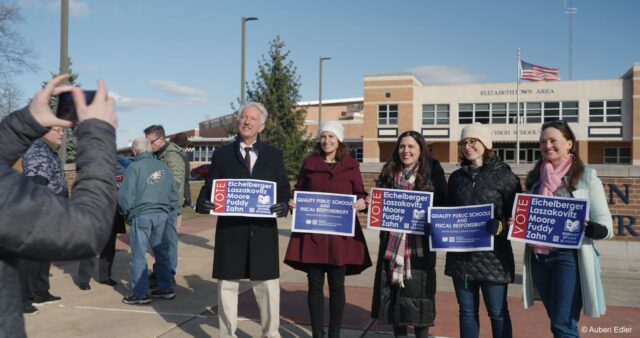
An American Pastoral will make for poignant viewing for IDFA audiences in the wake of the US elections earlier this month. In the film, screening in the festival’s main competition and sold by Mediawan Rights, French director Auberi Edler ventures to Elizabethtown in Pennsylvania. This is a small community that reveals in microcosm the huge divisions between liberals and conservatives, Republicans and Democrats, that exist across the US. People are trying to live with each other when their world views are radically at odds.
In the town, Christian Nationalists and GOP supporters want to ban all sorts of seemingly harmless books from the school library on the grounds that they will corrupt the youth. At the same time, many of the locals are talking up their constitutional rights to bear weapons.
“A lot of research and a similar amount of luck,” Edler explains what drew her to Pennsylvania. “I wanted to understand how America had reached that point of fracture where people cannot talk, cannot exchange ideas anymore.”
As an author, documentary director and journalist, Elder had been covering the US for many years. Her previous credits include such docs as last year’s American Laundry (2022) and Clean Torture: An American Fabrication (2019).
As she embarked on the new doc, the director felt the country was now at “a stalemate.”
Pennsylvania is “a swing state,” but that wasn’t what drew her. She liked the idea of a town that seemed so rural and traditional. “It’s very quaint America, the America you would have in your imagination, thinking of the 50s.”
Elizabethtown is a predominantly white community. Many people there still go to church every Sunday. This is a settled community. In normal circumstances, everyone gets along just fine. They’ve known each other for years. Now, though, obvious fissures are appearing.
“I wanted to understand what was happening at ground level, if I can use that expression; to be within a community, and I felt that the best way to understand what was causing the fracture was to follow an election, in my case the school board election.”
It was a point of principle for the director to treat all her subjects, whether Christian Nationalists or progressives, in a fair way. “I’ve had two lives. I have been a journalist and mainly a war reporter for close to 20 years and, for the past 20 years, I have been a documentary filmmaker.”
Edler works in the spirit of Direct Cinema. Her method is to go somewhere, to “spend an awful lot of time in one place,” to observe and to film.
But, no, not everyone the town gave her a warm welcome.
“The people you see in the film are the people who decided to open their doors and their hearts to us. What you don’t see are the others. The people who accepted us were not the majority but they were enough to understand what was at stake; to understand the campaign, to understand what sort of world they envisioned for the US…both sides understood my style of filmmaking wouldn’t involve any interviews or narration. I was just a fly on the wall.”
The main challenge for Edler was to explore just “why people who had been living side by side forever were suddenly barely able to communicate and all had the feeling that the others didn’t listen to them….”
We see heated conversations at school committee meetings on the subjects of books that some are desperate to have taken off the shelves. Edler can’t help but notice a certain irony here.
“What is very interesting about this whole story in the US regarding the school libraries is that the truth is not a lot of books are sexually explicit…kids, when we spent time at the libraries, were on their tablets; they were on their computers. Were they perusing through rows of books? I didn’t see it.”
The director established a rapport with certain characters who had extreme views. One man, Jim, has clearly had a rough life. He had been a drug dealer, possibly a gang leader too. Now, though, he had found God. “A few years back, he was a Democrat voter. Jim is somebody you can also appreciate for his honesty. He is not pretending to be somebody he is not.”
Edler and her team spent several months in the town. Over time, their relationships with locals changed. She was there to make a film, not to make friends. She points out, though, that if you make a two-hour documentary, it would become “unsustainable” and “impossible to do” if you don’t respect your subjects.
“Documentary makers way more famous than me always said that you cannot make a good film if you don’t love the people you are filming…love might sound like a big word, but I do see the humanity in all of them.”
The director remains in contact with all the people in the film, “and mainly with Jim.” She also got on with Tina, a GOP supporter and one of the women in the community most determined to get the books banned.
“She is so adamant about the dynamite about to explode on the shelves of the school library [but] she, as a person, is extremely educated, an avid reader and probably one of the funniest women I have ever met.”
Although the documentary portrays a very divided world, she insists there’s some optimism lurking within it too.
“I do hope that the people who watch the film will see the humanity in each of the characters. If you can see the humanity, we still can have hope for this country. If we really think there are monsters on one side and people like the rest of us on the other, well, the film is just a dead-end, and it could have lasted 10 minutes…”
An American Pastoral is produced by Serge Lalou for Les Films d’Ici Méditerranée and has backing from ARTE.





