

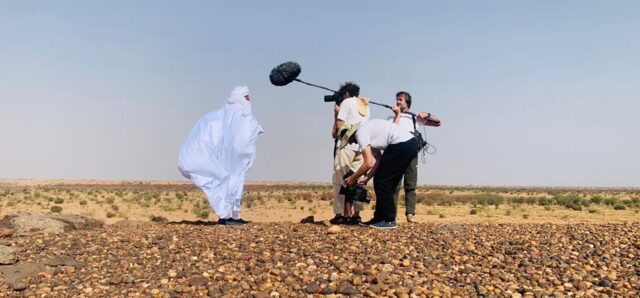
The Niger city of Agadez lies deep in the Sahara desert. It’s a very long way from Brussels but it was still part of a strange EU experiment. There was an attempt to create a new security border there, to combat terrorism and stem migration – a sort of Schengen equivalent in the African sands.
Gerald Igor Hauzenberger and Gabriela Schild’s On The Border, a world premiere in IDFA, makes it clear why this border plan was doomed to failure.
“We were joking. A researcher friend told me ‘the new concept of Europe is outsourcing border management,’” Hauzenberger remembers the bemusement many felt about the EU plans.
Work on the project started in earnest after he met a Tuareg (a member of the nomadic Saharan community) in Vienna, “a friend of my neighbour…he told me he could bring me to Agadez and show me everything I wanted to [see].”
Hauzenberger made his first solo trip to the city for a month in 2018. He quickly made friends with some of the people who would later become the protagonists of the documentary. “They invited me [in] like a family member,” he recalls.
The locals were surprised that Austrian Hauzenberger was prepared to stick around. Normally, TV reporters would turn up in Agadez, film for a couple of days and then leave quickly. Their despatches tended to be superficial and often inaccurate.
“For me, the most important thing was to tell a story about the inhabitants and to be not only close to the people but to tell a true story. I didn’t want to hear the stereotypes we have seen in so many [other] films.”
New Docs is handling sales for On The Border which was made through Vienna-based Framelab Filmproduktion in collaboration Swiss Mira Film and German Corso Film.
Hauzenberger and Schild pay strong attention to aesthetics. This is a very elegantly shot film. “You can see from the editing patterns, very often we used close-ups, and from the close-ups we went to panorama shots. Faces and panoramas were very significant to bring it [the film] together. The whole story of the Tuareg is a story of transition. The whole city disappears after the rainy season…the whole city is built on clay. They have to do renovations or it would disappear. For me, when we started to film, it was very important to show how deeply the landscape is in the minds of the people.”
The “prevailing way of life” is nomadism. For obvious reasons, this doesn’t work well with borders. “If you go there, you see this vastness; you see these people with camels walking for days. The whole concept of borders doesn’t make sense at all while you are there. This region is so big. It is twice as big as Germany…if you build a border, you need people to keep it – but this is impossible in this vastness,” Schild reflects.
Local wisdom has it that if you want to get rich, you head to the bazaar, but, if you want to learn wisdom, you should go to the desert.
“The whole perception of life is so much focused on the desert, survival, and finding skills to survive,” Hauzenberger reflects.
“Also, the city is the last gate before the Sahara. We really wanted to capture this place which is so hard to access now,” Schild says of the film’s spectacular, at times David Lean-like, visuals. “It’s a kind of meditative style [we use]. We wanted to recreate this special taste of Agadez.”
“Also, storm and sand are very important…pulses,” Hauzenberger explains how the seasons affect life in Agadez. “In spring time, the city is very hot. Then the rains come – and it is very wet. The storms are so powerful. You have to live with whatever comes. This is the survival strategy of the Tuaregs.”
This stoical strategy helped them cope with a huge range of challenges, everything from storms to military coups; from the intrusion of the Europeans to plastic litter.
The film opens in evocative fashion with one of the Tuaregs painstakingly picking plastic out of a tree. “We have seen so many films about trash in Africa. The plastic here is not trash. It is something like a leftover, of western civilisation and capitalism,” Hauzenberger says. “It is just there.”
Former mayor Rhissa Feltou, one of the main characters in the film, jokes that the plastic stuck in the trees is hard to get rid of, just like “the west.”
Rhissa is trying to fight against injustice and corruption while standing up for his people, who are a minority. The fight against plastic is just another of the many David v Goliath battles he is waging.
Igor’s first visit was in 2018. Schild accompanied him the following year. “We would spend a month or two a year there. This was a challenge because a lot what was going on when we were not there….”
In all, the two filmmakers visited Agadez five times. Eventually, the council chief told them: “You are part of us. Nobody [else] came as often as you…so you belong to the Tuareg. That was very impressive for us because that seemed [to show] that we were really interested in their problems and their point of view.”
Early on, there was a crew of seven or eight people. Alongside Rhissa, the other major protagonists were Ahmed Dizzi, a shop owner who remembers the days when tourists used to flock to the city and business was brisk, and radio journalist Tilla Amadou, whose reporting questions the purpose and efficiency of the border guard training.
Security was very strict. With bandits and jihadists on the prowl, the filmmakers needed to be accompanied by armed guards. This was a high risk area. They tell hair-raising stories about their vehicles breaking down in the desert and young motorbikers with guns suddenly screeching up around them.
“It was important for us to be as invisible as possible,” Hauzenberger says.
Early on, when the crew was smaller, the filmmakers could move “almost freely.” It helped that they had a connection with Rhissa, such a prominent local politician. Movement, though, became increasingly difficult as the pandemic hit and new regulations were put in place. They were still the only team given permission to shoot for longer than two weeks. “We somehow managed to get a permission for two years!”
The aim now is to show the film in Agadez. In the meantime, Rhissa is due in Amsterdam for IDFA.
Ask the duo what gives them the right as western European outsiders to tell the story of the Tuareg people and they deflect the question.
“The film is about what are the implications of European institutions there…that was our entry door to the whole topic. We wanted to see what the Europeans were doing there,” Schild states. “When we got there, we got so close to the people that there was a shift [to] making the film [more] as portraits of the people.”
The filmmakers had local technicians in their crew. “Friendship opens doors,” Hauzenberger notes of how the project broke down national barriers.
Predictably, the European border plans didn’t work out. Most of the EU representatives have now left town. Was it really to make the area more secure or was the real intention to keep refugees coming to Europe? That’s one central question the doc asks. Whatever the answer, the Russians have moved in instead. The Turks are there. So are the Americans. The filmmakers describe the city as “a microcosm of violence.” There has been yet another military coup (referred to at the end of the doc).
And the Tuareg have adjusted to their ever-changing circumstances with their usual flexibility.





