

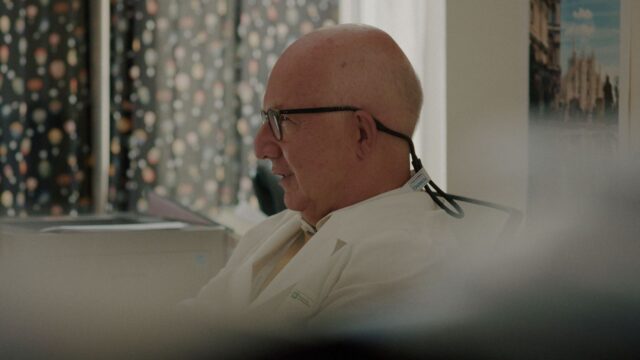
Dr Maurizio Bini is a remarkable man. A professor of gynaecology and obstetrics, the Italian has worked for many years at Milan’s Niguarda hospital. His patients have ranged from would-be mothers trying desperately to conceive to teenagers who want to change their gender identities. Polite, kind and always positive he is somewhere between a therapist, a philosopher and a father confessor. Given the hostility his patients encounter elsewhere in an increasingly right wing and conservative Italian society, it’s little wonder that he is so cherished.
In Gianluca Matarrese’s new feature doc (a world premiere in Sundance), Bini approaching the end of his career, mentoring a successor while continuing to fight for his patients.
The idea for the film, sold internationally by Mediawan, came from the director’s good friend, Donatella Della Ratta, a professor at John Cabot University.
“She was working on a book about the history and social and political economy of hormones in in vitro fertility and also in gender assignment,” Bini explains. “She wanted to observe a professor working on these topics, and a professor in Rome advised her to meet Dr Bini.”
When she met him, Della Ratta realised immediately that Dr Bini would be a perfect subject for Matarrese. Very quickly after his own first encounter with Bini, the director knew precisely the film he wanted to make. This wasn’t going to be a conventional story about overworked doctors and their traumatised patients. Instead, he wanted to focus on the encounters between Bini and the patients when they talk about their dreams and aspirations.
Bini is working at a public hospital but it’s very doubtful that those paying for expensive private consultations would get the level of care he provides to everyone who crosses his path.
In much of his film work, Matarrese explores what he calls the “thin line between documentary and reality.” For example, in his 2023 film The Zola Experience, he told the story of a woman separated from her husband and who is moving house. She is playing a role in an adaptation of ‘L’Assommoir’ by Emile Zola that uncannily echoes events in her own private life.
The director describes his method as “describing society…through micro stories.” He is dealing with big topics by looking at very specific case studies.
“Human desires such as to have a child or to deeply affirm one’s gender identity by changing one’s appearance and legal name are universal,” Matarrese notes.
Bini is shown in the documentary off-duty foraging in the forests for mushrooms. “There is a kingdom of mushrooms,” the doctor tells Business Doc Europe of his obsession with fungi. “People don’t know that in mushrooms, you have the female and the male…there is a huge variety – 400,000 species.“
Bini’s point is that human beings are protean too. Politicians and religious figures often seek to intervene when it comes to bodies and reproductive rights.
“Nobody has ideas about haemorrhoids or tonsils, but everybody has opinions about people who want to change sex or reproduce outside the family using DNA from other people and so on,” Bini points out that the double standards that cloud current debates on the subjects.
Filming Bini and his patients was an intriguing challenge for the director. This was verité filmmaking. The doctor praises the director for his “very discreet” approach. The camera was generally concealed behind a table. Neither the doctor nor the patients felt the filmmakers were intruding on their privacy.
“For me, it was really important to respect the distance. The patients go there to be in a comfortable zone with the doctor where they can express themselves with no boundaries. I really needed to be around the space, not inside the space,” Matarrese explains his framing. He never shot the doctor or patients frontally but always from the side. (The only exception is with the very last patient who is welcoming the new doctor taking over Bini).
“I didn’t feel that there was someone else in the room. I think the patients had the same impression,” the doctor remembers.
“It doesn’t have to be spying on them,” Matarrese adds that everyone knew the filmmakers were there. It was just that they were very very discreet. “I always say we were like little squirrels, little birds, sitting on the bookshelves, observing what was happening, and everybody was aware of our presence.”
The crew would generally be up to three people: the director, a second camera operator and Donatella, the originator of the project. Matarrese limited numbers and deliberately didn’t include a sound technician so that the crew could be as compact as possible. He used “optics and lenses” that allowed him to achieve a sense of intimacy but from a distance.
“But Bini liked the camera, I think,” the director confides.
The doctor, a natural showman, agrees that he wasn’t camera shy, but also points out that he always “protected” the patients. They were asked both before and after shooting if they gave permission for their encounters with the doctor to be used – and they all agreed that they did.
When he started editing, Matarrese had other material that he could have included: for example, footage showing therapists and lab technicians. “In the end, that was another film, about the institution, which is a different narrative. I came back to the main intention at the beginning which was to stay there, in that room, and tell the story of the fare between the doctor and the patient.”
Ask the doctor how he wins the trust of his many patients and he waves away the question.
“I am old,” he explains why they put such trust in him. He adds that it is a “female way of doing medicine.” The idea is to “take into consideration all the things around the patient.” He knew all the different national laws around reproductive and gender reassignment rights and so could offer the best practical advice. “If you are a single woman, you can go to Spain; if you’re a lesbian couple, it is better to got to Holland…you have to take into account many more things.”
Bini has spent 40 years battling for abortion and gender reassignment rights. “I keep my kindness for my patients,” he jokes of how belligerent he can be away from the hospital consulting room.
There is already strong international interest in GEN_. After Sundance, the documentary will screen at many other international festivals. An Italian distributor will shortly be announced. There will be special screenings in Milan to which politicians and participants will be invited.
“We are going to make a lot of noise, a lot of fuss around the film,” Matarrese proclaims. “It is all starting now!”





