“Do these ladies know what they are getting into?” someone asks early on in How to Build a Library, the new film from Maia Lekow and Christopher King (screening in Sundance World Cinema Competition and sold by Autlook).
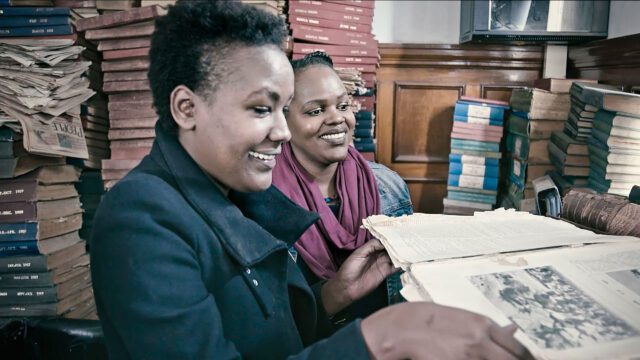
The “ladies” in question are publisher Angela Wachuka and writer Shiro Koinange, the founders of ‘Book Bunk.’ That was the name the formidable duo gave their initiative to restore a dilapidated library in downtown Nairobi, capital of Kenya.
The MacMillan Library had originally been built in the early 1930s by a British Kenyan family for “white use only.” On one level, the building stood as a legacy of the grim colonial past. On the other, though, the women saw an opportunity to put something inspirational in its place – a space devoted to books that would be available to all Kenyans. It was an admirable idea but to achieve their ambition they were going to need to raise substantial amounts of money and to deal with often pettifogging government officials.
Lekow and King (acclaimed documentary makers whose earlier feature The Letter was Kenya’s 2019 Oscar submission) had met the women several years before. They were part of the same creative community of people working in film, music and publishing in Kenya. Wachuka and Shiro had asked them to come into the library to do some filming for them for some footage they wanted to post online.
“Chris and I went down to the library and we just saw a bigger feature documentary in this. We said to them, ‘look, we don’t want to do your videos but we want to do a longer feature on your journey and on the way the library was bringing up all these other topics.’”
When Lekow was growing up, her mother ran a travel agency based not far from the library. She used to walk past the building as a kid but had never actually been inside it before.
“People who grew up in the 70s and 80s have fond memories of the library. I think the decline really happened in the late 1980s, 90s, and early 2000s. When various forces meant the place just fell apart,” King observes. “Most people you talk to now under the age of 30 or 40 have no connection to the building.”
The library they first enter with their cameras looks like the proverbial bomb site. There is mess and dust everywhere.
“It’s a beautiful building, it really is. The fact is that it was built in 1931 and it is in exactly the same state in terms of the structure…that shows the workmanship back in the day was much more solid and strong,” Lekow notes. She remembers being in shock when she first entered the library, both at the fact that the government had let it fall into such disrepair and at the lingering traces of beauty.
“The first time in there filming, I think visually I must have spent five hours just shooting the place. I knew that visually it was such a fascinating space…it felt so symbolic of this paralysis you feel in the Kenyan state and the way that things move; this post-colonial identity crisis where there is a painful history, but it’s also something you can’t ignore, erase, and pretend that it didn’t happen.”
The library came with a hoard of documents and images, some of them giving grim insights into the excesses and injustices of the colonial era. Much of this material has now been digitised and should be available online through a new partnership with Google. This includes one of the oldest newspaper collections anywhere in Kenya.
“But there’s a lot of beautiful stuff in the library that has essentially been ruined, or cats have urinated all over it,” Lekow reflects ruefully.
The two women have now put everything into proper order. Nonetheless, as the film shows, restoring the library is a Sisyphean tasks. Just when they think they’re near the end of the journey, there will be new hurdles put in their way. Two branches of the MacMillan are now fully renovated and thriving but the main hub still has some way to go.
“It’s still in limbo. They’ve at least cleaned out all the trash and they are doing monthly programmes, events, and an annual literature festival,” King says. However, more money needs to be raised to complete the structural work at the main library.
The directors hope the film can help with this.
One especially intriguing moment in the documentary comes with the visit of King Charles and Queen Camilla to the library. Wachuka and Shiro are ambivalent about the presence of British royalty but realise it can be to their advantage.
“As filmmakers, it was probably the most difficult part for eight years of filming,” King says of the royal visit. At first, they were told they wouldn’t even be allowed to set up their camera but after much negotiation they were given permission by the British High Commission to film from “one position.”
“It’s an important part of the film. It’s an important part of history and of the life of the library,” King says of the visit. “We were proud to be there to catch it.”
Lekow, meanwhile, remembers all her own “different feelings” about having the Royals in their midst and the conflicted emotions of the librarians.
“It’s the king and queen of England and so it is a huge deal. Obviously, they’re super famous people. In that excitement, you want to see them and be part of that journey. But, at the same time, like Shiro mentions in the film, you are questioning why they are coming and you are also questioning yourself…it was a little bit like psychological turmoil.”
The challenge was in being respectful while not allowing Charles and Camilla to hijack the story. After all, the film is not about them.
The two directors worked hard to win the trust of Wachuka and Shiro. “Obviously, in documentary, it is really difficult with protagonists because you’re filming them, filming their lives. You’re in their space the whole time. Shiro is much more open. Her heart is on her sleeve. She is able to say what she wants to say. Having her as a main character was amazing.”
Wachuka was initially more guarded but she too got behind the project fully as she came to understand that the filmmakers had her best interests at heart.
“We’ve really become such close friends with both Shiro and Wachuka. I think we have been through so much and we’ve witnessed so much of what they’ve gone through. We’ve had two children during the course of making the film, so they’ve got to know our kids,” King says of the bonds that are now between them after eight years of work on the documentary.
How to Build a Library received support from Docubox, East Africa’s first independent film fund. Oscar winner Roger Ross Williams was on the Docubox board. He became an executive producer on the project. Lekow and King describe him as “super supportive,” offering advice and helping with contacts.
The documentary is now set to travel the festival circuit. Its Kenyan premiere is likely to be at the NBO Festival later in the year. An impact campaign is also planned. “I think there are so many communities that can hopefully benefit from what the film captures both in Kenya and around the continent – and even other countries,” King states. “For us, the impact and the outreach are the most exciting parts of the filmmaking process.”