

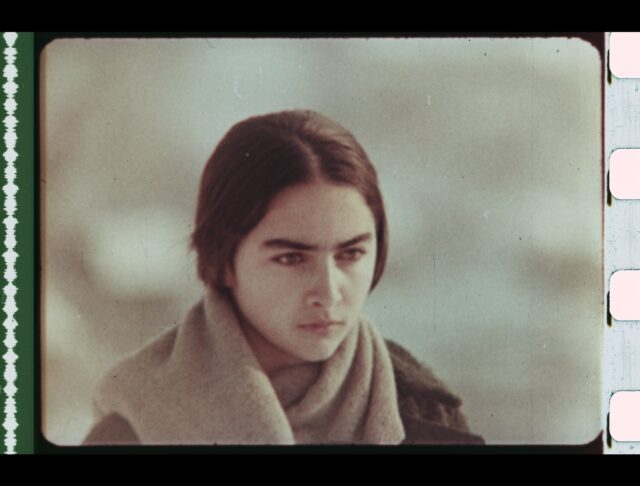
When Tamara Stepanyan’s father, the renowned Armenian stage and screen actor Vigen Stepanyan, died aged 68 in 2021, she felt an overwhelming sense of bereavement. “This was a big trauma because it was really a very unexpected death. He died very fast and sudden,” the Armenian director recalls. “I had this desire, a very profound one, to continue the discussion with him.”
Her new feature documentary, My Armenian Phantoms [sold by Cinephil] is her way of carrying on that discussion. It might best be described as a cinematic homage to Vigen. It is also a tribute to some of the forgotten gems of Armenian cinema (including several films in which Vigen appeared).
Stepanyan’s first step was to search for old photos of her father among them the ones she kept on her phone and in family albums. “When I started looking at the pictures, I really felt these images were having a strong dialogue with my inner state – with my sadness, my mourning,” the director recalls. “And then I went ahead and searched for his images in film, in cinema.”
That was when the idea came to her to make a fully-fledged documentary celebrating her father, but also engaging with other Armenian filmmakers and actors; she also began to mediate on Armenian identity and on the country’s film history, from the Soviet era onwards.
“Basically, the little story went into the big story. The personal story of Tamara and her father became a larger story of Tamara and the country, the system, the historical context.”
At the start of the documentary, Stepanyan talks about the magical Thursday evenings when, as a kid aged seven, she would sit with her family and they would all watch Armenian movies on TV together. It was a ritual that delighted her. Clips from several of the films she saw then are featured in the documentary.
“Of course, there were cartoons, kids’ stuff, that I would watch mostly alone or with my brother. But the evening films were mostly family films – and the family films would be mostly love stories or historical films.”
Some of the movies had disturbing elements. They might show Red Army soldiers fighting with Armenian nationalists or, like The Honor, depict the aftermath of horrific earthquakes. In Soviet Armenia, the authorities didn’t want filmmakers to mention the Turkish genocide against the Armenians, but filmmakers could still smuggle in oblique references to the trauma. As she puts it, they used “metaphors to highlight other metaphors.”
Stepanyan remembers only “half understanding” these movies. The images, though, stuck in her memory. She would ask herself why Armenians were sometimes shown killing each other.
Excerpts from the classic films are accompanied by the director’s searching and poetic voice over. “I started to work on this film almost three years ago because it also needed to grow inside of me – and then grow outside of me,” the director says of the slow-gestating project. “You need to walk a certain distance to understand what you are going to do with it. I knew from the beginning that it would be the most personal film I would ever do in my life…I knew it but I needed time to accept it.”
After she watched over 200 films, the director told her producer Céline Loiseau and her editor Olivier Ferrari that she needed more time. “I told them I would really like to edit for three weeks in order to write further.”
She knew there were many potential ways to approach the documentary. It could have been “chapter-based, theme-based, character-based or filmmaker-based.” Eventually, she came up with a more free-flowing structure that allowed her commentary to be combined with both home movie footage and the excerpts from the Soviet-era films.
As a child, Stepanyan’s dream had originally been to become an actor. Aged eight, she actually appeared in an Armenian movie. By the time she was a teenager, though, her ambitions had changed. Now, she wanted to become a director.
She was 12-years-old when her family moved to Lebanon after the break-up of the Soviet Union. That meant leaving her friends and relatives behind.
“To be honest, it was very, very tough,” she says of a period when she would ‘write sad poems and cry all night.’
“[But] I think this trauma of departure is part of my cinema today. I didn’t want to leave Armenia. As a child, I understood I should follow my parents. I remember my mother telling me that there [in Lebanon], we will have light, we will have electricity, warmth, clothes, and you will have a normal school life again.” (Stepanyan’s education in Armenia had been interrupted because of the freezing conditions and the lack of heating in the classrooms at the end of the Soviet period).
With her growing filmmaking ambitions, perhaps she was fortunate to leave. As the documentary points out, there were no female directors in Armenia. The industry was deeply patriarchal.
“It is quite ridiculous how women were like the little mice behind the curtains. Women were editing. They were doing all the laboratory and sound work. Without them, the films couldn’t exist. But, at the same time, they were never put in the spotlight,” Stepanyan talks about a chauvinistic world where it was almost impossible for women to call the shots. “No female could say I want to produce or I want to write or to have a bigger role.”
If the documentary is poetic and steeped in nostalgia, so are many of the films it quotes from. A sense of longing is apparent in many of them.
“It was very intuitive. I was very connected to some of the films. I was less connected to other films. That’s why I say this film is not a historical film. It’s a very personal film – and also the choice of films is very personal,” the director points out that it was never her intention to cover every part of Armenian movie history. Instead, she was focused on the moments that mattered most to her.
And her father was always at the centre of everything.
“My father was difficult to define. He was a great actor, he was very funny…he was always the bad guy in movies and in theatre. I remember saying to him once ‘can’t you be the nice guy so I can tell my friends you’re the nice guy.’ He said’ ‘Tamara, this is cinema, this is theatre, it is not real life,” Stepanyan reminisces. By the end of his career, he was playing King Lear. He was also a painter and a musician, “a multi-talented guy.”
When she began to pitch My Armenian Phantoms, there was immediate interest in the project from several sales agents. “For me, it is a very personal film that I am sharing with the public. It is not easy on me – so I wanted to pick a company that I had full trust in and that I got along well with…we had this zoom with the Cinephil team. Their sensitivity to the film helped me say, yes, let’s go with them. They really got the film. I told Celine, let’s go with them. Celine agreed. She had already worked with them. I am really happy about this collaboration.”
Now, Stepanyan has almost completed yet another film, her debut fiction drama Save The Dead starring Camille Cottin and Denis Lavant, and shot in Armenia last summer. This should be ready in time for Cannes. Pan Distribution will be handling the French release. It’s a drama about a French woman heading to Armenia to find the birth certificate of her recently deceased husband. When she arrives there, she is told by the authorities that the man she is looking for doesn’t exist. “Basically, another image of her husband opens up in front of her,” the director explains how her film deals with the trauma of war.





