

When Arjun Talwar was close to finishing Letters from Wolf Street (premiering in Panorama this week), the young Indian director realised that he hadn’t filmed all the shots he needed. The film chronicles life in the street in central Warsaw where he was living.
Talwar was using a digital Bolex, an unusual camera with a CCD sensor which he had borrowed from a filmmaker friend. He liked the way the camera gave images a “vintage look.”
After borrowing the camera for three years, he was due to give it back the next day and wanted to make sure he had all the images he needed – so he ventured out into the night.
It’s here the story takes on a vaguely surreal hue. “A car parked next to me and Roman Polanski got out,” Talwar tells Business Doc Europe.
You don’t expect to meet such a figure on an empty night-time street. Polanski was trying to buy something at the pharmacy but it had closed because it was too late. “He looked at me, saw me setting up this camera. Then, he just came up and said ‘what is that weird camera?’”
The Chinatown and Rosemary’s Baby director was curious about the lenses on the Bolex. So was Pawel Edelman, Polanski’s cinematographer, who had been lurking in a car nearby. They were the only three people still out on the street. Polanski was also intrigued to hear that Talwar, an Indian immigrant living in Warsaw, had been a student at the Polish Film School in Łódź.
Polanski doesn’t feature in the documentary but lots of other chance encounters are featured. The affable and endlessly curious Talwar just can’t help meeting new people.
The Delhi-born director is also his own main character, using the skills he learned in the cinematography department of the Polish Film School to film himself (even if that meant playing the camera on a balcony nearby and then rushing back to get in frame.)
Talwar is now thoroughly steeped in Polish cinema history. He reels off names of Polish doc directors he admires, figures like Jacek Bławut and Krzysztof Kieslowksi.
“Polish fiction films, to be honest, never moved me that much, but I am a big fan of Polish documentaries. I feel like they showed me something that was new – that a documentary could be as epic and cinematic as a fiction film, which I didn’t know before going to Poland.”
Talwar first travelled to Warsaw on the recommendation of a close friend. That friend, as the documentary reveals, was later to commit suicide. The director acknowledges his film is partly a response to the loss of the friend.
“I had to react in some way and I didn’t really know how. I thought, OK, I am going to make a film. I didn’t know what it was going to be but I thought I’ll poke around and see where it goes.”
Going out of the street and meeting new people was cathartic. Wolf Street is the only place that he has lived in since arriving in Poland. He is fascinated by its history. The city was heavily bombed in the Second World War but many buildings here somehow survived. The street has a rich range of shops, a police station…and a squat.
“I definitely saw there were a lot of different aspects of Poland there. There was this historic thing and there were these anarchists and there were some art galleries…and it’s not a long street. It’s 1 km long,” Talwar reflects. “This old Poland and the new Poland are both very present at the same time.”
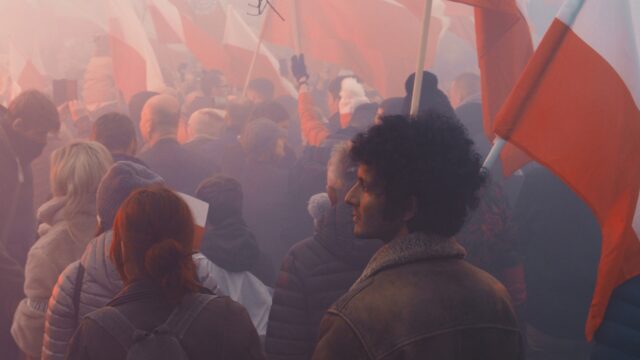
In one shot, we see Talwar bloodied and bruised just after he has been beaten up by a young nationalist thug. There’s also a memorable set piece when he takes part in a nationalist march with crowds baying that Europe should be kept for whites.
“I also wanted to give myself some Buster Keaton vibe and get some humour out of it,” he says of how he ended up charming the right-wing nationalists and even waving one of their flags. They were shocked that he could speak Polish so well. (He had had to learn the language to get through film school).
The film, then, is dealing with dark subjects. Its tone, nonetheless, remains jaunty and playful throughout.
“That’s part of my personality, to look for humour and find the absurdities,” Talwar volunteers. “Also, I chose characters who had a sense of humour. I made sure that all the characters had that…it was something important I wanted this film to possess, being able to laugh at life and at itself.”
The documentary is edited and co-written by Talwar’s creative partner, Bigna Tomschin. The director points out that the film’s unique tone and language is a result of this close collaboration. “The story contains many themes and characters,” Talwar stresses. “Bigna is a fantastic editor who was able to weave all this together in an intricate and poetic way. We also wrote the voiceover script together, in tandem with the edit.”
“The composer, Aleksander Makowski, is another key collaborator. The score is an eclectic mix of jazz, Polish tangos and bluesy guitar music. Its playful accent connects the film’s myriad storylines,” he adds.
Polish cinema may be on the gloomy side but Polish people, especially the older people, (the director discovered) have a very well-developed sense of ironic humour. Many of them were keen to explain the secrets of their homeland to the Indian filmmaker who had unexpectedly landed in their midst. “These people were looking at me with a kind of curiosity and they wanted me to understand their country – and so they were telling me how it is, which can also be funny.”
When he is walking out and about Talwar is often stopped by passers-by who call him “Michael Jackson” after the pop star.
“There are other things I find much more offensive,” he dismisses the idea that he is upset at being compared to the Billie Jean singer. “Michael Jackson doesn’t bother me too much…people also call you Osama or something like that.’
Warsaw, he adds, is very different to other towns in Poland. Outside the capital, “you have to watch your back,” especially if you’re “brown or Asian.” Łódź is a “hardcore” place with violence and poverty. “But I’ve actually escaped being beaten up many more times than I’ve been beaten up. Either I can talk my way out of it or run my way out of it.”
Talwar has a “love-hate” relationship with Poland. He doesn’t like the cold climate. The locals can be aloof and even xenophobic. Nonetheless, he soon manages to charm most of his neighbours.
What’s his secret? “You have basically to be interested in people. If you’re not, you can’t get that kind of warmth.”
For Talwar, it’s a point of principle to maintain eye contact with his subjects, not to hide behind the equipment, and to encourage empathy that way. “But ultimately, you’ve got to really want to know something about them.”
It helped, too, that the subjects all had stories they wanted to tell on camera. The director didn’t have to hassle them. Filming in his “own neighbourhood’ gave him the time to observe what happened and when to strike up relationships with all sorts of people.
The street is gradually becoming gentrified and losing some of its unique identity. However, it retains its fascination for him.
His film, meanwhile, is enrapturing festivals and distributors with prominent selections to be announced soon. Filmotor took on international rights recently. So Films is handling the Polish release.
The director is now planning to make his next movie back on home soil. “I am Indian and I miss my country. I need to spend time in my country,” he explains.





