

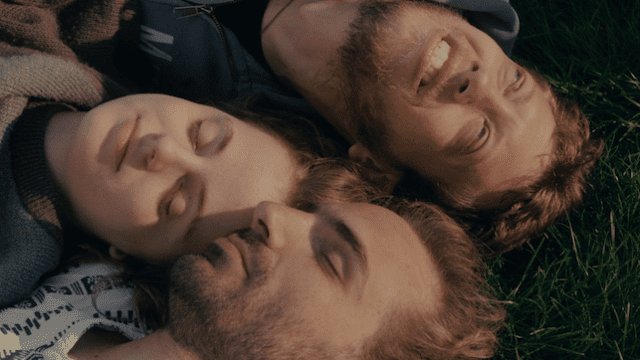
When she began work on The Tender Revolution (screening in Competition – Focus at FIFDH Geneva), German director Annelie Boros was “looking for people who put care at the centre of all they are doing – caregivers or also care-takers.”
The director wanted to explore why, in today’s society, so little time and money is available for care although it is such a fundamental part of all our lives – and will become yet more important as populations grow older.
But, as the beginning of the film reveals, Boros heard some devastating news. Her close friend and flatmate Kathrin had taken her own life. “When my friend committed suicide, I thought this was exactly the thing I was thinking about,” the director observes “This was a person who probably didn’t really find the care she needed and that she was looking for – and this was her only solution.”
Boros’ reaction to the tragedy becomes part of the story.
Other caregivers are profiled in the documentary. One is Arnold who lovingly looks after his disabled son Nico – and who finds himself impoverished and marginalised as a result. Another is Bożena, a woman from Eastern Europe working as a live-in carer in Germany, but being poorly paid and taken for granted by her employers She has her own family back home in Poland whom she rarely sees.
The other two main protagonists are Samuel, a wheelchair user and disability activist, and Peruvian climate activist Amanda, through whom the documentary introduces the topic of care for the environment.
“I feel there is this connection between taking care of humans but also everything which is alive – and this is something not really talked about in the care debate most of the time.”
Boros discovered her subjects in different ways. Arnold was written about in Gabriele Winker’s book, Care Revolution, which calls for far greater resources to be made available for the unemployed, refugees and single parents. “This [book] was a big inspiration for the film,” the director says. Bożena was chosen to represent the “unseen” and “invisible” side of care working. It helped too that she was such a strong personality and had successfully sued the agency which employed her.
The documentary examines the relationship between carers and those they care for. Often, paid carers are spending far more time with their patients than family members. In certain cases, they form very close emotional bonds with these patients – but they are also exploited, made to work punishing hours and to take on tasks which shouldn’t be their responsibility.
“There are so many nurses and caretakers quitting their jobs because the conditions are so bad,” the director points out that western societies are storing up daunting future problems for themselves.
Boros had a structure in mind from the beginning. She wanted her protagonists to share the stories of their difficulties but to end up in “a state of empowerment,” not ever to be portrayed as victims.
“What was really nice was that in the editing room, we found how the protagonists speak to each other. This was something I couldn’t have known before…someone will say something and then we will listen to the story of the next person and it will refer to something said before.”
Boros and her editor Nina Ergang (who’ve already worked on two films together) were looking for ways in which the different stories related to one another. The protagonists, though, were filmed separately. Most will be meeting for the first time in person at the screening in Geneva on March 11. (Arnold can’t make it but the others will be there).
The German release is handled by W-Film. The film was produced through Kinescope Film GmbH, Janina Sara Hennemann, Matthias Greving and Viktor Schimpf Filmproduktion. It was made in cooperation with ZDF / Das Kleine Fernsehspiel, FFF Bayern & DFFF.
Now, the aim is to get the film seen and to start a broader debate about the issues it raises.
Boros first began researching the project way back in 2020. Ask her what has been the biggest challenge in bringing the film to the screen and she answers immediately: “time.”
“I feel with four protagonists and a personal story, you limit yourself in a way,” the director notes. She had a lot to cover in only a short number of shooting days. This was supposed to be an observational documentary in which she would look in at her characters’ lives over a lengthy period. But the budget was limited, there were deadlines to hit – and there were pressures and stresses as a result.
“I was talking about care and then, in the end, it was really tough to take care of myself or for the team to take care of themselves, or for me to take care of the team…we are all living in a world where every minute counts and costs something,” Boros reflects. “This is exactly the same problem as in caretaking. The conditions are not really there to have a setting where you can take good care.”
She talks of having to “rush through this [filmmaking] process very fast…some things went really well but some things were super hard for everyone because we didn’t really have time to look after our needs in a good [way]. I feel that in the film industry, it is a repetition of the problem in a way.”
Boros has made several successful shorts (her 2018 short F32.2 was nominated for the student Oscar) but The Tender Revolution is her first full-length feature.
“I thought it was really hard actually,” she admits of the transition to longer form storytelling. “In the beginning, I felt like I have four characters so can I just make four short films. That’s easy…but then I realised that a feature-length documentary has a very different dramaturgy.”
The title The Tender Revolution was borrowed from the co-producer. “He was working on another film by the time I started to work on this film. He told me about this film called ‘The Tender Revolution’ he was working on – and at some point I said actually I think your title fits way better for my film. He said you’re right, take it”
One of Boros’ main ambitions was to make sure viewers felt “inspired” rather than “crushed” by what they were witnessing.
“I feel like in our capitalist working society – how the system works, you always have to count the minutes in a way. I feel it’s very, very tough to find the space and time to be caring…but when I look at the protagonists, there are so many ways I get inspired by them,” Boros describes her admiration for her subjects.
“That was precisely why I chose to work with those four…they can provide an idea [for the future], not only criticism. Going out of the cinema, I really didn’t want people to go out and cry…I wanted to make it empowering and to give an idea of what change could look like.”





