

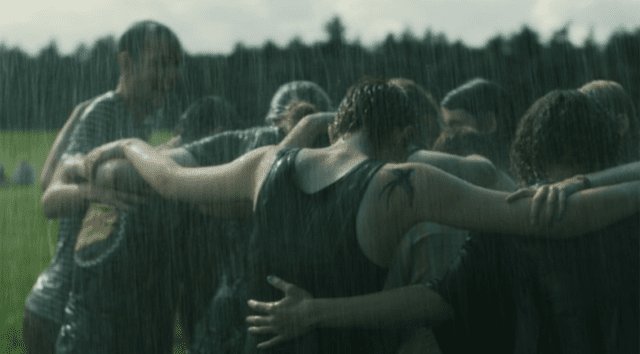
Welcome to the very unusual rural retreat in the south of the Netherlands where queer youngsters can spend time attending workshops, having fun and addressing any anxieties they may feel about school, family or identity.
The camp, one of the few of its kind, hosts around 60 children. Directors Geneva Lucas van der Rhee and Chris Westendorp, whose Queerkamp screens in FIFDH Competition – Focus talk of the emotion they felt in filming there.
“When I saw the field full of parents dropping off their kids, I immediately had to cry. A field full of queer young people who are accepted by their parents – that affected me so super deeply. It was beautiful to have a mini-society where everyone was equal and not judging….for the first time, I felt like this how straight people feel all the time,” van der Rhee describes his feelings.
This is a very intimate and closely focused piece of storytelling in which viewers are given the sense they are inside the camp with the kids, experiencing everything at first hand.
“I think it was all about spending a lot of time together,” Westendorp explains how the two directors got so close to their subjects. Before filming began, they met the kids, spoke to their parents and explained their plans for the documentary.
They then joined the kids at the camp – but shot with a deliberately small crew to make it easier to fit in. “We were just like them, having dinner together…it was all of us spending the week together,” Westendorp says.
“And beforehand, we shared our stories with them.” van der Rhee adds. “I think as filmmakers, we were as much excited as they were [to be in the camp].”
“We told them why it was important for us to make the movie and why it was important for people to see the movie. I think they were just like us, wanting to help people who were not in a camp – they were activists just as we were about showing how it is to be queer or trans,” Westendorp chimes in.
The directors made sure that their subjects were comfortable at being filmed. They would ask them before shooting sensitive moments – but also made it clear they wanted to shoot everything they possibly could. They told the kids that if they were unhappy with anything, they should say so.
“We said we are going to be very close with you for six days. If you have problems, we will show you the editing afterwards and we’ll talk about what you want and what you need,” Westendorp emphasises that the kids were consulted even during post-production.
When the directors showed their subjects an early cut of the film, the response was immediately very positive. “They were super proud of themselves. They were all like ‘this is really us,’” Westendorp remembers.
“They came from a very dark period, most of them. They really wanted to celebrate that week and to find themselves,” her co-director explains why they were so keen to get behind the documentary.
Belgium-based van der Rhee, who originated the project, comes from a traditional conservative family. He found it a struggle to come out. He suggested to Westendorp, whom he didn’t previously know, that they should see if there was potential for a documentary about the camp.
“We spent a week there together and thought then let’s make this film.”
The filmmakers describe the camp as ”quite unique.” For one, it’s not focused on any negative part of being queer. Its main emphasis is on camaraderie and enjoyment.
“The gender and sexuality issues you are struggling with are a very important part, and how to give that a place in your life, but the camp focuses so hard on friendship and building trust,” van der Rhee notes. Westendorp, meanwhile, describes how “in just one week, people grow by feeling they can be themselves and relax finally.”
Some of the characters were nervous initially about attending. Fano wasn’t sure if he would be able to stick it out for five days. Finley, a private character, was apprehensive about having to spend so much time with strangers. Jeroen was looking for acceptance.
The camp is organised along very structured lines with set times for meals, workshops etc. This worked well for the filmmakers, allowing then to plan in advance.
In preparation for shooting, they had met around 25 kids, eventually choosing a group of ten as their principal subjects. The mums and dads were very supportive of the project.
“They understood that we really were on the side of the kids. They wanted the kids to be accepted so badly. For them, it was about helping their own kids and helping other kids. And, of course, we shared our own stories and we were honest about everything.”
Since leaving the camp, many of the kids have remained in touch with each other. “It was very bonding but, on the other hand, they are very different…they have different lives. But I think they will be important for each other for a very long time,” Westendorp says.
“And they try to meet up with each other every now and then,” van der Rhee agrees. “They were very important to each other at that specific time of their lives. I think that is a very important and beautiful part of their friendship. The friendship can be for one summer and then maybe they will see each other [again] in about 10 years.”
In certain cases, their parents have also remained in touch.
Funding for the project came from Dutch public broadcaster, Human. The filmmakers explained that they were making a “character-driven” documentary that would “get in the heads of the kids.”
FIFDH Geneva marks international roll out of the film. It has already screened in the Netherlands to strong reviews. Some, though, have questioned its length. It is 60 minutes – and so perched in limbo land between a short and a feature. The directors are therefore contemplating making a slightly longer version. Not that they have a huge mountain of unused material to draw on.
“We shot quite economically because we already had a focus on the main characters. We didn’t just shoot everything…but I think we can make it to 70 minutes,”
The documentary was produced through Willy Waltz International. International sales are handled by Dutch CORE.
“I don’t think I would have had the guts to go,” Westendorp reflects on whether she might have attended the camp if the opportunity had been there when she was a teenager. Van der Rhee is similarly reticent and says he would have been very wary about putting himself in such a “super vulnerable” position. “But these young people are super cool…I think that is so beautiful.”





