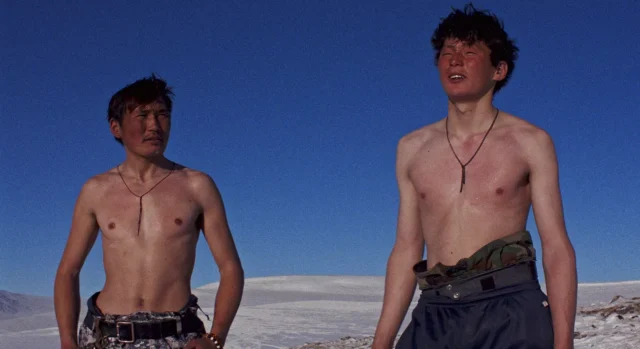
Iron Winter (sold by Journeyman Pictures and a world premiere in VdR’s International Competition) is set during one of the coldest Mongolian winters of recent times. On an epic trek across the steppes, young herders of the Tsakhir Valley try to keep their herd of hundreds of horses safe. The filmmakers follow them every step of the journey.
Australian director Kasimir Burgess is used to making bold projects set in remote places. His 2022 feature doc Franklin was at once a rafting adventure and an account of the battle to save the Tasmanian river, The Franklin, from being destroyed by a huge dam.
Iron Winter is on an even more ambitious scale.
“I went over there [to Mongolia] on a recce to see if the herders were going to do the winter herd firstly and how they felt about us coming along for the ride. They expressed a lot of enthusiasm for this ritual and their journey being followed and documented,” the director remembers. “They thought we were pretty crazy to be there but also expressed to us that perhaps an outsider’s eye could see maybe even more beauty than they could because, as they said, “this is our regular life, this is our regular landscape. We go to work and see this but you are seeing something different to that.” Our Mongolian producer Eenee Sengemugaa has been wanting to tell this story for many years. We were telling the story very much with him and alongside the herders. It felt as though it was a real collaboration. That’s the only way we could have made the film.”
The trek is a rite of passage for young Mongolian herders – a chance to prove themselves in the most daunting circumstances imaginable.
It was tough for the filmmakers too. “Initially, it was a matter of just trying to find them which, as Enee said, was going to be like finding a needle in a haystack, or a horse in a forest. It was really hard,” Burgess remembers.
One moment, the filmmakers were shooting in a “relatively warm Ger [a round Mongolian tent] and the next they were dealing with temperatures of minus 40 or worse. Early in the morning, the freezing moisture on the lenses and viewfinder meant they couldn’t film until conditions warmed. “It was extremely inhospitable,” Burgess says with obvious understatement. “I don’t want to be melodramatic but I think we were quite naive and underprepared in some ways. It tested our stamina – and the gear was tested to its limits as well.”
At one stage, the filmmakers took seven days to get over a pass blocking their way. They were travelling in land cruisers accompanied by a 1920s missile carrier which helped clear a path in the snow. The nearest town, road or hospital was days away. “It was the middle of nowhere,” Burgess notes.
Eventually, they set up at the herders’ camp. They were “not too close to interfere but close enough for us to be able to live alongside side them and observe them at close quarters…we filmed in a relatively unobtrusive way, on their terms.”
The documentary is full of spectacular imagery of the horses and herders crossing vast, snowy landscapes.
The distinctive tableau style framing was as much to do with pragmatism as aesthetics. “That’s what you get when you don’t have a lot of time. When your fingers are about to freeze off, you set something that you like, that is a strong image that can tell the story simply and directly.”
Burgess knew that the crew would only be able to shoot for a few minutes before the cold would become unbearable and they would be forced back inside the tent or one of their vehicles. He pays tribute to his cinematographer Ben Bryan for his work in such challenging circumstances.
“Every frame in those hills was like a painting. It felt right to use wide lenses,” he says of the visual style of the storytelling.
No, the director hasn’t grown up around horses. “But the relationship Mongolians have with horses is something else. They’re kind of bound together. A horse is somehow their god.”
When a horse dies, the sense of devastation can be overwhelming. “It saddens them deeply.”
Alongside footage of the epic trek, Burgess also captures the Mongolian families in their home settings.
“That particular Ger the herders were living in was hundreds of years old. It had been handed down and down…every scratch and broken slat and meticulously patched and woven piece tells a story. There was a lot of love and history within those homes. They were meticulously kept. They are looking after the horses 24 hours a day and so I was always impressed with how house proud they were.”
Young Mongolians are coming under increase pressure to turn their back on the herding lifestyle and to move to the city instead. The sublime landscapes can’t disguise the social and economic problems facing the documentary’s protagonists.
“You could romanticise this group of herders and focus on the poetry and the initiation aspect of the story of these boys and their pathway to manhood…but perhaps just as relevant and even universal is that they’re a family business, like farmers in a way, who are just trying to get by in an increasingly hostile environment which is becoming so hard to predict because of climate change.”
Burgess’ films have screened at numerous festivals. His debut feature Fell was a revenge thriller and he moves easily between documentary and fiction. “I try not to differentiate in some ways If there is a story that I fall in love with and that I feel needs to be told.”
Iron Winter, though, has been one of his most gruelling projects. “It was an incredibly demanding shoot and also a very long post path,” he says of the film which he himself edited. “I love to be a part of that and to get to know all the ingredients and the shots really well. It’s a relationship with the films, the characters and the landscape. I find it sometimes hard to let go after a shoot. My impulse is to stay with it until it is finished.”
The doc was made through Repeater Productions. The Australian premiere is at the Melbourne Festival later in the summer and Australian theatrical distribution is being handled by Jonathan Page’s Bonsai Films.