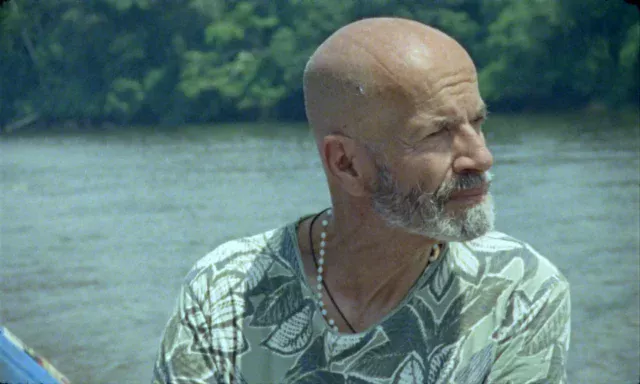
It’s easy to be reminded of the Jabberwocky or the Snark (mythical creatures in Lewis Carroll’s nonsense stories) by the Mokélé-Mbembé, the so-called “dinosaur of the Congo” that French cryptozoologist Michel Ballot has spent so long searching for in the jungles of Cameroon. Marie Voignier has already made one film about his idiosyncratic quest, Now, she is back with another, Anamocot, a world premiere in VdR’s International Feature Competition this week.
“It was 2008/2009. I was at that time very interest in cryptozoology…people interested in animals still unknown to science like Nessie [the Loch Ness Monster] or the Big Foot or things like that, and also more serious creatures,” the French director explains how she first encountered Ballot. He was one of the rare of cryptozoologists actually active “in the field.”
Ballot agreed to allow Voignier to make a film about him.
“I am not a cryptozoologist myself but I think it’s a very cinematographical research [subject] because it is between science, myth and imagination. It’s a lot about speculation and creating pictures to represent the animals we are looking for,” Voignier explains the fascination of this strange and esoteric field of study.
Fifteen years ago, the French director went with Ballot to south-east Cameroon to make The Mokélé-Mbembé Hypothesis. “At that time, his research was driven by science. He wanted to find proof, footprints, and to collect testimonies and drawings,” she remembers.
Since then, Ballot’s research has “taken a new turn.” Now, he is spending more time listening to local people and steeping himself in their rituals. This provided Voignier with a new perspective for a second documentary.
In Anamocot, we don’t just hear from Ballot but also from villagers and fellow scientists. Some can sound sceptical about his pursuit of the creature.
“It was difficult, of course, for Michel to listen to that and to accept for that to be in the film,” Voignier says of the carping that came her subject’s way. “The fact that it is in local languages that I don’t understand, Michel doesn’t understand, gives a space of freedom to the people who are talking. They know of course that I will translate…[but] Michel was very open to be criticised.”
Voignier herself is very fond of her subject but he still sometimes surprises her. “I’ve known Michel for a very long but sometimes I still can’t predict what he is going to think, to say…it is difficult because, of course, we are close.”
Whatever else, Voignier admires Ballot’s “pugnacity.” He refuses to give up.
One key strand in the film is colonialism and its legacy. Local people talk on camera about outsiders coming into their community and trying to take things away. Explorers aren’t regarded in a neutral light but are viewed as white former colonialists. Inevitably, the vexed history between western Europe and Africa can never quite be forgotten.
“I think it’s central,” the directors says of this theme. “It is almost the main subject of the film – the encounter of two ways of seeing the world. One way historically has dominated the other way. It is completely at the centre…it’s the way a white man, a white team, tries to understand something that is out of its reach.”
Some viewers may feel that Ballot does not want to find the creature. If he did so, that would mean the end of the journey and could be very anticlimactic. The director disagrees. “I think it would be a huge relief because he is struggling against the doubt in the scientific community, the public and also of himself because sometimes he goes through deep doubts,” she notes. “It would be very important for him. It would not be good for the film because it’s a film about faith…”
During production, Voignier kept her crew small. She was working with cinematographer Thomas Favel and sound technician Thomas Fourel. She made sure to feature local women’s voices and to give their perspective on this French explorer in their midst.
In one way, the director acknowledges, she is like her subject. She’s on a quest too, following Ballot on his never-ending search.
“But I think those quests, even Nessie and Bigfoot, they are not disconnected from the cultural, historical and political context,” she reflects. “Those creatures are not yet recognised as physical animals. They are human projections, human speculations, constructions starting from testimonies and reports.”
As far as Voignier is aware, there are not any Cameroonian cryptozoologists looking for the Mokélé-Mbembé. This is very much a western pastime. The Mokélé-Mbembé has a place within Cameroonian culture but it is regarded in a more mystical than a scientific light. Villagers talk of needing second sight to see the creature.
Ballot has invested heavily in his various expeditions. He uses small digital cameras to record the forests in the hope he will eventually catch a glimpse of his quarry. Sometimes, he receives support from magazines keen to publish accounts of his search. Whatever interest his expeditions generate with the public, he certainly isn’t becoming rich.
“He’s not very good at selling himself. Sometimes people come to him and ask if they can come with him. That gives enough money to fund the expedition but not more. He can’t make a living out of that…”
There is no sign of him giving up. Since the film was shot, he has been back twice to continue looking for the creature and is due to return again later in the summer for a river expedition. “He is always making plans with a new method, a new idea, to continue the quest.”
This is the third film the director has made with Eugenie Michel Villette of Les Films du Bilboquet. “There is a lot of trust in the relationship with her. She is really there and helpful. She knows Cameroon very well. It’s a very good partnership.”
The Cameroonian co-producer on Anamocot is Tara Group. The film will be broadcast on Arte next year and will also be exhibited at the Marcelle Alix Gallery in Paris. Before then, it is also likely to be spotted at many further festivals.