

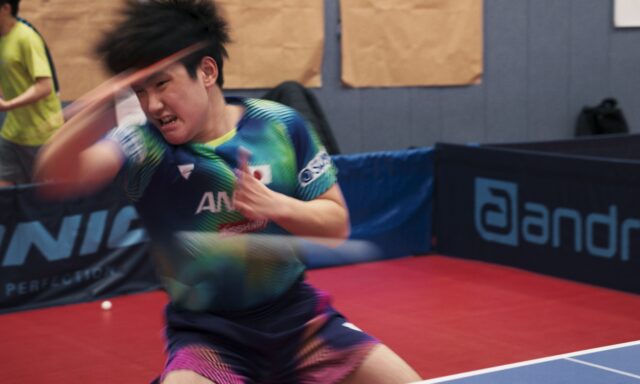
The sport of table tennis (or ‘whiff whaff’ as former British Prime Minister Boris Johnson once famously called it) hasn’t been much covered by filmmakers. However, it spins firmly into view in Jonas Egert’s feature documentary, Ping Pong Paradise, a world premiere in DOK.fest Munich (and its director’s student diploma film).
Jonas Egert had been looking for a topic for a film when he read an article about a new table tennis team. TTC Neu-Ulm had just been created by successful businessman and publisher Florian Ebner in 2019 and applied for a license to take part in the main table tennis league.
“It was this very small club in this very niche sport. I was interested in table tennis privately but not as a club player or semi-pro,” Egert remembers. He was fascinated, though, at this idea of a team started from scratch and without any infrastructure whatsoever, but which was still aiming for the big time.
Owner Ebner had played professional tennis when younger and was fascinated by sport in general. Now, table tennis had piqued his curiosity. This was a very different world from that of pro football or golf. There was far less money involved which meant that it was possible to build a competitive team without spending millions. Nonetheless, Ebner achieved spectacular results.
After the Russian full-scale invasion of Ukraine in 2022, he was able to recruit some of the best players in the world. Stars like the Kyiv-born Dimitrij Ovtcharov and young Taiwanese ace Lin Yun-Ju suddenly became available. There were also young Russian players still at the club. Following Putin’s illegal war against Ukraine, it was not clear they’d be allowed to compete.
In the film, Egert follows the team and its very intense coach, Dmitrij Mazunov, a former Russian player who has now been living in Germany for 30 years.
“He noticed that I was interested not only in the new main squad, which everybody was reporting about, but also in the [other] players. He’s a very empathetic person…he was open to our film project from the beginning [and] his openness grew.”
The filmmakers spent 60 days shooting the table tennis players. Thanks to Mazunov’s support, they were allowed unfettered access to the team players.
“We decided very early that we just wanted to observe them, not to make interviews with them or have voice-over narration. That led us to try not to miss these rare opportunities when the players came together. We had a very small set-up. It was just the cameraman and me. We were very agile – and just became like part of the team,” the director explains his fly on the wall approach.
One advantage is that table tennis takes place within a confined area and the players don’t run far. That makes it easier to film. During training, the camera crew could get very close to their protagonists, During the matches, they had to keep more of a distance for obvious reasons – but even then they could stand beside the coach and use more than one camera to get extra angles.
The TTC Neu-Ulm team achieved spectacular success, winning an important cup just a few years after its formation. The other teams, though, were jealous and complained that the team had been breaking eligibility rulers because players had also competed for other clubs. It was clear that the other teams wanted this new upstart rival removed.
TTC Neu-Ulm didn’t last long, and those involved were surprisingly philosophical about its short-lived nature. “For the club’s owner. Florian Ebner, it was kind of a project, a practical thing. He wanted to win the cup – and he won it. For the new players who come, it’s not a big deal – it’s normal to join a club and then leave again.”
Coach Mazunov’s philosophy was that the players simply needed to cope with the upheaval. It’s the nature of professional sports that nothing is ever stable for long. “In your sports life, you can be sick, you can have illness, the club can close and you have to deal with that,” Egert sums ups up the coach’s pragmatic view. “I really like that.”
Although the full-scale invasion of Ukraine has turned many of their lives upside down, the players tended to avoid discussing the politics. Ovtcharov is from Ukraine but that didn’t stop him from working alongside the Russians in the team in friendly and collegial fashion. Egert deliberately didn’t ask the players about the war. “They are funded by their countries. They have to be very careful what they say…from a personal view, getting to know them as characters, I just got along [with them]. We could film in the locker rooms.”
The Russians faced being conscripted into the military when they returned home. However, the director points out, as athletes, they’re not kept in the armed forces for long, and are soon able to resume their professional careers. Mazunov was disappointed that they left and hasn’t stayed in touch with them.
“They were close, maybe too close. Maybe a coach can’t be a father figure at the same time,” observes Egert.
Table tennis is far better known as an individual than a team sport – and it still doesn’t have a massive following in Europe when compared to football, golf and tennis. Nonetheless, the director himself is now a true ping pong convert and recommends that everyone should try to watch it played at a high level if they have the chance. “I wasn’t so interested before but seeing this in a very focused way, standing so close…is incredible.”
Ping Pong Paradise was made through madfilms, the production outfit Egert co-founded with fellow film school student, Sylvain Cruiziat (director of Boyz which premiered at IDFA in 2023). Egert also works as a producer and assistant for Fleiss’s Munich-based outfit, if…Productions. Cine Global will handle the German distribution of Ping Pong Paradise.





