

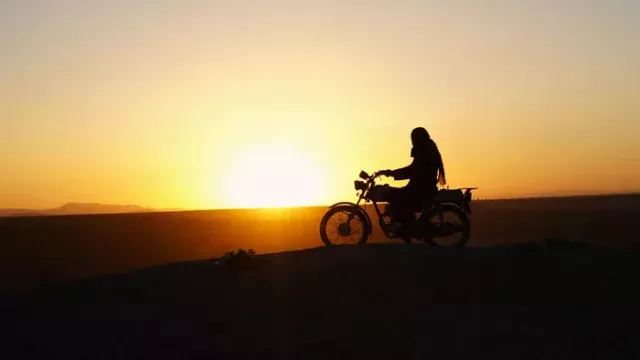
It took seven years for Sara Khaki and Mohammadreza Eyni to complete their remarkable new documentary, Cutting Through Rocks, which world premiered in Sundance’s World Cinema Documentary Competition and which is now selected for DocsBarcelona Competition. During that period, they chronicled huge ebbs and flows in the life of their main protagonist, Sara Shahverdi, the motorcycling ex-midwife from a remote Iranian village who took the leap into local politics.
Iranian-American filmmaker Khaki had been living in New York, working as an editor, but she had the ambition to make a movie about women in Iran fighting against injustice. She did some research and came across Sara’s story. Khaki spent several months talking to Sara by phone. When she discovered that Sara was running for a council seat in her Iranian community, she decided that would be the perfect point from which to start the movie.
Director-cinematographer Eyni, soon to become her partner, was living in Iran. She knew him from previous collaborations. “He was really busy at that time with many projects but it was by luck that we got on this journey together,” Khaki says.
Eyni proved the perfect collaborator. He was from a similar background to Sara and understood perfectly the “dynamics and nuances” of Iranian village life. “My parents are coming from the same region…when [Khaki] talked to me about a woman from that region, I thought, wow, that is great.”
Khaki, according to Eyni, had a “very deep understanding” of gender inequality and the patriarchal culture of the community. He, for his part, understood the mindset of the men there and was able to “reach out” to them. The directors therefore complemented each other.
“Without Mohammadreza Eyni, I wouldn’t have been able to make the film,” Khaki says. He responds that he couldn’t have done it without her either.
Sara’s motorbike becomes like a character in its own right. It’s a symbol of her freedom and of her defiance. “From the very beginning, we knew the motorcycle would be like an essential character in the film,” Khaki agrees. “Sara is the only woman in this rural village to ride a motorcycle. She learned how to ride it from her father and from her childhood onward, she would ride around the village. She is the only woman who, when men see her, don’t question her. They’re so used to her riding it.”
Sara didn’t just ride the bike. At a certain point in her life, she began to trade motorcycles.
Even before going into production, the two directors sketched storyboards of the types of shots they were after. – shots of Sara riding in different seasons, in the snow or in high summer. The directors filmed her on the bike with handheld camera, from the air, or from a tripod, so they had as much different material as possible.
They both knew that motorcycle riding was “a big taboo” for women in the region. Sara was an exception but others couldn’t even get licenses. “Specifically in this region, they don’t like women on motorcycles because they think it’s like seducing men,” Eyni explains.
The two filmmakers had complete trust from their subject. There is one sequence late on when we see Sara, deeply stressed from her political endeavours, going for a check-up with a doctor. It is a poignant, private and painful moment but the camera is there to record it.
“She was very open to the story we were unfolding about her. Also, because we spent many years in the region, people knew us. They were thinking about us not as filmmakers but as villagers – as people from there,” Eyni explains how the filmmakers became insiders. They made eight separate trips to Sara’s villages, often spending several months at a time there.
“What you see in terms of intimacy has a lot to do with the time we spent in this place,” Khaki agrees. “In the beginning, we didn’t really want to do that. We wanted to have a full story about Sara’s council seat [election] but we realised there were so many other layers that we kept on shooting.”
A pivotal moment came when Sara’s sisters realised that they had been hoodwinked into signing a legal document by their brother. Sara intervenes, angrily telling off the brother and ripping up the document into tiny pieces.
At first, the filmmakers were reluctant to pick up their cameras in the middle of a big family row. They realised, though, that this was a very revealing moment. “We are very much part of their family and they didn’t mind us being there. At some points, they would point to the camera as a witness…we did not plan it. It was by luck we happened to be there.”
The men in the community are deeply entrenched in their old views that women should live either with their fathers or husbands – and that they shouldn’t be given any independence. There are grim scenes of young girls being married off to much older husbands, and being denied any possibility of education or employment as a result.
“First of all, they are very proud of their opinions and very open to talk about their thoughts. Because I am used to their thoughts, it was not hard at all to talk to them about these things,” Eyni says of the men whom the documentary tries to represent fairly.
The film, though, takes an ultimately optimistic view about the possibility that the deep-rooted chauvinism of these men will eventually change.
Khaki acknowledges that the women’s predicament in the village was “harsher” than she had expected before shooting. “But there is one thing we share deeply with Sara, and that is her resilience…I think that every person inside Iran, and outside Iran, continues life persevering in hope. That is really the only way to survive,” she reflects. “If you persevere with something, some good will happen eventually…the harsh reality is already there so we might as well think about what could happen.”
“It’s very small, slow steps. It is not something that happens in one week or one decade,” Eyni observes of the long battle ahead to change attitudes. “It demands time. I prefer to remain optimistic.”
The filmmakers have shown plenty of patience of their own in getting their movie funded. It has backing from, among others, Sundance Film Institute, Chicken & Egg Pictures, Doha Film Institute, Firelight Media, Hot Docs CrossCurrent Doc Fund, IDFA Bertha and Classic, Bertha Foundation and Andrew Berends Film Fellowship.
“It was not straightforward at all. It took us a couple of years to get any funding at all,” Khaki sighs. The directors, who are also the producers, shot material when they could, took the project to many pitching events, and gradually pulled together their budget. In the end, they received backing from some of the most prestigious financiers on the documentary circuit. Sales are handled by Autlook.
Now, the dogged duo are hatching further projects on similar themes. “Some are documentary, some are fiction…and we cannot wait to get into production,” Khaki states.





